Institute for Terrestrial and Aquatic Wildlife Research, University of Veterinary Medicine Hannover, Hannover, Germany.
Department of Pathology, University of Veterinary Medicine Hannover, Hannover, Germany.
PLoS One. 2020 Jun 16;15(6):e0234044. doi: 10.1371/journal.pone.0234044. eCollection 2020.
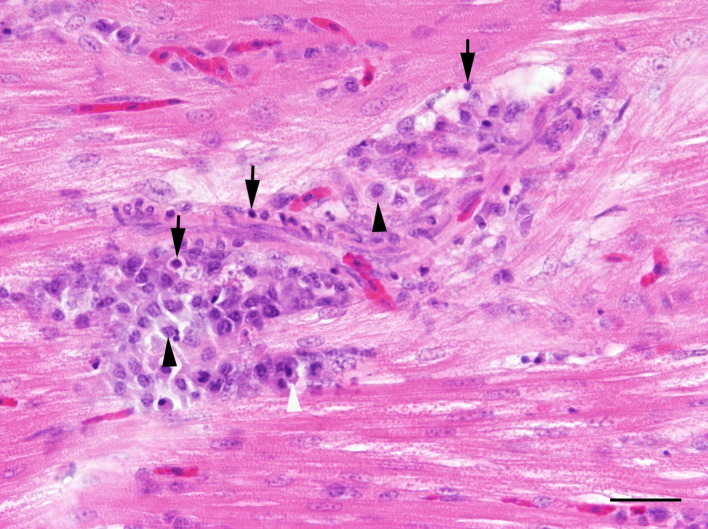
Being a typical ground-breeding bird of the agricultural landscape in Germany, the pheasant has experienced a strong and persistent population decline with a hitherto unexplained cause. Contributing factors to the ongoing negative trend, such as the effects of pesticides, diseases, predation, increase in traffic and reduced fallow periods, are currently being controversially discussed. In the present study, 62 free-ranging pheasant chicks were caught within a two-year period in three federal states of Germany; Lower Saxony, North Rhine-Westphalia and Schleswig-Holstein. The pheasant chicks were divided into three age groups to detect differences in their development and physical constitution. In addition, pathomorphological, parasitological, virological, bacteriological and toxicological investigations were performed. The younger chicks were emaciated, while the older chicks were of moderate to good nutritional status. However, the latter age group was limited to a maximum of three chicks per hen, while the youngest age class comprised up to ten chicks. The majority of chicks suffered from dermatitis of the periocular and caudal region of the head (57-94%) of unknown origin. In addition, intestinal enteritis (100%), pneumonia (26%), hepatitis (24%), perineuritis (6%), tracheitis (24%), muscle degeneration (1%) and myositis (1%) were found. In 78% of the cases, various Mycoplasma spp. were isolated. Mycoplasma gallisepticum (MG) was not detected using an MG-specific PCR. Parasitic infections included Philopteridae (55%), Coccidia (48%), Heterakis/Ascaridia spp. (8%) and Syngamus trachea (13%). A total of 8% of the chicks were Avian metapneumovirus (AMPV) positive using RT-PCR, 16% positive for infectious bronchitis virus (IBV) using RT-PCR, and 2% positive for haemorrhagic enteritis virus (HEV) using PCR. All samples tested for avian encephalomyelitis virus (AEV), infectious bursal disease virus (IBDV) or infectious laryngotracheitis virus (ILTV) were negative. The pool samples of the ten chicks were negative for all acid, alkaline-free and derivative substances, while two out of three samples tested were positive for the herbicide glyphosate. Pheasant chick deaths may often have been triggered by poor nutritional status, probably in association with inflammatory changes in various tissues and organs as well as bacterial and parasitic pathogens. Theses impacts may have played a major role in the decline in pheasant populations.
作为德国农业景观中典型的地面繁殖鸟类,野鸡经历了强烈而持续的种群减少,其原因迄今仍未得到解释。目前正在争议性地讨论导致持续负面趋势的因素,如农药、疾病、捕食、交通增加和休耕期减少的影响。在本研究中,在德国三个联邦州(下萨克森州、北莱茵-威斯特法伦州和石勒苏益格-荷尔斯泰因州)的两年内,共捕获了 62 只自由放养的野鸡雏鸟。将雏鸟分为三组,以检测它们发育和体质的差异。此外,还进行了病理形态学、寄生虫学、病毒学、细菌学和毒理学研究。较小的雏鸟消瘦,而较大的雏鸟营养状况中等至良好。然而,后者的年龄组最多每只母鸡 3 只雏鸟,而最小的年龄组则多达 10 只雏鸟。大多数雏鸟患有未知原因的眼周和头部尾部皮肤炎(57-94%)。此外,还发现了肠道肠炎(100%)、肺炎(26%)、肝炎(24%)、神经鞘膜炎(6%)、气管炎(24%)、肌肉退化(1%)和肌炎(1%)。在 78%的情况下,分离出了各种支原体。使用 MG 特异性 PCR 未检测到鸡败血支原体(MG)。寄生虫感染包括嗜皮蝇科(55%)、球虫(48%)、异刺线虫/蛔虫(8%)和气管比翼线虫(13%)。使用 RT-PCR 检测到 8%的雏鸡为禽偏肺病毒(AMPV)阳性,16%的雏鸡为传染性支气管炎病毒(IBV)阳性,2%的雏鸡为出血性肠炎病毒(HEV)阳性。所有用于检测禽脑脊髓炎病毒(AEV)、传染性法氏囊病病毒(IBDV)或传染性喉气管炎病毒(ILTV)的样本均为阴性。十只雏鸡的混合样本均未检测到所有酸、碱性自由和衍生物质,而三份样本中有两份检测到除草剂草甘膦呈阳性。野鸡雏鸡死亡可能经常是由营养不良引起的,可能与各种组织和器官的炎症变化以及细菌和寄生虫病原体有关。这些影响可能在野鸡种群减少中发挥了重要作用。