Burris Kellie P, Simmons Otto D, Webb Hannah M, Deese Lauren M, Moore Robin Grant, Jaykus Lee-Ann, Zheng Jie, Reed Elizabeth, Ferreira Christina M, Brown Eric W, Bell Rebecca L
Department of Food, Bioprocessing and Nutrition Sciences, North Carolina State University, Raleigh, NC, United States.
Department of Horticultural Science, North Carolina State University, Raleigh, NC, United States.
Front Microbiol. 2020 May 29;11:1135. doi: 10.3389/fmicb.2020.01135. eCollection 2020.
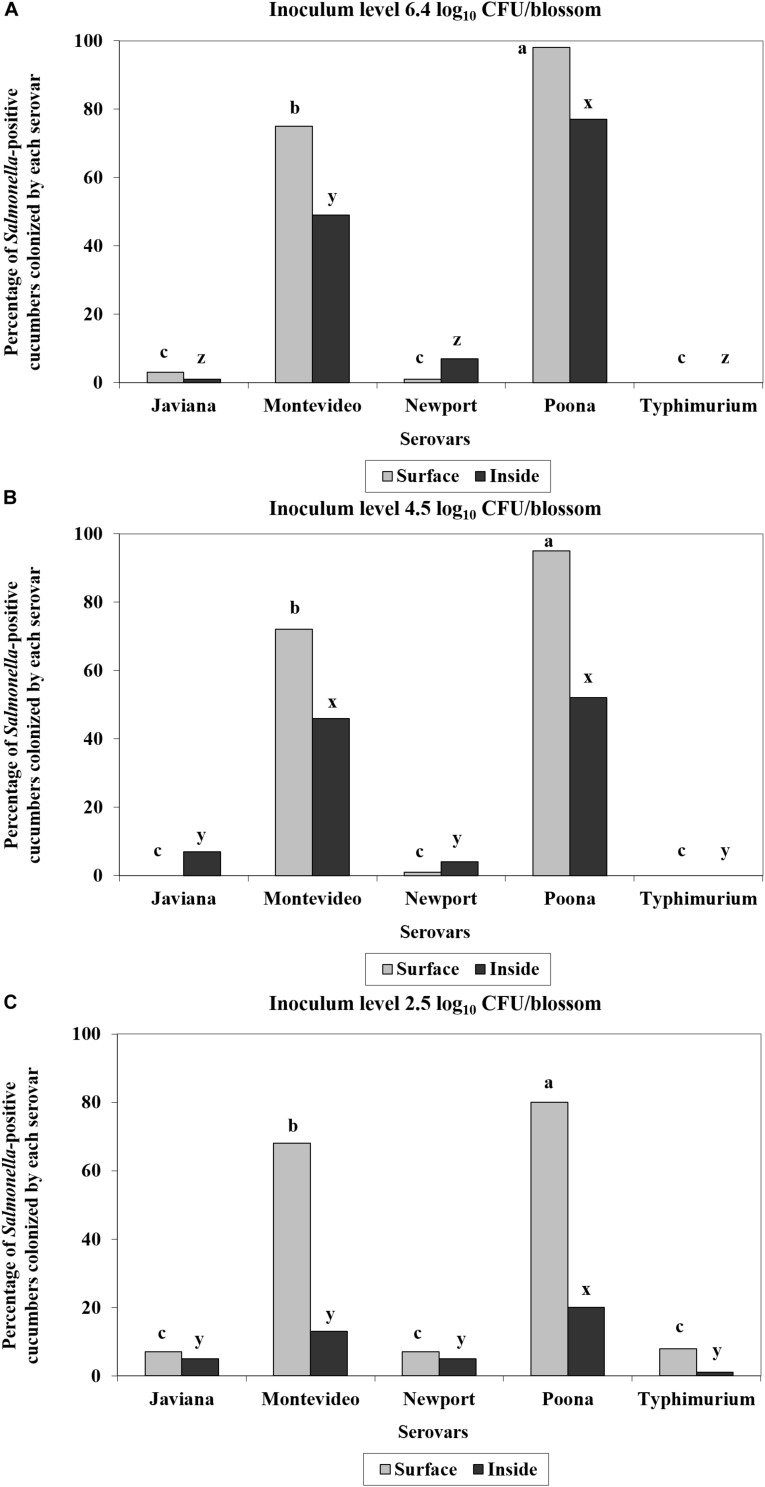
Consumption of cucumbers ( var. ) has been linked to several foodborne outbreaks involving . The purpose of this work was to investigate the efficiency of colonization and internalization of into cucumber plants by various routes of contamination. Produce-associated outbreak strains of (a cocktail of serovars Javiana, Montevideo, Newport, Poona, and Typhimurium) were introduced to three cultivars of cucumber plants (two slicing cultivars and one pickling) via blossoms (ca. 6.4 log CFU/blossom, 4.5 log CFU/blossom, or 2.5 log CFU/blossom) or soil (ca. 8.3 log CFU/root zone) and were analyzed for prevalence of contamination (internal and external) and serovar predominance in fruit and stems. Of the total slicing fruit harvested from -inoculated blossoms (ca. 6.4, 4.5, or 2.5 log CFU/blossom), 83.9% (47/56), 81.4% (48/59) or 71.2% (84/118) were found colonized and 67.9% (38/56), 35.6% (21/59) or 22.0% (26/118) had internalized into the fruit, respectively. Poona was the most prevalent serovar isolated on or in cucumber fruits at all inoculation levels. When soil was inoculated at 1 day post-transplant (dpt), 8% (10/120) of the plants were shown to translocate to the lower stem 7 days post-inoculation (dpi). Results identified blossoms as an important route by which internalized at a high percentage into cucumbers, and Poona, the same strain isolated from the 2015 outbreak of cucumbers imported from Mexico, was shown to be well-adapted to the blossom niche.
食用黄瓜(品种)已与多起涉及[具体病菌名称未给出]的食源性疾病暴发事件相关联。本研究的目的是调查通过不同污染途径,[具体病菌名称未给出]在黄瓜植株上的定殖和内化效率。将与农产品相关的[具体病菌名称未给出]暴发菌株(由爪哇那、蒙得维的亚、纽波特、普纳和鼠伤寒等血清型组成的混合菌株)通过花朵(约6.4 log CFU/朵花、4.5 log CFU/朵花或2.5 log CFU/朵花)或土壤(约8.3 log CFU/根区)接种到三个黄瓜品种(两个切片品种和一个腌制品种)中,并分析果实和茎中[具体病菌名称未给出]污染的发生率(内部和外部)以及血清型优势。在从接种[具体病菌名称未给出]的花朵(约6.4、4.5或2.5 log CFU/朵花)收获的切片果实中,分别有83.9%(47/56)、81.4%(48/59)或71.2%(84/118)被发现定殖,67.9%(38/56)、35.6%(21/59)或22.0%(26/118)的果实中[具体病菌名称未给出]已内化。在所有接种水平下,普纳是在黄瓜果实上或果实中分离出的最常见血清型。在移植后1天(dpt)接种土壤时,8%(10/120)的植株在接种后7天(dpi)被发现将[具体病菌名称未给出]转移到了下部茎中。结果表明,花朵是[具体病菌名称未给出]高比例内化到黄瓜中的重要途径,并且从2015年从墨西哥进口的黄瓜暴发事件中分离出的相同菌株普纳,被证明非常适应花朵生态位。