Hu Emily A, Anderson Cheryl A M, Crews Deidra C, Mills Katherine T, He Jiang, Shou Haochang, Taliercio Jonathon J, Mohanty Madhumita J, Bhat Zeenat, Coresh Josef, Appel Lawrence J, Rebholz Casey M
Department of Epidemiology, Johns Hopkins University Bloomberg School of Public Health, Baltimore, MD, USA.
Department of Family Medicine and Public Health, University of California San Diego School of Medicine, San Diego, CA, USA.
Curr Dev Nutr. 2020 May 21;4(6):nzaa088. doi: 10.1093/cdn/nzaa088. eCollection 2020 Jun.
Beverages are a source of calories and other bioactive constituents but are an understudied aspect of the diet. Different beverages have varying effects on health outcomes.
We created the Healthy Beverage Score (HBS) to characterize participants' beverage patterns and examined its association with chronic kidney disease (CKD) progression, incident cardiovascular disease (CVD), and all-cause mortality among individuals with CKD.
We conducted a prospective analysis of 2283 adults aged 21-74 y with a baseline estimated glomerular filtration rate of 20-70 mL · min · 1.73 m from the Chronic Renal Insufficiency Cohort. Diet was assessed using a 124-item FFQ at visit 1 (2003-2008). The HBS, ranging from 7 to 28 possible points, consisted of 7 components, each scored from 1 to 4 based on rank distribution by quartile, except alcohol, which was based on sex-specific cutoffs. Participants were given more points for higher consumption of low-fat milk and of coffee/tea, for moderate alcohol, and for lower consumption of 100% fruit juice, whole-fat milk, artificially sweetened beverages, and sugar-sweetened beverages. CKD progression, incident CVD, and mortality were ascertained through January 2018. We conducted multivariable Cox proportional hazards models.
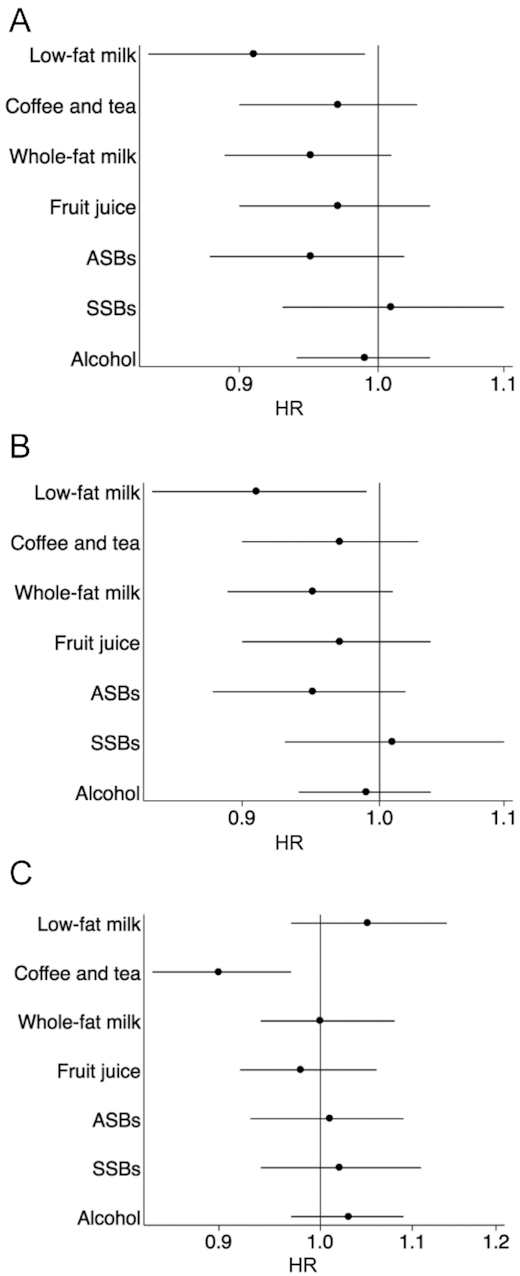
There were 815 cases of CKD progression, 285 cases of incident CVD, and 725 deaths over a maximum of 14 y of follow-up. Compared with participants in the lowest tertile of the HBS, participants in the highest tertile had a 25% lower likelihood of CKD progression (HR: 0.75; 95% CI: 0.63, 0.89; -trend = 0.001) and a 17% lower likelihood of all-cause mortality (HR: 0.83; 95% CI: 0.69, 1.00; -trend = 0.04) after adjusting for sociodemographic, clinical, and dietary factors. There was no significant trend for incident CVD.
Among individuals with CKD, a healthier beverage pattern was inversely associated with CKD progression and all-cause mortality. Beverage intake may be an important modifiable target in preventing adverse outcomes for individuals with CKD.
饮料是热量和其他生物活性成分的来源,但在饮食中是一个研究较少的方面。不同的饮料对健康结果有不同的影响。
我们创建了健康饮料评分(HBS)来描述参与者的饮料模式,并研究其与慢性肾脏病(CKD)进展、心血管疾病(CVD)发病以及CKD患者全因死亡率之间的关联。
我们对慢性肾功能不全队列中2283名年龄在21 - 74岁、基线估计肾小球滤过率为20 - 70 mL·min·1.73 m²的成年人进行了前瞻性分析。在第1次随访(2003 - 2008年)时使用124项食物频率问卷评估饮食情况。HBS的分数范围为7至28分,由7个部分组成,除酒精外,每个部分根据四分位数排名分布从1到4评分,酒精部分根据性别特异性临界值评分。低脂牛奶、咖啡/茶摄入量较高、适量饮酒以及100%果汁、全脂牛奶、人工甜味饮料和含糖饮料摄入量较低的参与者得分更高。通过2018年1月确定CKD进展、CVD发病和死亡率。我们进行了多变量Cox比例风险模型分析。
在最长14年的随访中,有815例CKD进展病例、285例CVD发病病例和725例死亡病例。与HBS最低三分位数的参与者相比,最高三分位数的参与者在调整社会人口统计学、临床和饮食因素后,CKD进展的可能性降低25%(风险比:0.75;95%置信区间:0.63, 0.89;P趋势 = 0.001),全因死亡率降低17%(风险比:0.83;95%置信区间:0.69, 1.00;P趋势 = 0.04)。CVD发病没有显著趋势。
在CKD患者中,更健康的饮料模式与CKD进展和全因死亡率呈负相关。饮料摄入量可能是预防CKD患者不良结局的一个重要可改变目标。