Natchev Emil, Vandeva Silvia, Kovatcheva Roussanka, Kirilov Georgi, Kalinov Krasimir, Zacharieva Sabina
Department of Endocrinology, Medical University, Sofia, Bulgaria.
New Bulgarian University, Sofia, Bulgaria.
Arch Endocrinol Metab. 2020 May-Jun;64(3):269-275. doi: 10.20945/2359-3997000000247.
Acromegaly is characterized by high neoplastic morbidity as a side effect of growth hormone (GH) hypersecretion. Increased incidence of goiter, thyroid carcinoma, and thyroid dysfunction is also reported. The aim of the present study was to find the prevalence of thyroid dysfunction and goiter in patients with acromegaly and determine its relationship to disease activity, disease duration, and the presence of secondary hypothyroidism.
In a cross-sectional study of the period 2008-2012 were included 146 patients with acromegaly (56 men, 90 women) of mean age 50.3 ± 12.4 years. Acromegaly disease activity and thyroid function were evaluated in all patients. Thyroid ultrasonography was performed to calculate thyroid volume and detect the presence of nodular goiter.
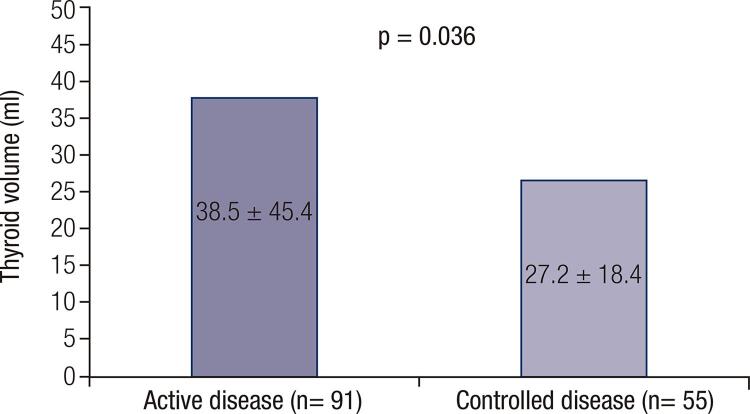
Ninety-one patients were determined to have an active disease, and 55, a controlled disease. The mean thyroid volume in patients without previous thyroid surgery was 37.6 ± 38.8 mL. According to disease activity, thyroid volume was significantly higher in patients with active disease (38.5 ± 45.4 mL vs. 27.2 ± 18.4 mL, p = 0.036). A weak positive correlation was found between thyroid volume and insulin-like growth factor 1 (IGF-1) in the whole group and in females (R = 0.218; p = 0.013, and R = 0.238; p = 0.037, respectively). There was no significant correlation of thyroid volume with disease duration and GH level in the whole group and in both sexes. The patients with secondary hypothyroidism had twofold smaller thyroid volume, relative to the rest of the group. The prevalence of thyroid dysfunction was 39%, with a female to male percentage ratio of 1.73. Goiter was diagnosed in 87% of patients, including diffuse goiter (17.1%) and nodular (69.9%), with no significant difference between patients with active and controlled disease or the presence of secondary hypothyroidism.
Thyroid volume in patients with acromegaly depends on disease activity and the presence of secondary hypothyroidism as a complication. The increased prevalence of nodular goiter determines the need of regular ultrasound thyroid evaluation in the follow-up of patients with acromegaly. Arch Endocrinol Metab. 2020;64(3):269-75.
肢端肥大症的特征是作为生长激素(GH)分泌过多的副作用,肿瘤发病率较高。也有报道称甲状腺肿、甲状腺癌和甲状腺功能障碍的发病率增加。本研究的目的是发现肢端肥大症患者甲状腺功能障碍和甲状腺肿的患病率,并确定其与疾病活动、疾病持续时间和继发性甲状腺功能减退的关系。
在一项2008 - 2012年的横断面研究中,纳入了146例肢端肥大症患者(56例男性,90例女性),平均年龄50.3±12.4岁。对所有患者进行肢端肥大症疾病活动和甲状腺功能评估。进行甲状腺超声检查以计算甲状腺体积并检测结节性甲状腺肿的存在。
91例患者被确定为疾病活动期,55例为疾病控制期。既往无甲状腺手术史的患者平均甲状腺体积为37.6±38.8 mL。根据疾病活动情况,疾病活动期患者的甲状腺体积显著更高(38.5±45.4 mL对27.2±18.4 mL,p = 0.036)。在整个组和女性中,甲状腺体积与胰岛素样生长因子1(IGF - 1)之间发现弱正相关(分别为R = 0.218;p = 0.013,以及R = 0.238;p = 0.037)。在整个组以及男性和女性中,甲状腺体积与疾病持续时间和GH水平均无显著相关性。继发性甲状腺功能减退患者的甲状腺体积相对于组内其他患者小两倍。甲状腺功能障碍的患病率为39%,女性与男性的比例为1.73。87%的患者被诊断为甲状腺肿,包括弥漫性甲状腺肿(17.1%)和结节性甲状腺肿(69.9%),疾病活动期和疾病控制期患者或存在继发性甲状腺功能减退的患者之间无显著差异。
肢端肥大症患者的甲状腺体积取决于疾病活动以及继发性甲状腺功能减退作为并发症的存在。结节性甲状腺肿患病率的增加决定了在肢端肥大症患者随访中需要定期进行甲状腺超声评估。《内分泌与代谢档案》。2020;64(3):269 - 75。