Department of Anthropology, Northwestern University, Evanston, IL, USA.
Department of Anthropology, Stony Brook University, Stony Brook, NY, USA.
Sci Rep. 2020 Jun 19;10(1):9961. doi: 10.1038/s41598-020-66865-2.
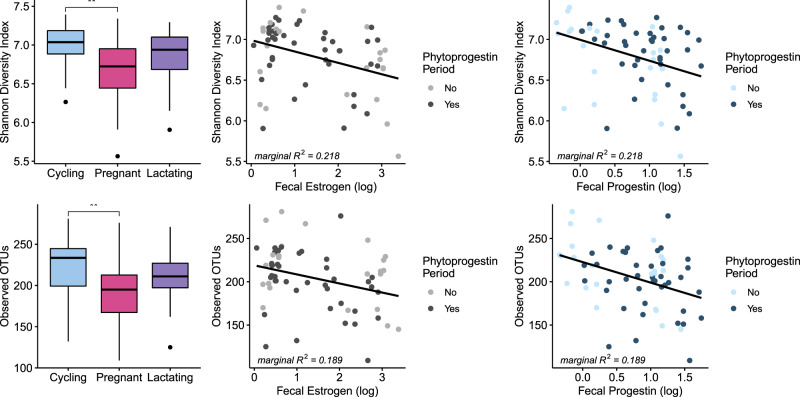
Studies in multiple host species have shown that gut microbial diversity and composition change during pregnancy and lactation. However, the specific mechanisms underlying these shifts are not well understood. Here, we use longitudinal data from wild Phayre's leaf monkeys to test the hypothesis that fluctuations in reproductive hormone concentrations contribute to gut microbial shifts during pregnancy. We described the microbial taxonomic composition of 91 fecal samples from 15 females (n = 16 cycling, n = 36 pregnant, n = 39 lactating) using 16S rRNA gene amplicon sequencing and assessed whether the resulting data were better explained by overall reproductive stage or by fecal estrogen (fE) and progesterone (fP) concentrations. Our results indicate that while overall reproductive stage affected gut microbiome composition, the observed patterns were driven by reproductive hormones. Females had lower gut microbial diversity during pregnancy and fP concentrations were negatively correlated with diversity. Additionally, fP concentrations predicted both unweighted and weighted UniFrac distances, while reproductive state only predicted unweighted UniFrac distances. Seasonality (rainfall and periods of phytoprogestin consumption) additionally influenced gut microbial diversity and composition. Our results indicate that reproductive hormones, specifically progestagens, contribute to the shifts in the gut microbiome during pregnancy and lactation.
在多个宿主物种中的研究表明,肠道微生物多样性和组成在怀孕和哺乳期发生变化。然而,这些变化的具体机制尚不清楚。在这里,我们使用来自野生菲氏叶猴的纵向数据来检验以下假设,即生殖激素浓度的波动导致怀孕期间肠道微生物的变化。我们使用 16S rRNA 基因扩增子测序描述了 15 只雌性(n=16 只循环,n=36 只怀孕,n=39 只哺乳)的 91 个粪便样本的微生物分类组成,并评估了整体生殖阶段或粪便雌二醇(fE)和孕酮(fP)浓度是否更好地解释了所得数据。我们的结果表明,尽管整体生殖阶段影响了肠道微生物组的组成,但观察到的模式是由生殖激素驱动的。怀孕期间,雌性的肠道微生物多样性较低,fP 浓度与多样性呈负相关。此外,fP 浓度预测了未加权和加权 UniFrac 距离,而生殖状态仅预测了未加权 UniFrac 距离。季节性(降雨和植物孕酮摄入期)也会影响肠道微生物多样性和组成。我们的结果表明,生殖激素,特别是孕激素,在怀孕和哺乳期肠道微生物组的变化中起作用。