School of Geography and Planning, Sun Yat-Sen University, Xingang Xi Road, Guangzhou, 510275, China.
Guangdong Key Laboratory for Urbanization and Geo-simulation, Sun Yat-Sen University, Xingang Xi Road, Guangzhou, 510275, China.
Int J Health Geogr. 2020 Jun 20;19(1):22. doi: 10.1186/s12942-020-00216-2.
Urban residents from the developing world have increasingly adopted a sedentary lifestyle and spend less time on physical activities (PA). Previous studies on the association between PA facilities and individuals' PA levels are based on the assumption that individuals have opportunities to use PA facilities within neighborhoods all day long, ignoring the fact that their willingness and opportunities to use nearby facilities depend on how much discretionary time (any time when people have a choice what to do) they have. Further, scant attention has been paid to the influence of PA facilities within both residential and workplace neighborhoods in the dense urban context. To address the above research gaps, this study investigated the links between the spatial access to PA facilities within home/workplace neighborhoods and time spent on PA among working adults, focusing on whether results were different when different measures of accessibility were used and whether participants' discretionary time over a week affected their time spent on PA.
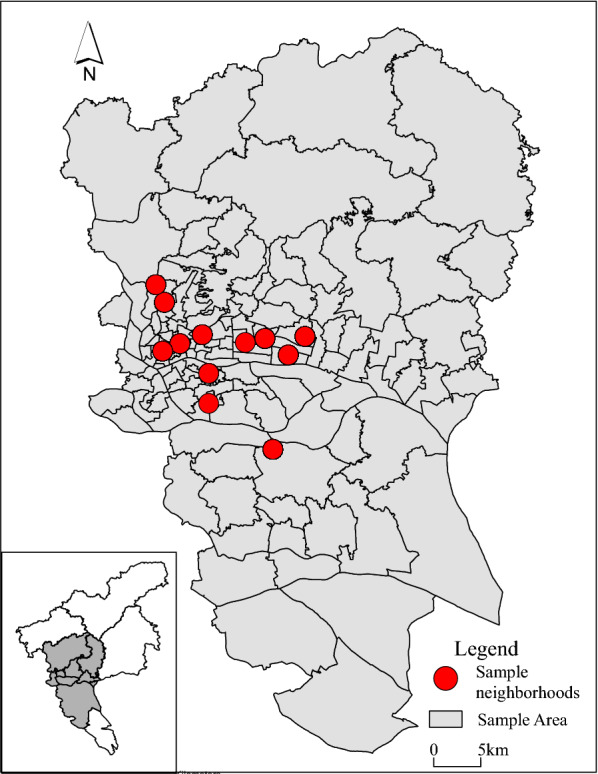
This study used data from a questionnaire survey (n = 1002) in Guangzhou between June and July 2017 and point of interest (POI) data from online mapping resources. Outcome variables included the amount of time spent on physical activity/moderate and vigorous intensity physical activity (PA/MVPA) over the past week. Home/workplace neighborhoods were measured as different distance buffers (500 m circular buffers, 1000 m circular buffers, and 1080 m network buffers) around each respondent's home/workplace. Spatial access to PA facilities was measured using two indicators: the counts of PA facilities and proximity to PA facilities within home/workplace neighborhoods. The amount of discretionary time was calculated based on activity log data of working day/weekend day from the Guangzhou questionnaire survey, and regression models were used to examine relationships between the spatial access of PA facilities, the time spent on PA/MVPA, and the amount of discretionary time, adjusted for covariates. Associations were stratified by gender, age, education, and income.
Using different measures of accessibility (the counts of and proximity to PA facilities) generated different results. Specifically, participants spent more time on PA/MVPA when they lived in neighborhoods with more PA facilities and spent more time on MVPA when worked in closer proximity to PA facilities. A larger amount of discretionary time was associated with more time spent on PA/MVPA, but it did not strengthen the relationship between access to PA facilities and PA/MVPA time. In addition, relationships between access to PA facilities and PA levels varied by gender, age, education, and income.
This study contributes to the knowledge of PA-promoting environments by considering both the home and workplace contexts and by taking into account the temporal attributes of contextual influences. Policymakers and urban planners are advised to take into account the workplace context and the temporal variability of neighborhood influences when allocating public PA facilities and public spaces.
发展中国家的城市居民越来越多地采用久坐的生活方式,减少了体育锻炼的时间。以往关于体育锻炼设施与个人体育锻炼水平之间关系的研究是基于这样一种假设,即个人有机会在全天内使用社区内的体育锻炼设施,但忽略了这样一个事实,即他们使用附近设施的意愿和机会取决于他们有多少可自由支配的时间(即人们有选择做什么的时间)。此外,在密集的城市环境中,很少有人关注居住和工作场所社区内的体育锻炼设施对个人体育锻炼水平的影响。为了解决上述研究空白,本研究调查了家庭/工作场所社区内体育锻炼设施的空间可达性与工作成年人体育锻炼时间之间的联系,重点关注使用不同可达性衡量指标时结果是否不同,以及参与者一周内的可自由支配时间是否会影响他们的体育锻炼时间。
本研究使用了 2017 年 6 月至 7 月期间在广州进行的一项问卷调查(n=1002)和在线地图资源的兴趣点(POI)数据。因变量包括过去一周内进行体育锻炼/中等强度和剧烈强度体育锻炼(PA/MVPA)的时间。家庭/工作场所社区被测量为受访者家庭/工作场所周围不同距离的缓冲区(500m 圆形缓冲区、1000m 圆形缓冲区和 1080m 网络缓冲区)。体育锻炼设施的空间可达性使用两个指标进行测量:家庭/工作场所社区内体育锻炼设施的数量和与体育锻炼设施的接近程度。可自由支配时间是根据广州问卷调查的工作日/周末活动日志数据计算得出的,回归模型用于检验体育锻炼设施的空间可达性、体育锻炼/剧烈强度体育锻炼时间和可自由支配时间之间的关系,并调整了协变量。按性别、年龄、教育和收入对关联进行分层。
使用不同的可达性衡量指标(体育锻炼设施的数量和接近程度)会产生不同的结果。具体而言,当参与者居住在有更多体育锻炼设施的社区时,他们会花费更多的时间进行体育锻炼/剧烈强度体育锻炼,而当他们在更接近体育锻炼设施的地方工作时,他们会花费更多的时间进行剧烈强度体育锻炼。更多的可自由支配时间与更多的体育锻炼/剧烈强度体育锻炼时间相关,但它并没有增强体育锻炼设施可达性与体育锻炼/剧烈强度体育锻炼时间之间的关系。此外,体育锻炼设施可达性与体育锻炼水平之间的关系因性别、年龄、教育和收入而异。
本研究通过考虑家庭和工作场所的背景,并考虑到背景影响的时间属性,为促进体育锻炼的环境知识做出了贡献。建议政策制定者和城市规划者在分配公共体育锻炼设施和公共空间时,考虑到工作场所的背景和社区影响的时间可变性。
