Lee Jen-Pei, Chen Shuya, Tsai Chien-Tsung, Chung Hsu-Chih, Chang Wen-Dien
Department of Neurosurgery, Da-Chien General Hospital, Miaoli, Taiwan.
Department of Physical Therapy, China Medical University, Taichung, Taiwan.
Occup Ther Int. 2020 May 24;2020:2387378. doi: 10.1155/2020/2387378. eCollection 2020.
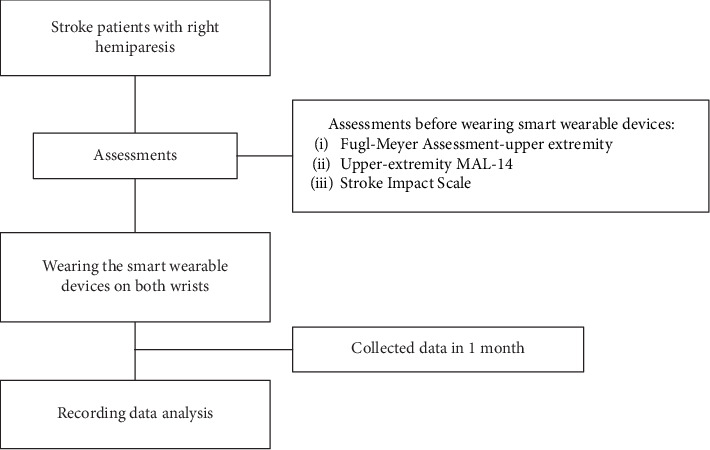
Spontaneous arm use in patients with poststroke hemiparesis is crucial to the recovery of functional interaction. Patients with stroke and subsequent right hemiparesis have more difficulty adapting to a right-handed environment. The aim of this study was to use wearable devices to assess the asymmetry and difference in the amount of activity of the nondominant and dominant affected hands among patients with stroke and right hemiparesis. The real activity of both hands was measured to assess the correlation with various aspects of the International Classification of Functioning, Disability and Health (ICF). . Patients with stroke and right hemiparesis were recruited. They were divided into two groups according to the affected hand. Groups A and B comprised patients with affected nondominant and dominant hands, respectively. The Fugl-Meyer assessment-Upper Extremity (FM-UE) scores, Motor Activity Log (MAL), and hand function domain scores on the Stroke Impact Scale (SIS) were used for assessment. Patients were asked to wear smart wearable devices on both hands 24 hours a day for a month. The amount of activity in both hands was recorded and analyzed.
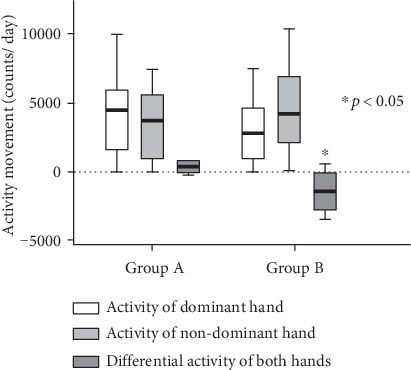
A total of 29 patients with stroke were divided into group A ( = 14) and group B ( = 15). FM-UE scores were significantly and strongly correlated with the amount of use (AOU) in the MAL. The recorded differential real activity of both hands in group B was significantly lower than that in group A. The asymmetry index of hand use was significantly less favorable in group B. However, no significant differences in AOU in the MAL, FM-UE, and hand function domain in the SIS were identified between the nondominant and dominant affected hands.
The asymmetry and differential activity of both hands were worse in the patients with poststroke right hemiparesis, whose dominant hand was affected. However, no differences of three aspects of the ICF were found between dominant and nondominant affected hands.
脑卒中后偏瘫患者的自发手臂使用对于功能交互的恢复至关重要。患有脑卒中及随后出现右侧偏瘫的患者更难以适应右手环境。本研究的目的是使用可穿戴设备评估脑卒中并伴有右侧偏瘫患者患侧非优势手和优势手活动量的不对称性及差异。测量双手的实际活动以评估与《国际功能、残疾和健康分类》(ICF)各方面的相关性。招募了患有脑卒中及右侧偏瘫的患者。根据患手将他们分为两组。A组和B组分别由患侧非优势手和优势手的患者组成。使用Fugl-Meyer上肢评估(FM-UE)评分、运动活动日志(MAL)以及卒中影响量表(SIS)上的手功能领域评分进行评估。要求患者双手每天佩戴智能可穿戴设备24小时,持续一个月。记录并分析双手的活动量。
共29例脑卒中患者被分为A组(n = 14)和B组(n = 15)。FM-UE评分与MAL中的使用量(AOU)显著且强烈相关。B组记录的双手实际活动差异显著低于A组。B组的手使用不对称指数明显更不理想。然而,在患侧非优势手和优势手之间,未发现MAL中的AOU、FM-UE以及SIS中的手功能领域存在显著差异。
脑卒中后右侧偏瘫且优势手受累的患者双手的不对称性和差异活动更差。然而,在患侧优势手和非优势手之间未发现ICF三个方面的差异。