Department of Cardiology, National Hospital Organization Tokyo Medical Center, Japan.
Division of Cardiovascular Medicine, Toho University Ohashi Medical Center, Tokyo, Japan.
Dis Markers. 2020 May 29;2020:2479830. doi: 10.1155/2020/2479830. eCollection 2020.
Talin-1 is a cytoskeletal protein that binds integrin, thereby leading to integrin activation and affecting focal adhesions. Recently, talin-1 expression was reported to be downregulated in human atherosclerotic plaques. However, blood levels of soluble talin-1 (sTalin-1) in patients with atherosclerotic disease, such as coronary artery disease (CAD), have not been elucidated.
We measured plasma sTalin-1 levels in 349 patients undergoing elective coronary angiography. The severity of CAD was represented as the number of stenotic coronary vessels and segments.
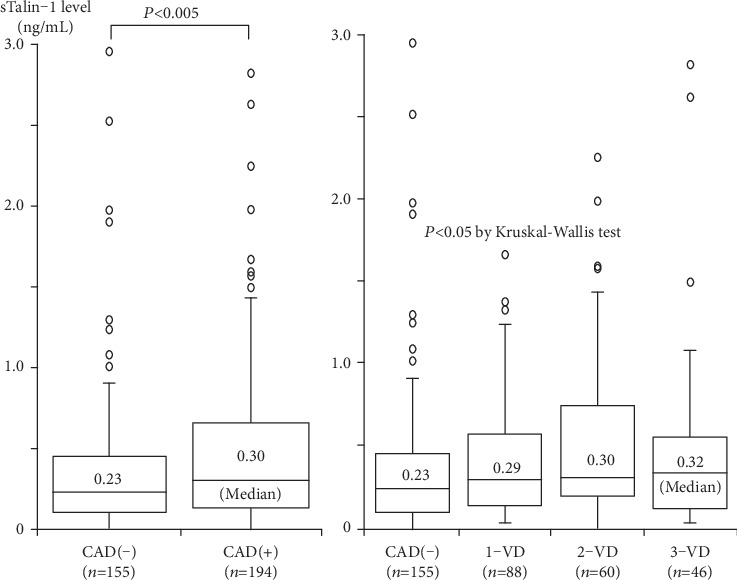
Of the 349 study patients, CAD was found in 194 patients, of whom 88 had 1-vessel disease (1-VD), 60 had 2-vessel disease (2-VD), and 46 had 3-vessel disease (3-VD). Plasma sTalin-1 levels were higher in 194 patients with CAD than in 155 without CAD (CAD(-) group) (median 0.30 vs. 0.23 ng/mL, < 0.005). A stepwise increase in sTalin-1 levels was found depending on the number of >50% stenotic coronary vessels: 0.23 in CAD(-), 0.29 in 1-VD, 0.30 in 2-VD, and 0.32 ng/mL in 3-VD group, respectively, ( < 0.05). High sTalin-1 level (>0.28 ng/mL) was found in 36% of CAD(-), 51% of 1-VD, 53% of 2-VD, and 59% of 3-VD group ( < 0.025). sTalin-1 levels also correlated with the number of >50% stenotic segments ( = 0.14, < 0.02). The multivariate analysis revealed that sTalin-1 levels were independently associated with CAD. The odds ratio for CAD was 1.83 (95%CI = 1.14 - 2.93) for high sTalin-1 level (>0.28 ng/mL) ( < 0.02).
Plasma sTalin-1 levels in patients with CAD were found to be high and to be associated with the presence and severity of CAD, suggesting a role of sTalin-1 in the progression of coronary atherosclerosis.
Talin-1 是一种细胞骨架蛋白,它与整合素结合,从而导致整合素激活并影响焦点黏附。最近,有报道称,talin-1 在人类动脉粥样硬化斑块中的表达下调。然而,在患有动脉粥样硬化疾病(如冠心病)的患者中,可溶性 talin-1(sTalin-1)的血液水平尚未阐明。
我们测量了 349 例行选择性冠状动脉造影的患者的血浆 sTalin-1 水平。冠心病的严重程度用狭窄冠状动脉血管和节段的数量表示。
在 349 例研究患者中,194 例患者发现冠心病,其中 88 例为单支血管病变(1-VD),60 例为双支血管病变(2-VD),46 例为三支血管病变(3-VD)。与无冠心病(CAD(-))的 155 例患者相比,194 例冠心病患者的血浆 sTalin-1 水平更高(CAD 组:中位数 0.30 vs. 0.23ng/mL,<0.005)。根据 >50%狭窄冠状动脉血管的数量,sTalin-1 水平呈阶梯式升高:CAD(-)组为 0.23ng/mL,1-VD 组为 0.29ng/mL,2-VD 组为 0.30ng/mL,3-VD 组为 0.32ng/mL,差异均有统计学意义(<0.05)。在 CAD(-)组、1-VD 组、2-VD 组和 3-VD 组中,高 sTalin-1 水平(>0.28ng/mL)的比例分别为 36%、51%、53%和 59%(<0.025)。sTalin-1 水平也与 >50%狭窄节段的数量相关(=0.14,<0.02)。多变量分析显示,sTalin-1 水平与冠心病独立相关。高 sTalin-1 水平(>0.28ng/mL)患者发生冠心病的比值比为 1.83(95%CI=1.14-2.93)(<0.02)。
发现冠心病患者的血浆 sTalin-1 水平较高,且与冠心病的存在和严重程度相关,表明 sTalin-1 在冠状动脉粥样硬化的进展中起作用。