Faculdade Ciências Médicas de Minas Gerais, BR.
Universidade Federal de Juiz de Fora, BR.
Ann Glob Health. 2020 Jun 9;86(1):56. doi: 10.5334/aogh.2756.
Cervical cancer represents an important preventable cause of morbidity and mortality in developing countries such as Brazil. Investigating temporal evolution of a disease burden in the different realities of the country is essential for improving public policies.
To describe the national and subnational burden of cervical cancer, based on the estimates of the 2017 Global Burden of Disease study.
Descriptive study of premature mortality (years of life lost [YLL]) and burden of disease (disability-adjusted life years [DALYs]) associated with cervical cancer among Brazilian women aged 25-64 years, between 2000 and 2017.
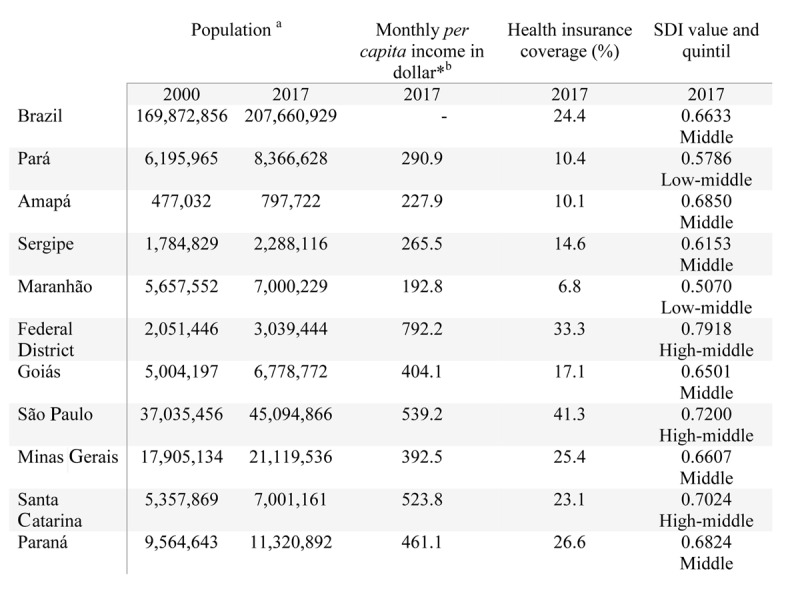
During the study period, age-standardized incidence decreased from 23.53 (22.79-24.26) to 18.39 (17.63-19.17) per 100,000 women, while mortality rates decreased from 11.3 (11.05-11.56) to 7.74 (7.49-8.02) per 100,000 women. These rates were about two to three times greater than equivalent rates in a developed country, such as England: 11.98 (11.45-12.55) to 10.37 (9.85-10.9), and 3.75 (3.68-3.84) to 2.82 (2.75-2.9) per 100,000 women, respectively. Poorer regions of Brazil had greater rates of the disease; for instance, Amapá State in the Northern Region had rates twice as high as the national rates during the same period. Cervical cancer was the leading cause of premature cancer-related mortality (YLL = 100.69, 91.48-110.61 per 100,000 women) among young women (25-29 years) in Brazil and eight federation units of all country regions except the Southeast in 2017. There was a decrease in the burden of cervical cancer in Brazil from 339.59 (330.82-348.83) DALYs per 100,000 women in 2000 to 238.99 (230.45-247.99) DALYs per 100,000 women in 2017.
Although there has been a reduction in the burden of cervical cancer in Brazil, the rates remain high, mainly among young women. The persistence of inequalities between regions of Brazil suggests the importance of socioeconomic determinants in the burden for this cancer.
在巴西等发展中国家,宫颈癌是导致发病率和死亡率的一个重要可预防原因。研究疾病负担在该国不同现实中的时间演变对于改善公共政策至关重要。
根据 2017 年全球疾病负担研究的估计,描述宫颈癌在巴西妇女中的全国和国家级以下负担。
对 2000 年至 2017 年期间 25-64 岁巴西妇女中与宫颈癌相关的过早死亡(生命年损失[YLL])和疾病负担(伤残调整生命年[DALY])进行描述性研究。
在研究期间,年龄标准化发病率从每 100,000 名妇女 23.53(22.79-24.26)降至 18.39(17.63-19.17),而死亡率从每 100,000 名妇女 11.3(11.05-11.56)降至 7.74(7.49-8.02)。这些比率大约是英格兰等发达国家的两倍到三倍:每 100,000 名妇女分别为 11.98(11.45-12.55)和 10.37(9.85-10.9),以及 3.75(3.68-3.84)和 2.82(2.75-2.9)。巴西较贫穷地区的疾病发病率更高;例如,2017 年,北部地区的阿马帕州的发病率是同期全国平均水平的两倍。宫颈癌是巴西年轻女性(25-29 岁)中与癌症相关的过早死亡的主要原因(YLL=100.69,每 100,000 名妇女 91.48-110.61),也是除东南部以外所有国家地区的 8 个联邦单位的主要原因。2000 年,巴西每 100,000 名妇女宫颈癌负担为 339.59(330.82-348.83)残疾调整生命年,到 2017 年降至 238.99(230.45-247.99)。
尽管巴西宫颈癌负担有所减轻,但发病率仍然很高,主要发生在年轻女性中。巴西各地区之间存在不平等,这表明社会经济决定因素对这种癌症负担的重要性。