Jeong Seri, Park Min-Jeong, Song Wonkeun, Kim Hyon-Suk
Department of Laboratory Medicine, Kangnam Sacred Heart Hospital, Hallym University College of Medicine, Seoul, South Korea.
Department of Laboratory Medicine, Severance Hospital, Yonsei University College of Medicine, Seoul, South Korea.
Ann Transl Med. 2020 May;8(9):608. doi: 10.21037/atm.2019.12.42.
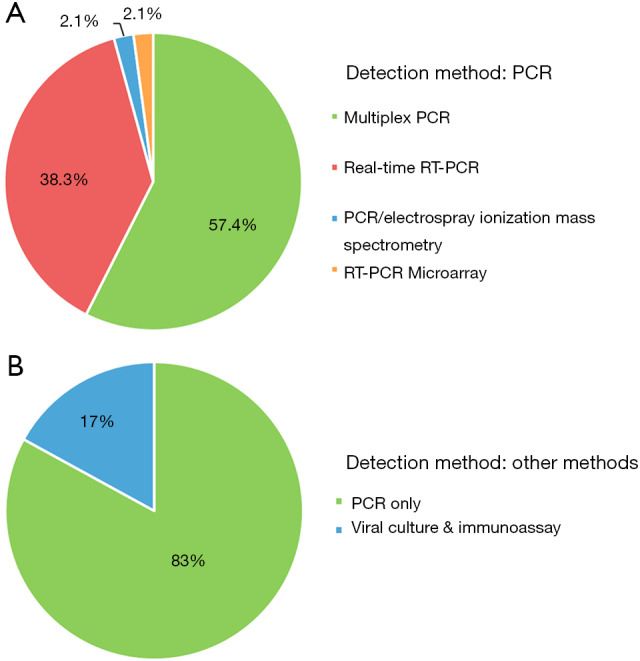
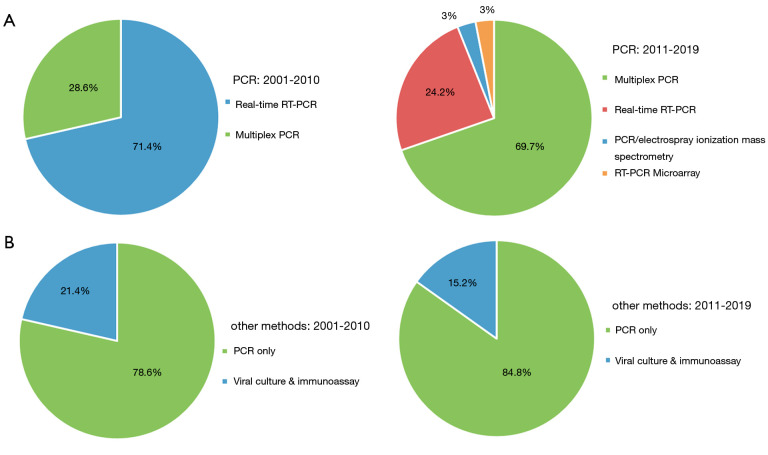
Human metapneumovirus (HMPV) is one of the major causes of acute respiratory tract infection (ARI) and shows high morbidity and mortality, particularly in children and immunocompromised patients. Various methods for detecting HMPV have been developed and applied in clinical laboratories. When reviewing the literature, we found that polymerase chain reaction (PCR)-based assays have been most frequently and consistently used to detect HMPV. The most commonly used method was multiplex reverse transcriptase-PCR (RT-PCR; 57.4%), followed by real-time RT-PCR (38.3%). Multiplex RT-PCR became the more popular method in 2011-2019 (69.7%), in contrast to 2001-2009 (28.6%). The advent of multiplex PCR in detecting broader viral pathogens in one run and coinfected viruses influenced the change in user preference. Further, newly developed microarray technologies and ionization mass spectrometry were introduced in 2011-2019. Viral culture (including shell vial assays) and fluorescent immunoassays (with or without culture) were once the mainstays. However, the percentage of studies employing culture and fluorescent immunoassays decreased from 21.4% in 2001-2010 to 15.2% in 2011-2019. Meanwhile, the use of PCR-based methods of HMPV detection increased from 78.6% in 2001-2010 to 84.8% in 2011-2019. The increase in PCR-based methods might have occurred because PCR methods demonstrated better diagnostic performance, shorter hands-on and run times, less hazards to laboratory personnel, and more reliable results than traditional methods. When using these assays, it is important to acquire a comprehensive understanding of the principles, advantages, disadvantages, and precautions for data interpretation. In the future, the combination of nanotechnology and advanced genetic platforms such as next-generation sequencing will benefit patients with HMPV infection by facilitating efficient therapeutic intervention. Analytical and clinical validation are required before using new techniques in clinical laboratories.
人偏肺病毒(HMPV)是急性呼吸道感染(ARI)的主要病因之一,发病率和死亡率高,尤其是在儿童和免疫功能低下的患者中。已经开发了多种检测HMPV的方法并应用于临床实验室。在查阅文献时,我们发现基于聚合酶链反应(PCR)的检测方法最常且一致地用于检测HMPV。最常用的方法是多重逆转录PCR(RT-PCR;57.4%),其次是实时RT-PCR(38.3%)。与2001-2009年(28.6%)相比,多重RT-PCR在2011-2019年成为更受欢迎的方法(69.7%)。多重PCR能够在一次检测中检测更广泛的病毒病原体以及合并感染的病毒,这影响了用户偏好的变化。此外,2011-2019年引入了新开发的微阵列技术和电离质谱技术。病毒培养(包括空斑试验)和荧光免疫测定(有或没有培养)曾是主要方法。然而,采用培养和荧光免疫测定的研究比例从2001-2010年的21.4%降至2011-2019年的15.2%。与此同时,基于PCR的HMPV检测方法的使用从2001-2010年的78.6%增加到2011-2019年的84.8%。基于PCR的方法的增加可能是因为PCR方法显示出比传统方法更好的诊断性能、更短的操作和检测时间、对实验室人员危害更小以及结果更可靠。使用这些检测方法时,全面了解其原理、优点、缺点以及数据解释的注意事项非常重要。未来,纳米技术与先进的基因平台(如下一代测序)的结合将通过促进有效的治疗干预,使HMPV感染患者受益。在临床实验室使用新技术之前,需要进行分析和临床验证。