Department of Neurology, Ophthalmology and Otolaryngology, Semey Medical University, Semey, Kazakhstan.
Department of Personalized Medicine, Semey Medical University, Semey, Kazakhstan.
J Korean Med Sci. 2020 Jun 22;35(24):e227. doi: 10.3346/jkms.2020.35.e227.
Coronavirus disease 2019 (COVID-19) pandemic entered Kazakhstan on 13 March 2020 and quickly spread over its territory. This study aimed at reporting on the rates of COVID-19 in the country and at making prognoses on cases, deaths, and recoveries through predictive modeling. Also, we attempted to forecast the needs in professional workforce depending on implementation of quarantine measures.
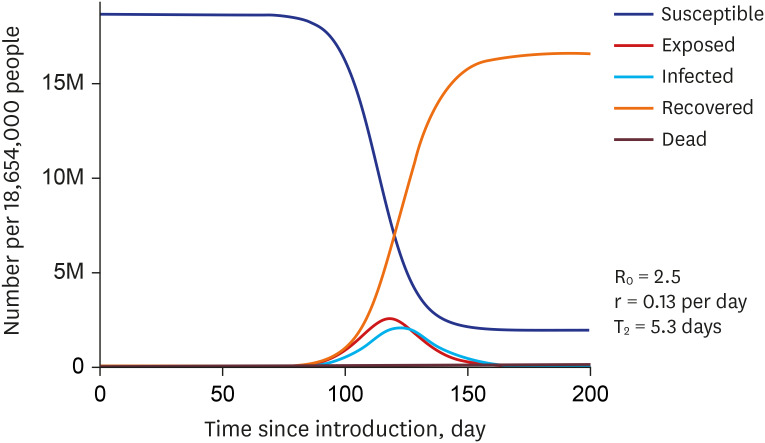
We calculated both national and local incidence, mortality and case-fatality rates, and made forecast modeling via classic susceptible-exposed-infected-removed (SEIR) model. The Health Workforce Estimator tool was utilized for forecast modeling of health care workers capacity.
The vast majority of symptomatic patients had mild disease manifestations and the proportion of moderate disease was around 10%. According to the SEIR model, there will be 156 thousand hospitalized patients due to severe illness and 15.47 thousand deaths at the peak of an outbreak if no measures are implemented. Besides, this will substantially increase the need in professional medical workforce. Still, 50% compliance with quarantine may possibly reduce the deaths up to 3.75 thousand cases and the number of hospitalized up to 9.31 thousand cases at the peak.
The outcomes of our study could be of interest for policymakers as they help to forecast the trends of COVID-19 outbreak, the demands for professional workforce, and to estimate the consequences of quarantine measures.
2019 年冠状病毒病(COVID-19)疫情于 2020 年 3 月 13 日进入哈萨克斯坦,并迅速在其境内蔓延。本研究旨在报告该国 COVID-19 的发病率,并通过预测建模对病例、死亡和康复进行预测。此外,我们还试图根据检疫措施的实施情况预测专业劳动力的需求。
我们计算了全国和局部的发病率、死亡率和病死率,并通过经典的易感-暴露-感染-清除(SEIR)模型进行了预测建模。利用卫生劳动力估算器工具对卫生保健人员能力进行了预测建模。
绝大多数有症状的患者表现为轻症,中度疾病的比例约为 10%。根据 SEIR 模型,如果不采取措施,将有 15.6 万名重症患者住院治疗,疫情高峰期将有 1.547 万人死亡。此外,这将大幅增加对专业医疗劳动力的需求。然而,如果 50%的人遵守隔离规定,可能会将死亡人数减少到 3750 例,高峰期住院人数减少到 9310 例。
我们的研究结果可能引起决策者的兴趣,因为它们有助于预测 COVID-19 疫情的趋势、对专业劳动力的需求,并估计检疫措施的后果。