Pourghasemi Hamid Reza, Pouyan Soheila, Heidari Bahram, Farajzadeh Zakariya, Fallah Shamsi Seyed Rashid, Babaei Sedigheh, Khosravi Rasoul, Etemadi Mohammad, Ghanbarian Gholamabbas, Farhadi Ahmad, Safaeian Roja, Heidari Zahra, Tarazkar Mohammad Hassan, Tiefenbacher John P, Azmi Amir, Sadeghian Faezeh
Department of Natural Resources and Environmental Engineering, College of Agriculture, Shiraz University, Shiraz, Iran.
Research Assistant, Department of Natural Resources and Environmental Engineering, College of Agriculture, Shiraz University, Shiraz, Iran.
Int J Infect Dis. 2020 Sep;98:90-108. doi: 10.1016/j.ijid.2020.06.058. Epub 2020 Jun 20.
Coronavirus disease 2019 (COVID-19) represents a major pandemic threat that has spread to more than 212 countries with more than 432,902 recorded deaths and 7,898,442 confirmed cases worldwide so far (on June 14, 2020). It is crucial to investigate the spatial drivers to prevent and control the epidemic of COVID-19.
This is the first comprehensive study of COVID-19 in Iran; and it carries out spatial modeling, risk mapping, change detection, and outbreak trend analysis of the disease spread. Four main steps were taken: comparison of Iranian coronavirus data with the global trends, prediction of mortality trends using regression modeling, spatial modeling, risk mapping, and change detection using the random forest (RF) machine learning technique (MLT), and validation of the modeled risk map.
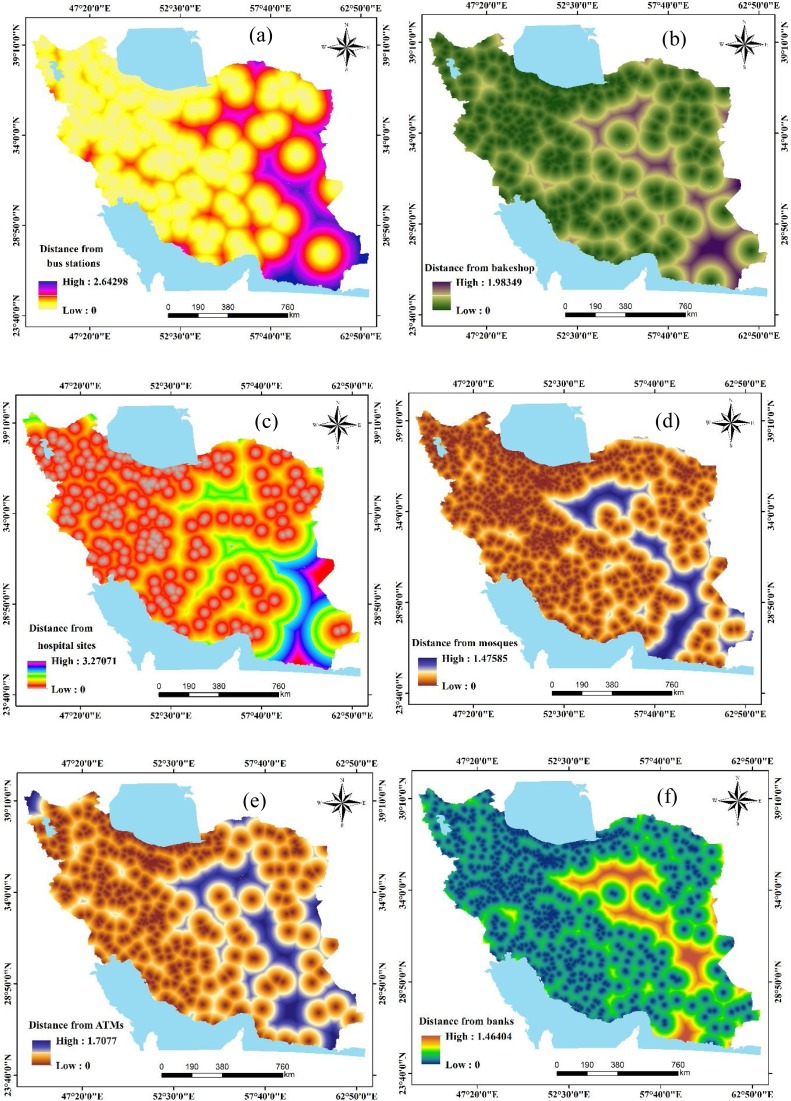
The results show that from February 19 to June 14, 2020, the average growth rates (GR) of COVID-19 deaths and the total number of COVID-19 cases in Iran were 1.08 and 1.10, respectively. Based on the World Health Organisation (WHO) data, Iran's fatality rate (deaths/0.1M pop) is 10.53. Other countries' fatality rates were, for comparison, Belgium - 83.32, UK - 61.39, Spain - 58.04, Italy - 56.73, Sweden - 48.28, France - 45.04, USA - 35.52, Canada - 21.49, Brazil - 20.10, Peru - 19.70, Chile - 16.20, Mexico- 12.80, and Germany - 10.58. The fatality rate for China is 0.32 (deaths/0.1M pop). Over time, the heatmap of the infected areas identified two critical time intervals for the COVID-19 outbreak in Iran. The provinces were classified in terms of disease and death rates into a large primary group and three provinces that had critical outbreaks were separate from the others. The heatmap of countries of the world shows that China and Italy were distinguished from other countries in terms of nine viral infection-related parameters. The regression models for death cases showed an increasing trend but with some evidence of turning. A polynomial relationship was identified between the coronavirus infection rate and the province population density. Also, a third-degree polynomial regression model for deaths showed an increasing trend recently, indicating that subsequent measures taken to cope with the outbreak have been insufficient and ineffective. The general trend of deaths in Iran is similar to the world's, but Iran's shows lower volatility. Change detection of COVID-19 risk maps with a random forest model for the period from March 11 to March 18 showed an increasing trend of COVID-19 in Iran's provinces. It is worth noting that using the LASSO MLT to evaluate variables' importance, indicated that the most important variables were the distance from bus stations, bakeries, hospitals, mosques, ATMs (automated teller machines), banks, and the minimum temperature of the coldest month.
We believe that this study's risk maps are the primary, fundamental step to take for managing and controlling COVID-19 in Iran and its provinces.
2019年冠状病毒病(COVID-19)是一项重大的全球大流行威胁,截至2020年6月14日,已蔓延至212多个国家,全球有记录的死亡人数超过432,902人,确诊病例达7,898,442例。调查COVID-19疫情的空间驱动因素对于预防和控制该疾病至关重要。
这是对伊朗COVID-19的首次全面研究;它对该疾病传播进行了空间建模、风险制图、变化检测和疫情趋势分析。采取了四个主要步骤:将伊朗冠状病毒数据与全球趋势进行比较,使用回归模型预测死亡率趋势,使用随机森林(RF)机器学习技术(MLT)进行空间建模、风险制图和变化检测,以及对建模的风险地图进行验证。
结果显示,2020年2月19日至6月14日,伊朗COVID-19死亡人数和COVID-19病例总数的平均增长率(GR)分别为1.08和1.10。根据世界卫生组织(WHO)的数据,伊朗的病死率(死亡人数/10万人)为10.53。相比之下,其他国家的病死率分别为:比利时 - 83.32,英国 - 61.39,西班牙 - 58.04,意大利 - 56.73,瑞典 - 48.28,法国 - 45.04,美国 - 35.52,加拿大 - 21.49,巴西 - 20.10,秘鲁 - 19.70,智利 - 16.20,墨西哥 - 12.80,德国 - 10.58。中国的病死率为0.32(死亡人数/10万人)。随着时间推移,感染地区的热图确定了伊朗COVID-19疫情爆发的两个关键时间间隔。根据疾病和死亡率,各省份被分为一个大的主要组,三个疫情严重的省份与其他省份分开。世界各国的热图显示,中国和意大利在九个与病毒感染相关的参数方面与其他国家有所不同。死亡病例的回归模型显示呈上升趋势,但有一些转折迹象。确定了冠状病毒感染率与省份人口密度之间的多项式关系。此外,死亡人数的三次多项式回归模型最近显示呈上升趋势,表明随后为应对疫情采取的措施不足且无效。伊朗死亡人数的总体趋势与全球相似,但伊朗的波动较小。使用随机森林模型对2020年3月11日至3月18日期间的COVID-19风险地图进行变化检测,结果显示伊朗各省份的COVID-19呈上升趋势。值得注意的是,使用套索MLT评估变量的重要性表明,最重要的变量是与公交车站、面包店、医院、清真寺、自动取款机(ATM)、银行的距离以及最冷月份的最低温度。
我们认为,本研究的风险地图是伊朗及其各省份管理和控制COVID-19的首要基本步骤。