School of Sport and Exercise Sciences, Liverpool John Moores University, Liverpool, United Kingdom.
Club Atlético Peñarol, Estadio Campeón del Siglo, Montevideo, Uruguay.
PLoS One. 2020 Jun 22;15(6):e0234458. doi: 10.1371/journal.pone.0234458. eCollection 2020.
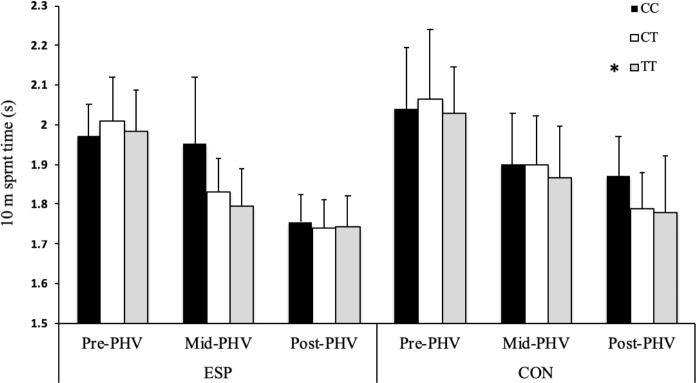
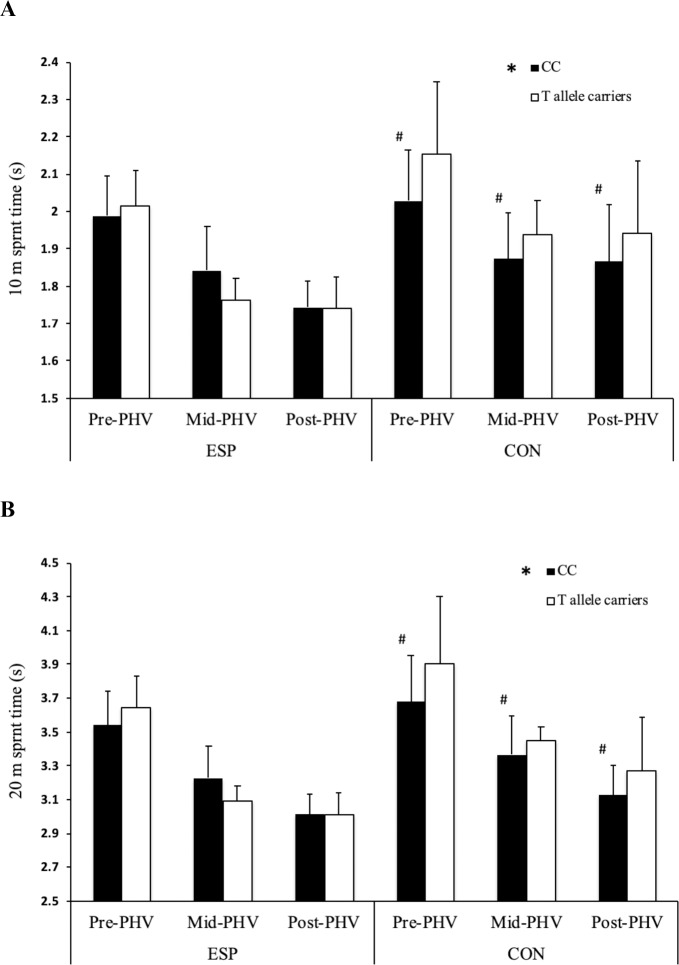
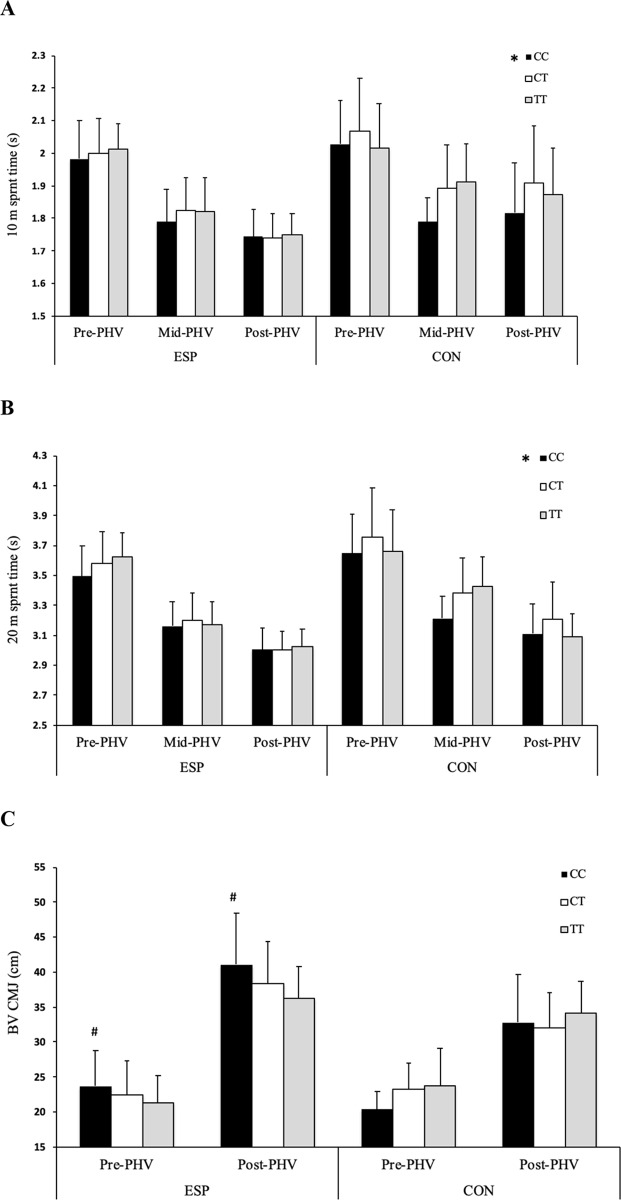
We investigated the association of multiple single nucleotide polymorphisms (SNPs) with athlete status and power/speed performance in elite male youth soccer players (ESP) and control participants (CON) at different stages of maturity. ESP (n = 535; aged 8-23 years) and CON (n = 151; aged 9-26 years) were genotyped for 10 SNPs and grouped according to years from predicted peak-height-velocity (PHV), i.e. pre- or post-PHV, to determine maturity status. Participants performed bilateral vertical countermovement jumps, bilateral horizontal-forward countermovement jumps, 20m sprints and modified 505-agility tests. Compared to CON, pre-PHV ESP demonstrated a higher ACTN3 (rs1815739) XX ('endurance') genotype frequency distribution, while post-PHV ESP revealed a higher frequency distribution of the PPARA (rs4253778) C-allele, AGT (rs699) GG genotype and NOS3 (rs2070744) T-allele ('power' genotypes/alleles). BDNF (rs6265) CC, COL5A1 (rs12722) CC and NOS3 TT homozygotes sprinted quicker than A-allele carriers, CT heterozygotes and CC homozygotes, respectively. COL2A1 (rs2070739) CC and AMPD1 (rs17602729) GG homozygotes sprinted faster than their respective minor allele carrier counterparts in CON and pre-PHV ESP, respectively. BDNF CC homozygotes jumped further than T-allele carriers, while ESP COL5A1 CC homozygotes jumped higher than TT homozygotes. To conclude, we have shown for the first time that pre- and post-PHV ESP have distinct genetic profiles, with pre-PHV ESP more suited for endurance, and post-PHV ESP for power and speed (the latter phenotypes being crucial attributes for post-PHV ESP). We have also demonstrated that power, acceleration and sprint performance were associated with five SNPs, both individually and in combination, possibly by influencing muscle size and neuromuscular activation.
我们研究了多个单核苷酸多态性(SNP)与精英男性青年足球运动员(ESP)和不同成熟阶段的对照参与者(CON)的运动员身份和力量/速度表现之间的关联。ESP(n=535;年龄 8-23 岁)和 CON(n=151;年龄 9-26 岁)根据预测身高生长高峰速度(PHV)的年数进行了 10 个 SNP 的基因分型,分为 PHV 前或 PHV 后,以确定成熟状态。参与者进行了双侧垂直反向跳跃、双侧水平向前反向跳跃、20m 冲刺和改良的 505 敏捷性测试。与 CON 相比,PHV 前的 ESP 表现出更高的 ACTN3(rs1815739)XX(“耐力”)基因型频率分布,而 PHV 后的 ESP 则表现出更高的 PPARA(rs4253778)C-等位基因、AGT(rs699)GG 基因型和 NOS3(rs2070744)T-等位基因(“力量”基因型/等位基因)的频率分布。BDNF(rs6265)CC、COL5A1(rs12722)CC 和 NOS3 TT 纯合子比 A-等位基因携带者、CT 杂合子和 CC 纯合子冲刺更快。COL2A1(rs2070739)CC 和 AMPD1(rs17602729)GG 纯合子在 CON 和 PHV 前的 ESP 中分别比各自的次要等位基因携带者冲刺更快。BDNF CC 纯合子跳跃距离大于 T-等位基因携带者,而 ESP COL5A1 CC 纯合子跳跃高度高于 TT 纯合子。总之,我们首次表明,PHV 前和 PHV 后的 ESP 具有不同的遗传特征,PHV 前的 ESP 更适合耐力,而 PHV 后的 ESP 更适合力量和速度(后一种表型是 PHV 后 ESP 的关键属性)。我们还表明,力量、加速度和冲刺表现与五个 SNP 相关,无论是单独还是组合,可能通过影响肌肉大小和神经肌肉激活。