CREEC, MIVEGEC, UMR IRD/CNRS/UM 5290, 911 Avenue Agropolis, BP 64501, 34394, Montpellier Cedex 5, France.
Department of Immunology, School of Medicine, University of Pittsburgh, Pittsburgh, PA, 15261, USA.
Sci Rep. 2020 Jun 22;10(1):10106. doi: 10.1038/s41598-020-66813-0.
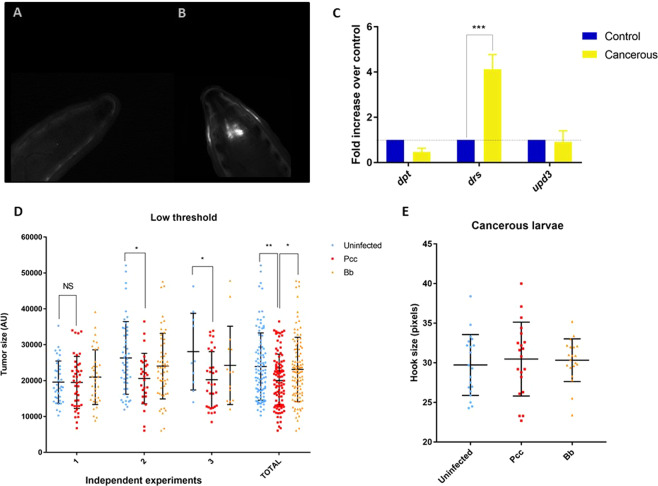
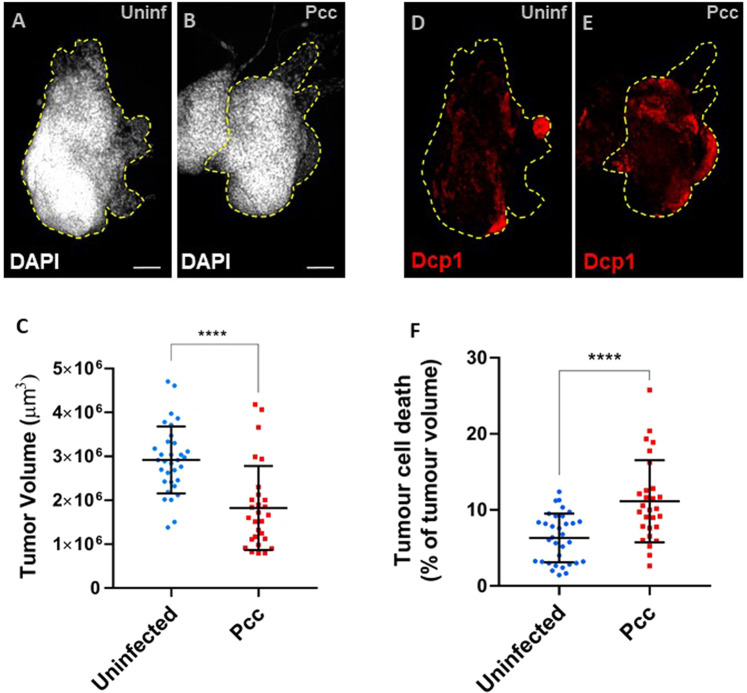
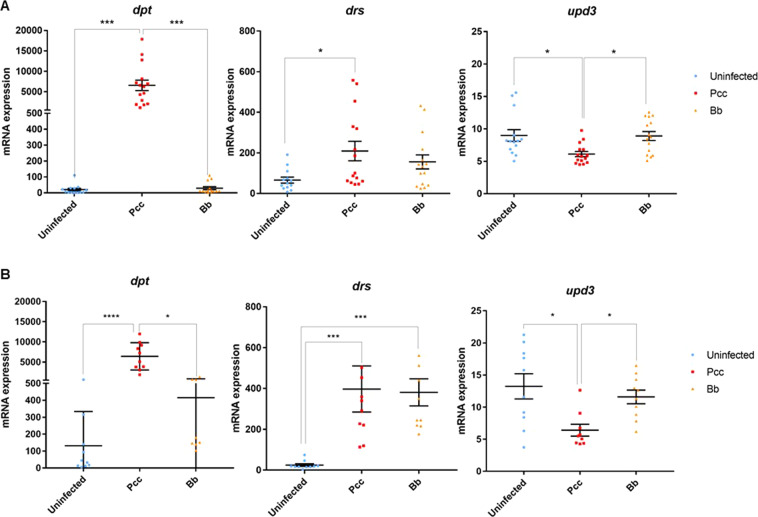
All multicellular organisms are exposed to a diversity of infectious agents and to the emergence and proliferation of malignant cells. The protection conferred by some infections against cancer has been recently linked to the production of acquired immunity effectors such as antibodies. However, the evolution of innate immunity as a mechanism to prevent cancer and how it is jeopardized by infections remain poorly investigated. Here, we explored this question by performing experimental infections in two genetically modified invertebrate models (Drosophila melanogaster) that develop invasive or non-invasive neoplastic brain tumors. After quantifying tumor size and antimicrobial peptide gene expression, we found that Drosophila larvae infected with a naturally occurring bacterium had smaller tumors compared to controls and to fungus-infected larvae. This was associated with the upregulation of genes encoding two antimicrobial peptides-diptericin and drosomycin-that are known to be important mediators of tumor cell death. We further confirmed that tumor regression upon infection was associated with an increase in tumor cell death. Thus, our study suggests that infection could have a protective role through the production of antimicrobial peptides that increase tumor cell death. Finally, our study highlights the need to understand the role of innate immune effectors in the complex interactions between infections and cancer cell communities in order to develop innovative cancer treatment strategies.
所有多细胞生物都面临着多种感染因子的威胁,以及恶性细胞的出现和增殖。最近,一些感染对癌症的保护作用与获得性免疫效应因子(如抗体)的产生有关。然而,先天免疫作为预防癌症的机制的进化以及感染如何危及它,这些问题仍未得到充分研究。在这里,我们通过在两种遗传修饰的无脊椎动物模型(黑腹果蝇)中进行实验性感染来探索这个问题,这两种模型都会发展出侵袭性或非侵袭性的脑瘤。在量化肿瘤大小和抗菌肽基因表达后,我们发现,与对照组和真菌感染的幼虫相比,感染了一种天然细菌的果蝇幼虫的肿瘤更小。这与编码两种抗菌肽(双翅素和果蝇素)的基因的上调有关,这些抗菌肽已知是肿瘤细胞死亡的重要介导物。我们进一步证实,感染后肿瘤的消退与肿瘤细胞死亡的增加有关。因此,我们的研究表明,感染可能通过产生增加肿瘤细胞死亡的抗菌肽来发挥保护作用。最后,我们的研究强调了需要理解先天免疫效应物在感染和癌细胞群落之间复杂相互作用中的作用,以便开发创新的癌症治疗策略。