Jimenez-Mora Mario A, Nieves-Barreto Luz D, Montaño-Rodríguez Angélica, Betancourt-Villamizar Eddy C, Mendivil Carlos O
Universidad de los Andes, School of Medicine, Bogotá, Colombia.
Team Foods, Bogotá, Colombia.
Diabetes Metab Syndr Obes. 2020 Jun 3;13:1887-1898. doi: 10.2147/DMSO.S244761. eCollection 2020.
Latin American countries are experiencing a nutritional and demographic transition that predisposes to the spread of the obesity epidemic, especially among the socially and economically disadvantaged. We aimed to describe the prevalence of obesity, overweight and abdominal obesity and their association with household socioeconomic status (SES) and personal educational level in the five major cities of Colombia (Bogotá, Medellín, Cali, Barranquilla and Bucaramanga).
We collected demographic and anthropometric measurements from a population-based, stratified, multi-stage probability sample of individuals aged 2-75 years. Study surveys and anthropometric measurements were administered by highly trained staff. All reported prevalences are expanded to the target population, taking into account the sampling design.
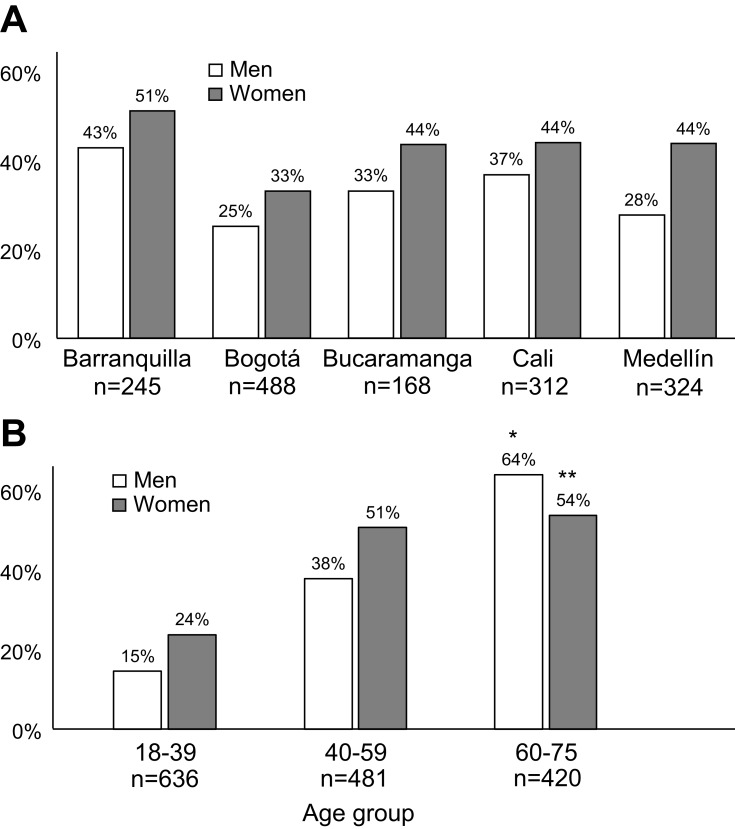
The study sample included 1922 participants. In children and adolescents, the prevalence of overweight and obesity were respectively 23% and 8.8%. Overweight was most prevalent in the 2-4 (30.9%), followed by the 5-11 (23.8%) and the 12-17 age group (17.8%). The combined prevalence of childhood overweight and obesity increased with SES (16.8% in the lowest vs 42.8% in the highest stratum). In adults (18-75 years), the prevalence of excess body weight was 57.5% (36.2% overweight, 21.3% obesity), the prevalence of abdominal obesity was 34.4%, all prevalences increased with age. Obesity was far more prevalent among adult women (29.4%) than men (12.6%) (p˂0.001). Adult obesity and abdominal obesity decreased significantly and monotonically with SES and were most prevalent in individuals with the lowest educational level (35.3% and 50.7%, respectively). Almost 40% of overweight adults had abdominal obesity.
Obesity and abdominal obesity are highly prevalent in the urban population of Colombia, and much more frequent among adults of lower SES and educational level. Excess body weight affected more often children of higher SES. Public health measures are urgently needed to tackle the spread of the obesity epidemic in Colombia and other Latin American countries, with a focus on low-income and low-educational level segments of society.
拉丁美洲国家正经历营养和人口结构转型,这使得肥胖症流行更容易传播,尤其是在社会和经济弱势群体中。我们旨在描述哥伦比亚五个主要城市(波哥大、麦德林、卡利、巴兰基亚和布卡拉曼加)肥胖、超重和腹型肥胖的患病率及其与家庭社会经济地位(SES)和个人教育水平的关联。
我们从一个基于人群的、分层的、多阶段概率抽样的2至75岁个体样本中收集了人口统计学和人体测量数据。研究调查和人体测量由训练有素的工作人员进行。考虑到抽样设计,所有报告的患病率都扩大到目标人群。
研究样本包括1922名参与者。在儿童和青少年中,超重和肥胖的患病率分别为23%和8.8%。超重最常见于2至4岁年龄组(30.9%),其次是5至11岁年龄组(23.8%)和12至17岁年龄组(17.8%)。儿童超重和肥胖的合并患病率随社会经济地位升高而增加(最低阶层为16.8%,最高阶层为42.8%)。在成年人(18至75岁)中,超重患病率为57.5%(超重36.2%,肥胖21.3%),腹型肥胖患病率为34.4%,所有患病率均随年龄增加。成年女性肥胖患病率(29.4%)远高于男性(12.6%)(p˂0.001)。成年肥胖和腹型肥胖随社会经济地位显著且单调下降,在教育水平最低的个体中最为普遍(分别为35.3%和50.7%)。近40%的超重成年人患有腹型肥胖。
肥胖和腹型肥胖在哥伦比亚城市人口中高度流行,在社会经济地位较低和教育水平较低的成年人中更为常见。超重更多地影响社会经济地位较高的儿童。迫切需要采取公共卫生措施来应对哥伦比亚和其他拉丁美洲国家肥胖症流行的蔓延,重点关注社会中的低收入和低教育水平群体。