Zhao Yongsheng, Zheng Renyan, Ning Dong, Xie Fei
Department of Thoracic Surgery, Affiliated Hospital of North Sichuan Medical College, Nanchong 637000, Sichuan.
Department of Integrated Western and Chinese Colorectal and Anal Surgery, Affiliated Hospital of North Sichuan Medical College, Nanchong 637000, Sichuan.
Cancer Manag Res. 2020 Jun 3;12:4171-4180. doi: 10.2147/CMAR.S248251. eCollection 2020.
To investigate the role of miR-625 on the invasion, migration, and epithelial-mesenchymal transition (EMT) of non-small cell lung carcinoma (NSCLC) cells, and the related mechanisms.
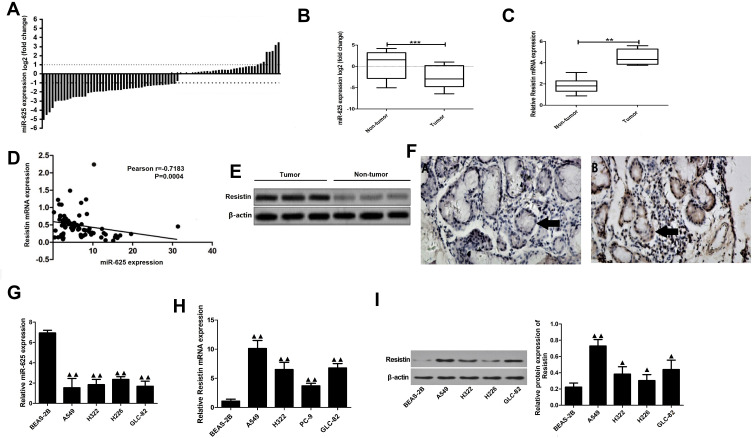
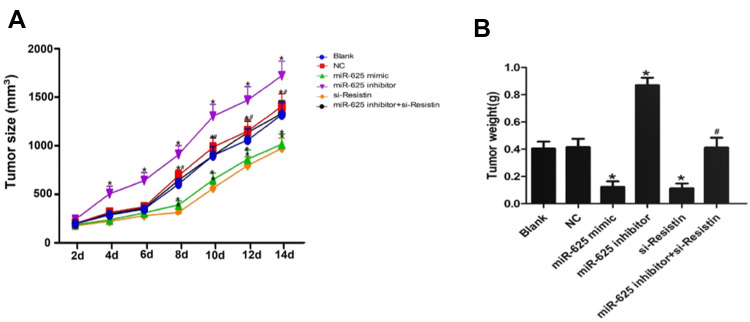
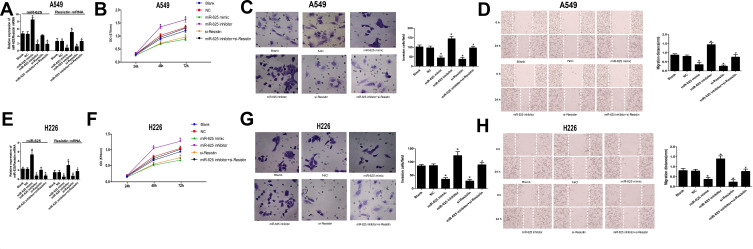
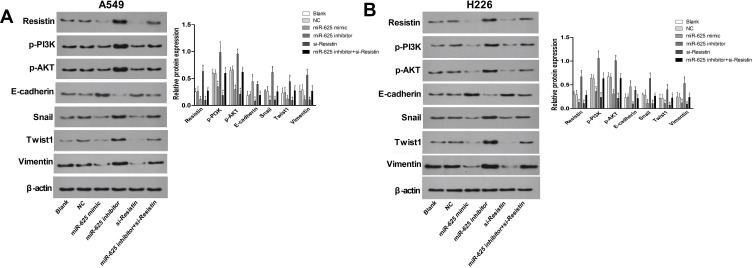
The expression levels of miR-625 and Resistin mRNA in 80 pairs of NSCLC and para-cancerous lung tissues were analyzed by RT-PCR. The relationship between miR-625 and Resistin was predicted by bioinformatics and verified by a dual-luciferase gene reporter assay. NSCLC cells were transfected with Resistin plasmids, si-Resistin plasmids, miR-625 mimics, or miR-625 inhibitors, and proliferation, invasion, and migration were determined by CCK-8, Transwell, and wound scratch assays, respectively. EMT-related proteins were determined by Western blot assay. A xenograft model of NSCLC was established in nude mice to validate the in vitro findings.
MiR-625 was significantly downregulated in NSCLC tissue compared to paired para-cancerous lung tissues, while Resistin was markedly increased in tumor tissue. The expression levels of miR-625 and Resistin were negatively correlated in NSCLC tissues, and high levels of Resistin correlated with greater tumor differentiation, more advanced clinical staging, and lymph node metastasis. Furthermore, Resistin was a target gene of miR-625, and the latter downregulated Resistin to inhibit the EMT, proliferation, invasion, and migration of NSCLC cells in vitro, likely via the PI3K/AKT/Snail signaling pathway. Finally, miR-625 also inhibited the tumorigenic effect of NSCLC cells in vivo by downregulating Resistin.
MiR-625 acts as a tumor suppressor in NSCLC and inhibits tumor cell invasion and metastasis by blocking the Resistin/PI3K/AKT/Snail pathway and by decreasing EMT.
探讨miR-625对非小细胞肺癌(NSCLC)细胞侵袭、迁移及上皮-间质转化(EMT)的作用及其相关机制。
采用RT-PCR分析80对NSCLC组织及癌旁肺组织中miR-625和抵抗素(Resistin)mRNA的表达水平。通过生物信息学预测miR-625与Resistin的关系,并采用双荧光素酶基因报告基因检测进行验证。将Resistin质粒、si-Resistin质粒、miR-625模拟物或miR-625抑制剂转染NSCLC细胞,分别采用CCK-8法、Transwell法和划痕实验检测细胞增殖、侵袭和迁移能力。通过蛋白质印迹法检测EMT相关蛋白。建立NSCLC裸鼠异种移植模型以验证体外实验结果。
与配对的癌旁肺组织相比,NSCLC组织中miR-625显著下调,而肿瘤组织中Resistin明显升高。NSCLC组织中miR-625与Resistin的表达水平呈负相关,Resistin高水平与肿瘤分化程度更高、临床分期更晚及淋巴结转移相关。此外,Resistin是miR-625的靶基因,并可能通过PI3K/AKT/蜗牛(Snail)信号通路,下调Resistin抑制NSCLC细胞体外EMT、增殖、侵袭及迁移。最后,miR-625还通过下调Resistin抑制NSCLC细胞体内致瘤作用。
MiR-625在NSCLC中起抑癌作用,通过阻断Resistin/PI3K/AKT/Snail通路及减少EMT抑制肿瘤细胞侵袭和转移。