Sah Shiv Kumar, Dahal Prastuti, Tamang Gyan Bahadur, Mandal Dipendra Kumar, Shah Rajesh, Pun Sher Bahadur
Purbanchal University, Little Buddha College of Health Science, Kathmandu, Nepal.
Sukraraj Tropical and Infectious Disease Hospital, Teku, Kathmandu, Nepal.
HIV AIDS (Auckl). 2020 Jun 2;12:193-200. doi: 10.2147/HIV.S244618. eCollection 2020.
Anemia is the commonest hematological complications in HIV patients, and has a significant impact on quality of life, morbidity, and mortality. However, little is known about the epidemiology of anemia in this population in a Nepalese setting. Therefore, the present study aimed at assessing the prevalence of anemia in patients living with HIV and further to determine the independent predictors associated with it.
This cross-sectional study was conducted in patients diagnosed with HIV at Sukraraj Tropical and Infectious Disease Hospital, Teku, Kathmandu from November 2016 to August 2017. Anemia was considered a core variable, and covariates used for analysis were age, sex, CD4 count, antiretroviral therapy regimen, history of intravenous drug use, marital status, religion, geography, employment status, hypertension, and diabetes mellitus. Prevalence of anemia and its independent predictors were evaluated. Fisher's exact and tests were performed to determine the significance of differences among categorical variables and -tests for continuous variables. Binary logistic regression was modeled to assess predictors associated with anemia.
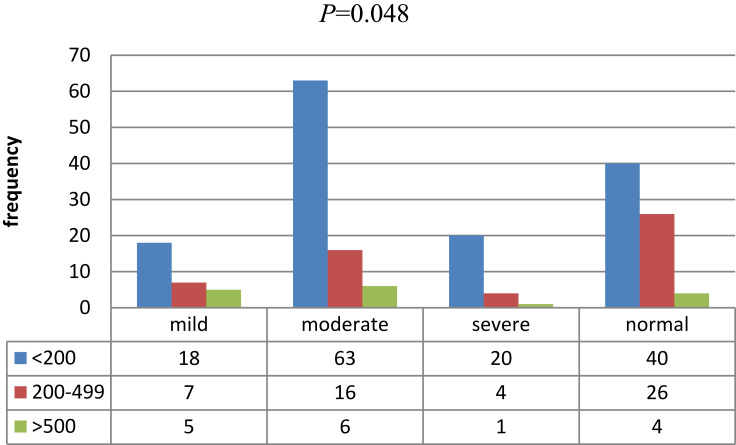
Of the total 210 patients analyzed, median age was 37.50±10.57 years, and 110 (52.6%) were male. The estimated prevalence of anemia overall was 66.7% (95% CI 60.64%-73.35%): mild anemia 14.3% (95% CI 8.25%-19.74%), moderate anemia 40.5% (95% CI 31.88%-48.11%), and severe anemia 11.9% (95% CI 6.61%-17.30%). Prevalence of anemia increased significantly with decreasing CD4 count: 5.71%, 12.85%, and 48.09% among patients with CD4 counts >500, 200-499, and <200 cells/mm, respectively (=0.019). Severity of anemia was significantly associated with immunostatus (<200, 200-499, and >500; =0.048). Female sex was significantly associated with increased odds of anemia (OR 2.27, =0.007).
The present study demonstrated a high rate of anemia in a substantial number of HIV individuals. Therefore, early detection and timely management of anemia, especially in females and those with decreased immunostatus, are crucial to prevent anemia progression and improve quality of life.
贫血是艾滋病患者最常见的血液学并发症,对生活质量、发病率和死亡率有重大影响。然而,在尼泊尔背景下,关于该人群贫血的流行病学情况知之甚少。因此,本研究旨在评估艾滋病患者贫血的患病率,并进一步确定与之相关的独立预测因素。
本横断面研究于2016年11月至2017年8月在加德满都特库的苏克拉拉杰热带病和传染病医院对确诊为艾滋病的患者进行。贫血被视为核心变量,用于分析的协变量包括年龄、性别、CD4细胞计数、抗逆转录病毒治疗方案、静脉吸毒史、婚姻状况、宗教、地理位置、就业状况、高血压和糖尿病。评估贫血的患病率及其独立预测因素。采用Fisher精确检验和卡方检验来确定分类变量之间差异的显著性,对连续变量采用t检验。建立二元逻辑回归模型以评估与贫血相关的预测因素。
在总共分析的210例患者中,中位年龄为37.50±10.57岁,男性110例(52.6%)。总体贫血估计患病率为66.7%(95%可信区间60.64%-73.35%):轻度贫血14.