Méndez-Sánchez Nahum, Valencia-Rodriguez Alejandro, Vera-Barajas Alfonso, Abenavoli Ludovico, Scarpellini Emidio, Ponciano-Rodriguez Guadalupe, Wang David Q-H
Liver Research Unit, Medica Sur Clinic & Foundation, Mexico City 14050, Mexico.
Faculty of Medicine, National Autonomous University of Mexico, Mexico City 04510, Mexico.
Hepatoma Res. 2020;6. doi: 10.20517/2394-5079.2019.29. Epub 2020 Feb 20.
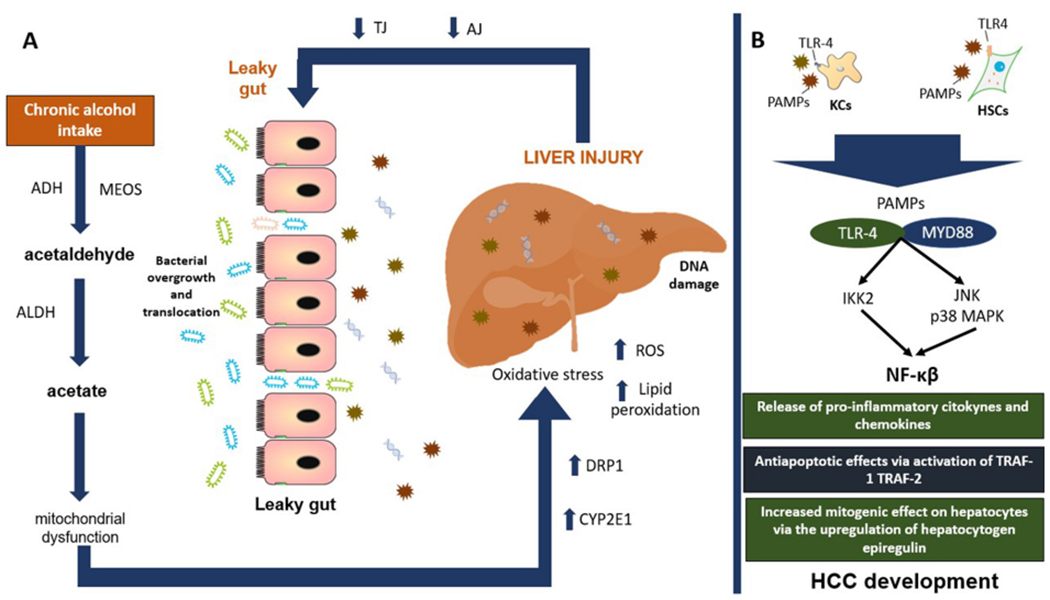
Currently, alcoholic liver disease (ALD) is one of the most prevalent chronic liver diseases worldwide, representing one of the main etiologies of cirrhosis and hepatocellular carcinoma (HCC). Although we do not know the exact mechanisms by which only a selected group of patients with ALD progress to the final stage of HCC, the role of the gut microbiota within the progression to HCC has been intensively studied in recent years. To date, we know that alcohol-induced gut dysbiosis is an important feature of ALD with important repercussions on the severity of this disease. In essence, an increased metabolism of ethanol in the gut induced by an excessive alcohol consumption promotes gut dysfunction and bacterial overgrowth, setting a leaky gut. This causes the translocation of bacteria, endotoxins, and ethanol metabolites across the enterohepatic circulation reaching the liver, where the recognition of the pathogen-associated molecular patterns via specific Toll-like receptors of liver cells will induce the activation of the nuclear factor kappa-B pathway, which releases pro-inflammatory cytokines and chemokines. In addition, the mitogenic activity of hepatocytes will be promoted and cellular apoptosis will be inhibited, resulting in the development of HCC. In this context, it is not surprising that microbiota-regulating drugs have proven effectiveness in prolonging the overall survival of patients with HCC, making attractive the implementation of these drugs as co-adjuvant for HCC treatment.
目前,酒精性肝病(ALD)是全球最常见的慢性肝病之一,是肝硬化和肝细胞癌(HCC)的主要病因之一。尽管我们尚不清楚为何只有部分ALD患者会发展至HCC终末期的确切机制,但近年来肠道微生物群在HCC进展中的作用已得到深入研究。迄今为止,我们知道酒精诱导的肠道生态失调是ALD的一个重要特征,对该疾病的严重程度有重要影响。本质上,过量饮酒导致肠道内乙醇代谢增加,促进肠道功能障碍和细菌过度生长,形成肠漏。这会导致细菌、内毒素和乙醇代谢产物通过肠肝循环转移至肝脏,在肝脏中,肝细胞通过特定的Toll样受体识别病原体相关分子模式,进而激活核因子κB通路,释放促炎细胞因子和趋化因子。此外,还会促进肝细胞的有丝分裂活性并抑制细胞凋亡,从而导致HCC的发生。在这种情况下,微生物群调节药物已被证明可有效延长HCC患者的总生存期,因此将这些药物用作HCC治疗的辅助药物具有吸引力也就不足为奇了。