Department of Public Health, Institute of Tropical Medicine, Antwerpen, Belgium
Center for Research on Population and Health, American University of Beirut Faculty of Health Sciences, Beirut, Lebanon.
BMJ Glob Health. 2020 Jun;5(6). doi: 10.1136/bmjgh-2020-002967.
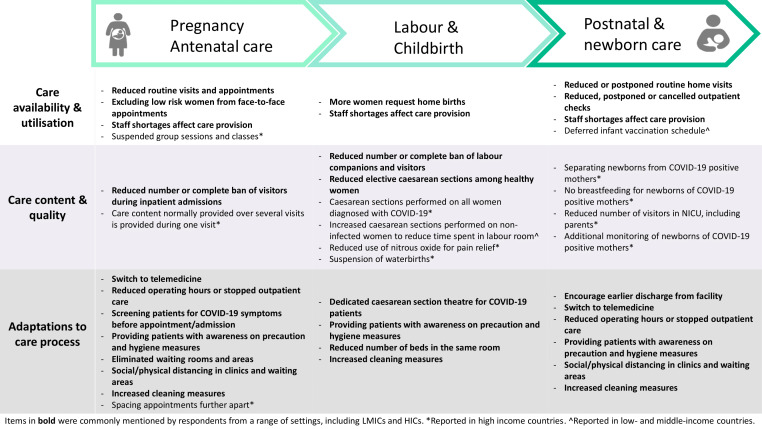
The COVID-19 pandemic has substantially impacted maternity care provision worldwide. Studies based on modelling estimated large indirect effects of the pandemic on services and health outcomes. The objective of this study was to prospectively document experiences of frontline maternal and newborn healthcare providers.
We conducted a global, cross-sectional study of maternal and newborn health professionals via an online survey disseminated through professional networks and social media in 12 languages. Information was collected between 24 March and 10 April 2020 on respondents' background, preparedness for and response to COVID-19 and their experience during the pandemic. An optional module sought information on adaptations to 17 care processes. Descriptive statistics and qualitative thematic analysis were used to analyse responses, disaggregating by low-income and middle-income countries (LMICs) and high-income countries (HICs).
We analysed responses from 714 maternal and newborn health professionals. Only one-third received training on COVID-19 from their health facility and nearly all searched for information themselves. Half of respondents in LMICs received updated guidelines for care provision compared with 82% in HICs. Overall, 47% of participants in LMICs and 69% in HICs felt mostly or completely knowledgeable in how to care for COVID-19 maternity patients. Facility-level responses to COVID-19 (signage, screening, testing and isolation rooms) were more common in HICs than LMICs. Globally, 90% of respondents reported somewhat or substantially higher levels of stress. There was a widespread perception of reduced use of routine maternity care services, and of modification in care processes, some of which were not evidence-based practices.
Substantial knowledge gaps exist in guidance on management of maternity cases with or without COVID-19. Formal information-sharing channels for providers must be established and mental health support provided. Surveys of maternity care providers can help track the situation, capture innovations and support rapid development of effective responses.
COVID-19 大流行对全球的产妇保健服务产生了重大影响。基于模型的研究估计大流行对服务和健康结果产生了大量间接影响。本研究的目的是前瞻性地记录一线孕产妇和新生儿保健提供者的经验。
我们通过在线调查,用 12 种语言通过专业网络和社交媒体向孕产妇和新生儿健康专业人员进行了全球跨部门研究。于 2020 年 3 月 24 日至 4 月 10 日之间收集了受访者对 COVID-19 的背景、准备情况和应对情况以及大流行期间的经验的信息。一个可选模块寻求了 17 个护理过程适应情况的信息。使用描述性统计和定性主题分析对答复进行了分析,并按低收入和中等收入国家(LMICs)和高收入国家(HICs)进行了分类。
我们分析了 714 名孕产妇和新生儿保健专业人员的答复。只有三分之一的人从他们的医疗机构接受过 COVID-19 培训,几乎所有人都是自己搜索信息。与 HICs 中的 82%相比,LMICs 中约有一半的受访者收到了提供护理的最新指南。总体而言,47%的 LMIC 参与者和 69%的 HIC 参与者表示,他们在照顾 COVID-19 产妇方面或多或少地完全了解。HIC 中比 LMIC 中更常见针对 COVID-19 的设施级应对措施(标识,筛查,测试和隔离室)。全球范围内,90%的受访者报告称压力水平有所或大大增加。人们普遍认为常规产妇保健服务的使用减少了,并且护理过程发生了变化,其中一些并非基于证据的实践。
关于管理有无 COVID-19 的产妇病例的指南存在很大的知识差距。必须为提供者建立正式的信息共享渠道,并提供心理健康支持。对产妇保健提供者的调查可以帮助跟踪情况,捕捉创新并支持快速制定有效的应对措施。