Xue Ai-Juan, Miao Shi-Jian, Sun Hua, Qiu Xiao-Xia, Wang Sheng-Nan, Wang Lin, Ye Zi-Qing, Zheng Cui-Fang, Huang Zhi-Heng, Wang Yu-Huan, Huang Ying
Department of Gastroenterology, Children's Hospital of Fudan University, Shanghai 201102, China.
World J Gastroenterol. 2020 Jun 14;26(22):3098-3109. doi: 10.3748/wjg.v26.i22.3098.
Several studies have employed animal models to explore the association between microbiota and interleukin (IL) 10 signaling; however, limited information is available about the human microbiome.
To characterize the microbiome in patients with mutations and to explore the association between gut dysbiosis and disease severity.
Fecal samples were collected from patients who were diagnosed with loss-of-function mutations in the gene between January 2017 and July 2018 at the Children's Hospital of Fudan University. Age-matched volunteer children were recruited as healthy controls. Patients with Crohn's disease (CD) were used as disease controls to standardize the antibiotic exposure. Microbial DNA was extracted from the fecal samples. All analyses were based on the 16S rRNA gene sequencing data.
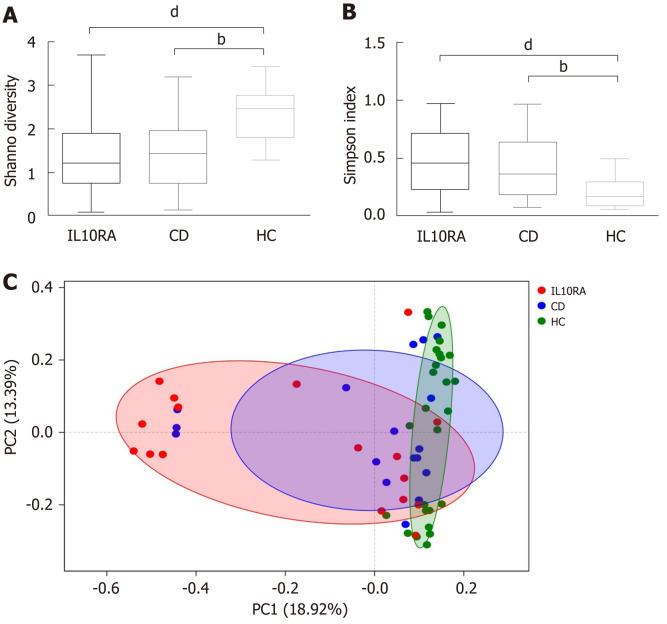
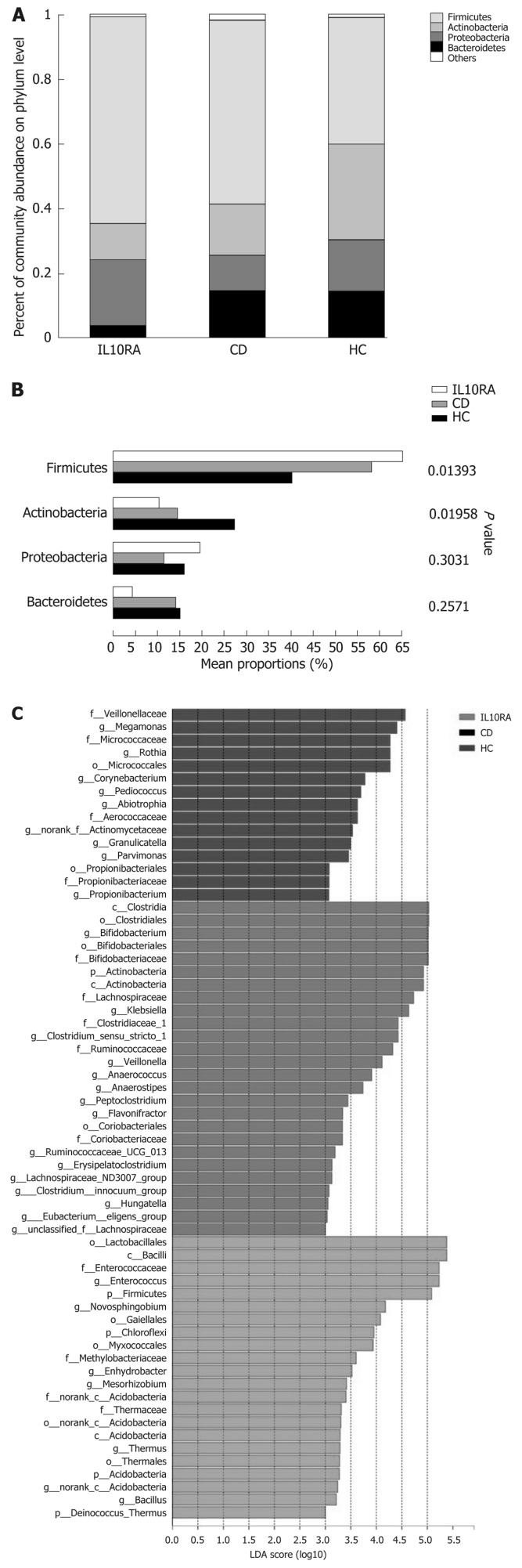
Seventeen patients with mutations (IL10RA group), 17 patients with pediatric CD, and 26 healthy children were included. Both patients with mutations and those with CD exhibited a reduced diversity of gut microbiome with increased variability. The relative abundance of was substantially increased in the IL10RA group ( 0.02). On further comparison of the relative abundance of taxa between patients with mutations and healthy children, 13 taxa showed significant differences. The IL10RA-specific dysbiosis indices exhibited a significant positive correlation with weighted pediatric CD activity index and simple endoscopic score for CD.
In patients with mutations and early onset inflammatory bowel disease, gut dysbiosis shows a moderate association with disease severity.
多项研究已采用动物模型来探索微生物群与白细胞介素(IL)-10信号传导之间的关联;然而,关于人类微生物组的信息有限。
对患有[基因名称]突变的患者的微生物组进行特征分析,并探讨肠道生态失调与疾病严重程度之间的关联。
于2017年1月至2018年7月在复旦大学附属儿科医院收集被诊断为[基因名称]功能丧失突变的患者的粪便样本。招募年龄匹配的志愿者儿童作为健康对照。将克罗恩病(CD)患者用作疾病对照以标准化抗生素暴露情况。从粪便样本中提取微生物DNA。所有分析均基于16S rRNA基因测序数据。
纳入了17例患有[基因名称]突变的患者(IL10RA组)、17例儿科CD患者和26名健康儿童。患有[基因名称]突变的患者和CD患者均表现出肠道微生物组多样性降低且变异性增加。[具体菌属名称]的相对丰度在IL10RA组中显著增加([具体数值]0.02)。在进一步比较患有[基因名称]突变的患者与健康儿童之间的分类群相对丰度时,有13个分类群显示出显著差异。IL10RA特异性生态失调指数与儿童CD加权活动指数和CD简单内镜评分呈显著正相关。
在患有[基因名称]突变和早发性炎症性肠病的患者中,肠道生态失调与疾病严重程度呈中度关联。