School of Public Health, Shanghai University of Traditional Chinese Medicine, 201203, China.
J Diabetes Res. 2020 Jun 7;2020:7261047. doi: 10.1155/2020/7261047. eCollection 2020.
This study is aimed at developing a risk nomogram of diabetic retinopathy (DR) in a Chinese population with type 2 diabetes mellitus (T2DM).
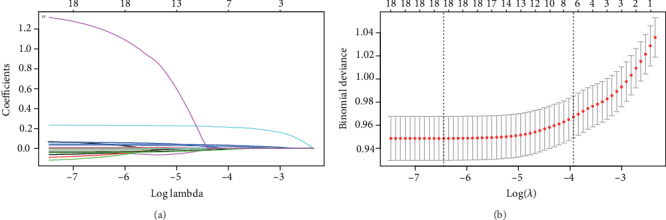
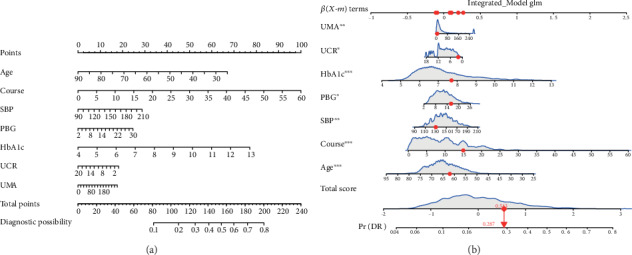
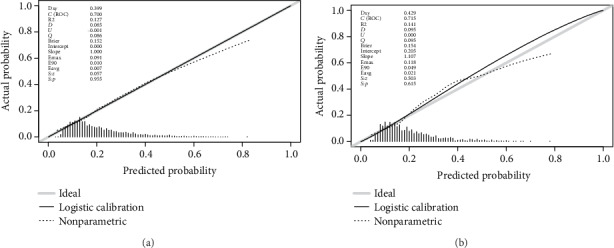
A questionnaire survey, biochemical indicator examination, and physical examination were performed on 4170 T2DM patients, and the collected data were used to evaluate the DR risk in T2DM patients. By operating R software, firstly, the least absolute shrinkage and selection operator (LASSO) regression analysis was used to optimize variable selection by running cyclic coordinate descent with 10 times cross-validation. Secondly, multivariable logistic regression analysis was applied to build a predicting model introducing the predictors selected from the LASSO regression analysis. The nomogram was developed based on the selected variables visually. Thirdly, calibration plot, receiver operating characteristic (ROC) curve, and decision curve analysis were used to validate the model, and further assessment was running by external validation.
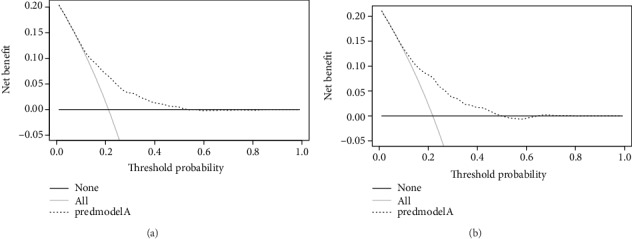
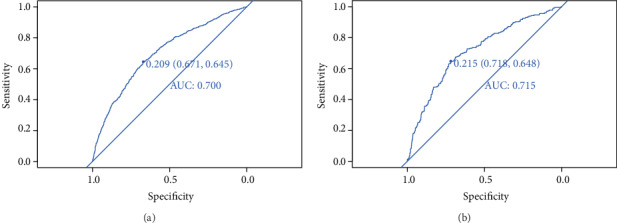
Seven predictors were selected by LASSO from 19 variables, including age, course of disease, postprandial blood glucose (PBG), glycosylated haemoglobin A1c (HbA1c), uric creatinine (UCR), urinary microalbumin (UMA), and systolic blood pressure (SBP). The model built by these 7 predictors displayed medium prediction ability with the area under the ROC curve of 0.700 in the training set and 0.715 in the validation set. The decision curve analysis curve showed that the nomogram could be applied clinically if the risk threshold is between 21% and 57% and 21%-51% in external validation.
Introducing age, course of disease, PBG, HbA1c, UCR, UMA, and SBP, the risk nomogram is useful for prediction of DR risk in T2DM individuals.
本研究旨在建立一个中国 2 型糖尿病患者糖尿病视网膜病变(DR)风险诺模图。
对 4170 例 2 型糖尿病患者进行问卷调查、生化指标检查和体格检查,收集的数据用于评估 2 型糖尿病患者的 DR 风险。首先,通过 R 软件,运用最小绝对收缩和选择算子(LASSO)回归分析,通过 10 次交叉验证运行循环坐标下降法,进行变量选择的最优化。其次,应用多变量逻辑回归分析,引入 LASSO 回归分析中选择的预测因子,建立预测模型。根据所选变量,通过视觉方法开发诺模图。然后,通过校准图、接受者操作特征(ROC)曲线和决策曲线分析来验证模型,并进行外部验证。
LASSO 从 19 个变量中选择了 7 个预测因子,包括年龄、病程、餐后血糖(PBG)、糖化血红蛋白 A1c(HbA1c)、尿酸肌酐(UCR)、尿微量白蛋白(UMA)和收缩压(SBP)。该模型在训练集和验证集的 ROC 曲线下面积分别为 0.700 和 0.715,具有中等预测能力。决策曲线分析曲线表明,在外部验证中,如果风险阈值在 21%-57%和 21%-51%之间,该诺模图可在临床上应用。
引入年龄、病程、PBG、HbA1c、UCR、UMA 和 SBP,风险诺模图可用于预测 2 型糖尿病患者的 DR 风险。