Singapore Eye Research Institute and Singapore National Eye Centre, Singapore, Singapore.
Department of Ophthalmology, The First Affiliated Hospital of China Medical University, Shenyang, China.
PLoS One. 2020 Mar 5;15(3):e0229665. doi: 10.1371/journal.pone.0229665. eCollection 2020.
Clinical trials have shown beneficial effects of blood pressure (BP) control in reducing the risk of diabetic retinopathy (DR). However, association between BP control and DR in population-based studies is not clear. We aimed to examine the association of hypertension and BP control with DR.
We analysed data from a population-based cross-sectional study of Chinese, Malay and Indians adults with diabetes and hypertension (2004-2011, n = 2189, aged 40-80 years) in Singapore. DR severity was assessed from retinal photographs and graded for any- and vision-threatening DR (VTDR) using the modified Airlie House classification. Hypertension status was classified into (1) good control: on treatment (SBP < 130 and DBP < 80 mm Hg), (2) moderate control: on treatment, with BP levels other than group 1 and 3, (3) poor control: on treatment (SBP ≥140 and DBP ≥ 90 mm Hg), (4) untreated hypertension, any BP level. SBP, DBP and pulse pressure (PP) were analyzed as categories and as continuous variables. The association between BP and DR was assessed using multivariable logistic regression models.
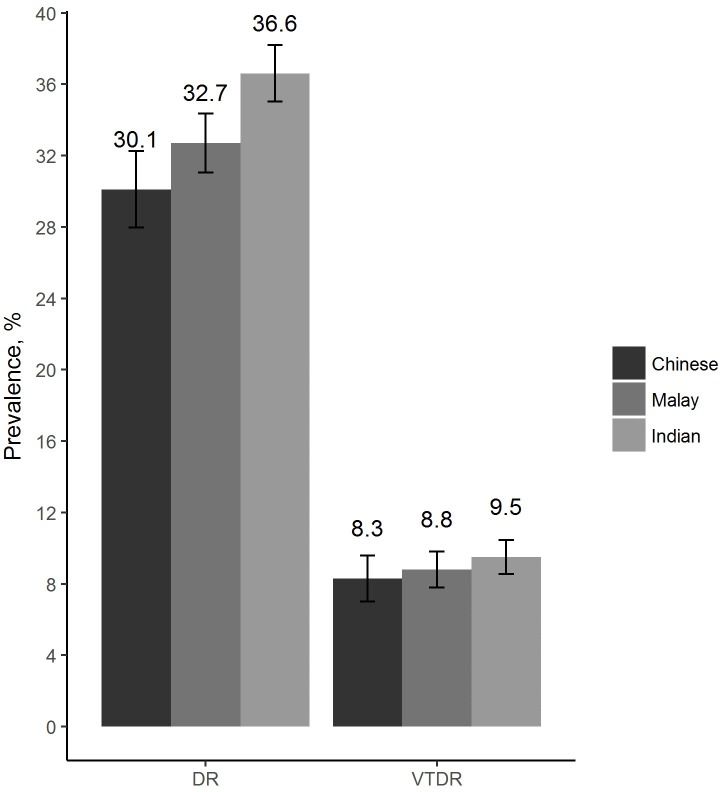
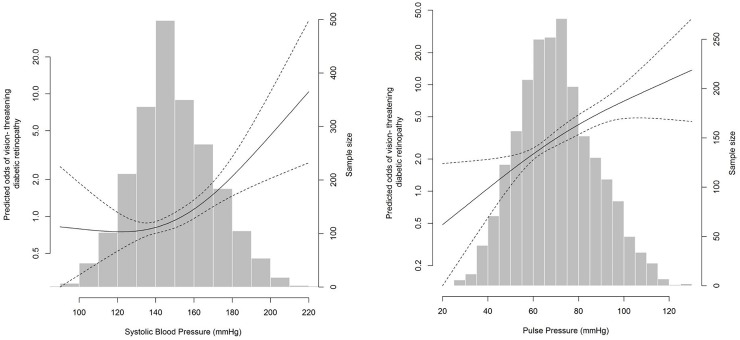
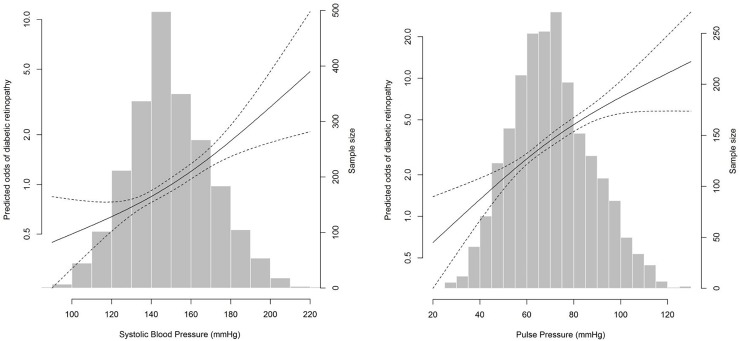
The prevalence of any-DR and VTDR in the study population was 33.8% and 9.0% respectively. Both poorly controlled and untreated hypertension were significantly associated with any-DR with odds ratio (OR) (95% confidence interval [CI]) of 1.97 (1.39-2.83), and 2.01 [1.34-3.05]. Among BP components, SBP and PP were associated with both any-DR and VTDR with OR (95% CI) of 1.45 (1.28-1.65) and 1.61 (1.41-1.84) for any-DR, and 1.44 (1.19-1.76) and 1.67 (1.37-2.06) for VTDR.
In a population-based sample of Asian adults with diabetes and hypertension, treated but poorly controlled as well as untreated hypertension were significantly associated with any-DR. Among the BP components, higher SBP and PP levels were associated with both any-DR and VTDR. Further longitudinal studies are necessary to confirm our findings.
临床试验表明,控制血压(BP)可降低糖尿病视网膜病变(DR)的风险。然而,基于人群的研究中 BP 控制与 DR 之间的关联尚不清楚。我们旨在研究高血压和 BP 控制与 DR 的关系。
我们分析了新加坡 2004-2011 年进行的一项基于人群的糖尿病和高血压的华裔、马来裔和印度裔成年人的横断面研究数据(n=2189,年龄 40-80 岁)。使用改良的 Airlie House 分类法,从视网膜照片评估 DR 严重程度,并对任何和威胁视力的 DR(VTDR)进行分级。高血压状态分为(1)良好控制:治疗中(SBP<130mmHg 和 DBP<80mmHg),(2)中度控制:治疗中,BP 水平不在第 1 组和第 3 组,(3)差的控制:治疗中(SBP≥140mmHg 和 DBP≥90mmHg),(4)未治疗的高血压,任何 BP 水平。SBP、DBP 和脉压(PP)被分析为类别和连续变量。使用多变量逻辑回归模型评估 BP 与 DR 之间的关系。
研究人群中任何-DR 和 VTDR 的患病率分别为 33.8%和 9.0%。未控制的高血压和未治疗的高血压均与任何-DR 显著相关,比值比(OR)(95%置信区间[CI])为 1.97(1.39-2.83)和 2.01 [1.34-3.05]。在 BP 成分中,SBP 和 PP 与任何-DR 和 VTDR 均相关,OR(95%CI)为 1.45(1.28-1.65)和 1.61(1.41-1.84)用于任何-DR,和 1.44(1.19-1.76)和 1.67(1.37-2.06)用于 VTDR。
在亚洲糖尿病和高血压成年人的基于人群的样本中,治疗但控制不佳的高血压以及未治疗的高血压与任何-DR 显著相关。在 BP 成分中,较高的 SBP 和 PP 水平与任何-DR 和 VTDR 均相关。需要进一步的纵向研究来证实我们的发现。