Kavli Institute for Systems Neuroscience, Centre for Neural Computation, The Egil and Pauline Braathen and Fred Kavli Centre for Cortical Microcircuits, NTNU, Trondheim, Norway.
Max Planck Institute for Human Cognitive and Brain Sciences, Leipzig, Germany.
Nat Commun. 2020 Jun 26;11(1):3247. doi: 10.1038/s41467-020-17000-2.
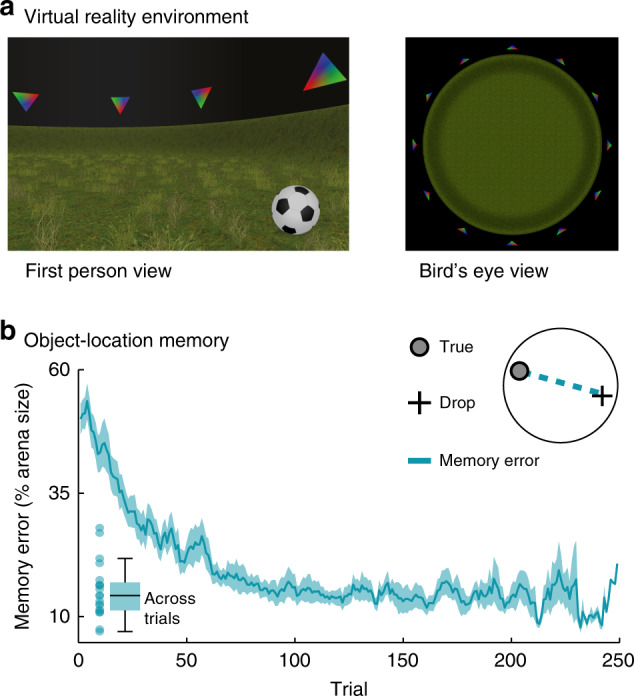
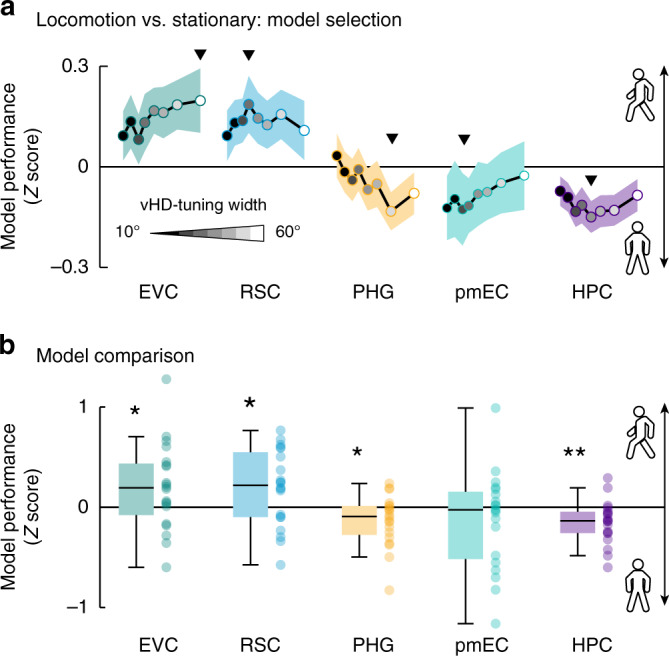
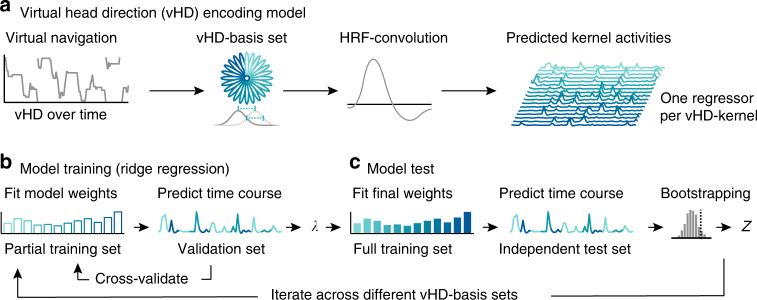
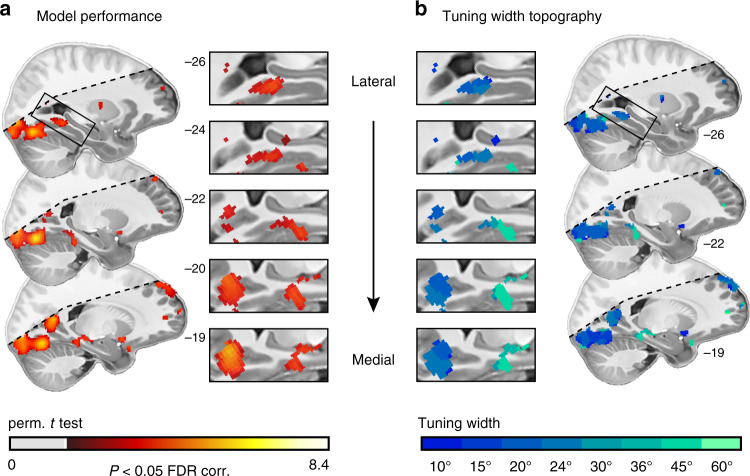
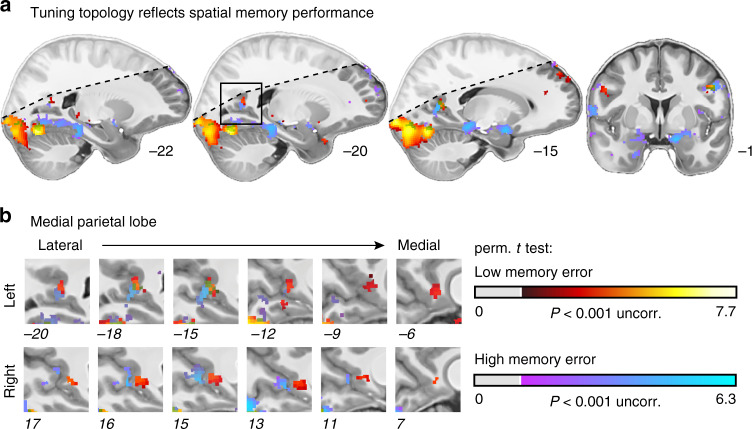
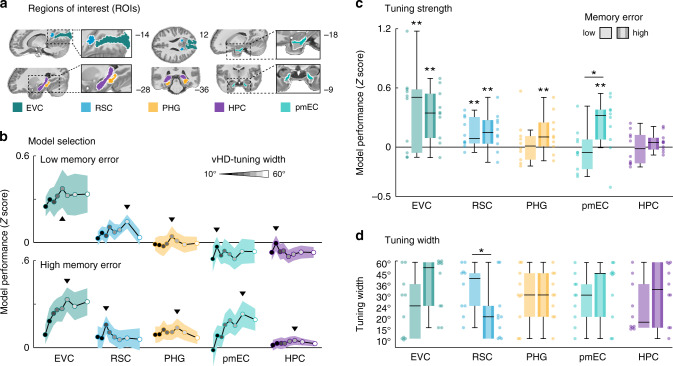
The brain derives cognitive maps from sensory experience that guide memory formation and behavior. Despite extensive efforts, it still remains unclear how the underlying population activity unfolds during spatial navigation and how it relates to memory performance. To examine these processes, we combined 7T-fMRI with a kernel-based encoding model of virtual navigation to map world-centered directional tuning across the human cortex. First, we present an in-depth analysis of directional tuning in visual, retrosplenial, parahippocampal and medial temporal cortices. Second, we show that tuning strength, width and topology of this directional code during memory-guided navigation depend on successful encoding of the environment. Finally, we show that participants' locomotory state influences this tuning in sensory and mnemonic regions such as the hippocampus. We demonstrate a direct link between neural population tuning and human cognition, where high-level memory processing interacts with network-wide visuospatial coding in the service of behavior.
大脑从感官经验中获得认知地图,指导记忆形成和行为。尽管付出了广泛的努力,但仍不清楚在空间导航过程中底层群体活动是如何展开的,以及它与记忆表现有何关系。为了研究这些过程,我们将 7T-fMRI 与基于核的虚拟导航编码模型相结合,以绘制人类大脑皮层中以世界为中心的方向调谐图。首先,我们对视觉、后扣带回、海马旁回和内侧颞叶皮层中的方向调谐进行了深入分析。其次,我们表明,在记忆引导导航过程中,这种方向编码的调谐强度、宽度和拓扑结构取决于环境的成功编码。最后,我们表明,参与者的运动状态会影响海马等感觉和记忆区域的这种调谐。我们证明了神经群体调谐与人类认知之间的直接联系,其中高级记忆处理与网络范围的视觉空间编码相互作用,以服务于行为。