University of Minnesota School of Public Health, Division of Epidemiology and Community Health, Minneapolis, Minnesota, USA.
Minnesota Department of Health, Infectious Disease Epidemiology, Prevention and Control, St. Paul, Minnesota, USA.
Epidemiol Infect. 2020 Jun 29;148:e156. doi: 10.1017/S0950268820001417.
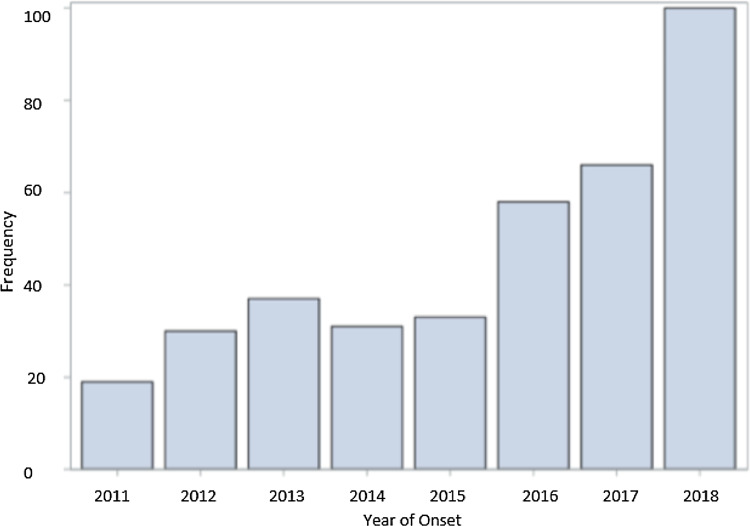
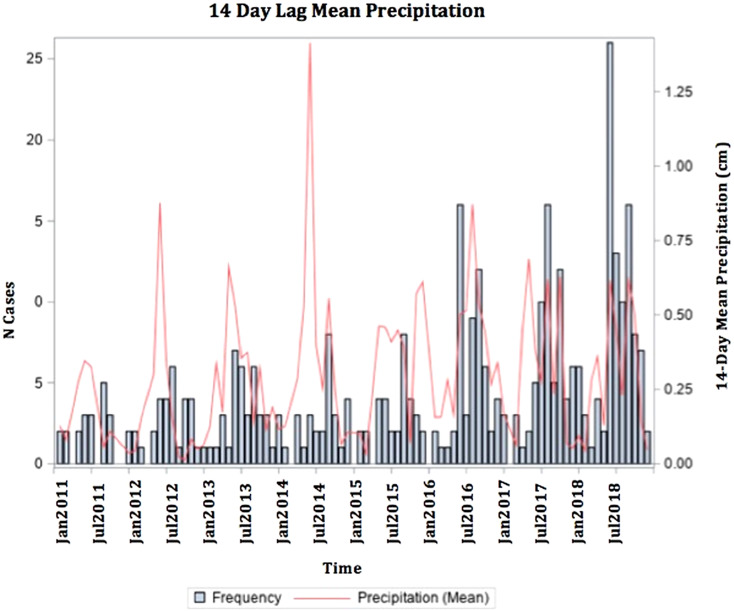
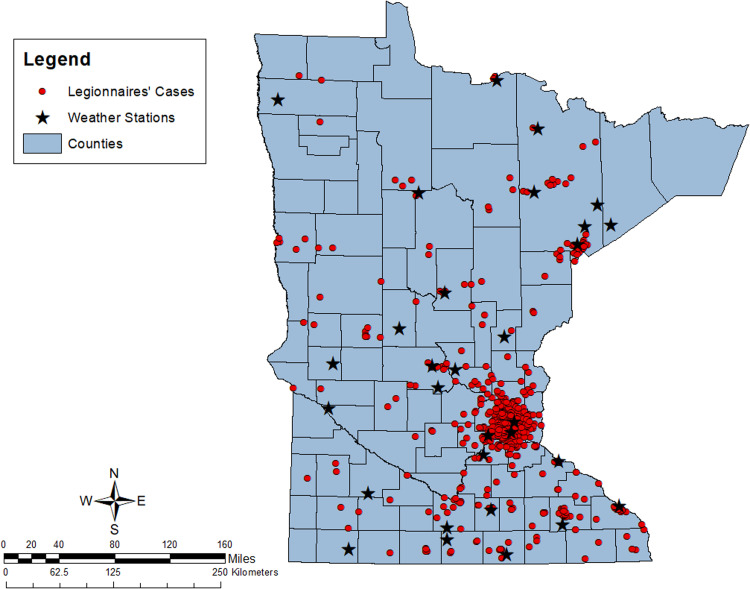
From 2011 through 2018, there was a notable increase in sporadic Legionnaires' disease in the state of Minnesota. Sporadic cases are those not associated with a documented outbreak. Outbreak-related cases are typically associated with a common identified contaminated water system; sporadic cases typically do not have a common source that has been identified. Because of this, it is hypothesised that weather and environmental factors can be used as predictors of sporadic Legionnaires' disease. An ecological design was used with case report surveillance data from the state of Minnesota during 2011 through 2018. Over this 8-year period, there were 374 confirmed Legionnaires' disease cases included in the analysis. Precipitation, temperature and relative humidity (RH) data were collected from weather stations across the state. A Poisson regression analysis examined the risk of Legionnaires' disease associated with precipitation, temperature, RH, land-use and age. A lagged average 14-day precipitation had the strongest association with Legionnaires' disease (RR 2.5, CI 2.1-2.9), when accounting for temperature, RH, land-use and age. Temperature, RH and land-use also had statistically significant associations to Legionnaires' disease, but with smaller risk ratios. This study adds to the body of evidence that weather and environmental factors play an important role in the risk of sporadic Legionnaires' disease. This is an area that can be used to target additional research and prevention strategies.
从 2011 年到 2018 年,明尼苏达州的散发性军团病显著增加。散发性病例是指与已记录的疫情无关的病例。与疫情相关的病例通常与一个共同确定的受污染的水系统有关;散发性病例通常没有确定的共同来源。正因为如此,人们假设天气和环境因素可以作为散发性军团病的预测指标。采用生态设计,对 2011 年至 2018 年明尼苏达州的病例报告监测数据进行了分析。在这 8 年期间,共有 374 例确诊的军团病病例纳入分析。降水、温度和相对湿度(RH)数据是从全州各地的气象站收集的。泊松回归分析检查了与降水、温度、RH、土地利用和年龄相关的军团病风险。在考虑温度、RH、土地利用和年龄的情况下,滞后平均 14 天的降水量与军团病的相关性最强(RR2.5,CI2.1-2.9)。温度、RH 和土地利用也与军团病有统计学上的显著关联,但风险比较小。这项研究增加了证据表明,天气和环境因素在散发性军团病的风险中起着重要作用。这是一个可以用来确定额外研究和预防策略的领域。