Hong Xiaoyu, Zhong Xiaofang, Du Guangsheng, Hou Yingying, Zhang Yunting, Zhang Zhirong, Gong Tao, Zhang Ling, Sun Xun
Key Laboratory of Drug Targeting and Drug Delivery System of the Education Ministry and Sichuan Province, West China School of Pharmacy, Sichuan University, Chengdu 610041, China.
College of Polymer Science and Engineering, Sichuan University, Chengdu 610065, China.
Sci Adv. 2020 Jun 19;6(25):eaaz4462. doi: 10.1126/sciadv.aaz4462. eCollection 2020 Jun.
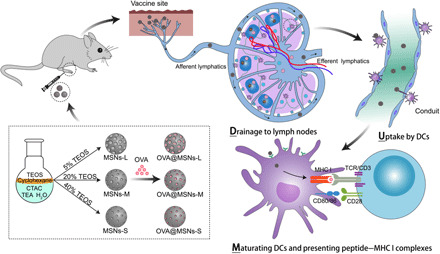
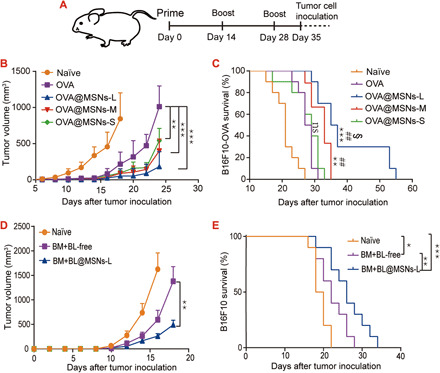
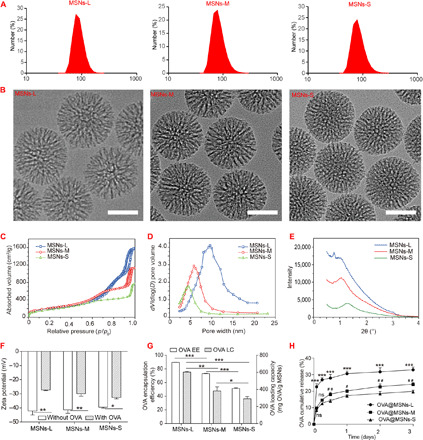
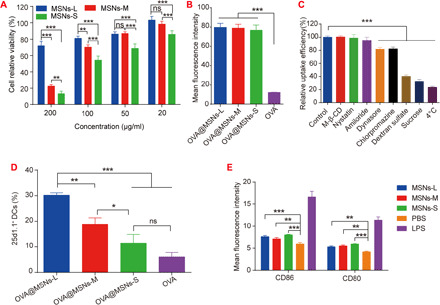
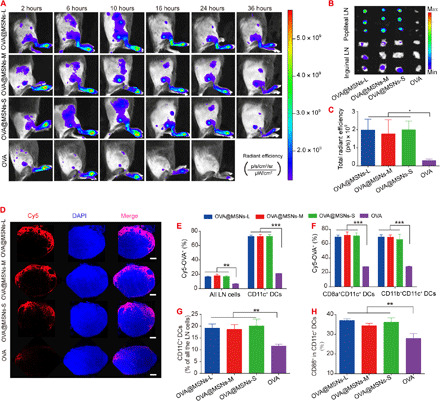
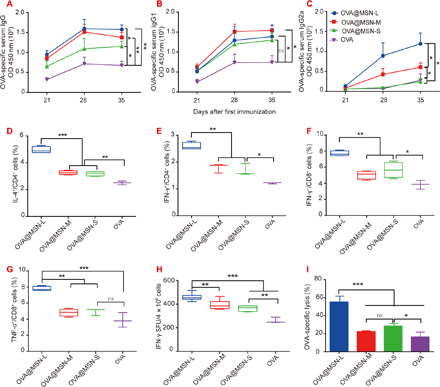
Subunit vaccines generally proceed through a 4-step in vivo cascade-the DUMP cascade-to generate potent cell-mediated immune responses: (1) drainage to lymph nodes; (2) uptake by dendritic cells (DCs); (3) maturation of DCs; and (4) Presentation of peptide-MHC I complexes to CD8 T cells. How the physical properties of vaccine carriers such as mesoporous silica nanoparticles (MSNs) influence this cascade is unclear. We fabricated 80-nm MSNs with different pore sizes (7.8 nm, 10.3 nm, and 12.9 nm) and loaded them with ovalbumin antigen. Results demonstrated these MSNs with different pore sizes were equally effective in the first three steps of the DUMP cascade, but those with larger pores showed higher cross-presentation efficiency (step 4). Consistently, large-pore MSNs loaded with B16F10 tumor antigens yielded the strongest antitumor effects. These results demonstrate the promise of our lymph node-targeting large-pore MSNs as vaccine-delivery vehicles for immune activation and cancer vaccination.
亚单位疫苗通常通过一个4步体内级联反应——即DUMP级联反应——来产生有效的细胞介导免疫反应:(1)引流至淋巴结;(2)被树突状细胞(DCs)摄取;(3)DCs成熟;以及(4)向CD8 T细胞呈递肽-MHC I复合物。疫苗载体(如介孔二氧化硅纳米颗粒(MSNs))的物理性质如何影响这一级联反应尚不清楚。我们制备了具有不同孔径(7.8 nm、10.3 nm和12.9 nm)的80 nm MSNs,并将卵清蛋白抗原负载于其中。结果表明,这些不同孔径的MSNs在DUMP级联反应的前三个步骤中同样有效,但孔径较大的MSNs显示出更高的交叉呈递效率(第四步)。同样,负载B16F10肿瘤抗原的大孔径MSNs产生了最强的抗肿瘤效果。这些结果证明了我们的淋巴结靶向大孔径MSNs作为免疫激活和癌症疫苗接种的疫苗递送载体的前景。