Shie Ming-You, Fang Hsin-Yuan, Lin Yen-Hong, Lee Alvin Kai-Xing, Yu Joyce, Chen Yi-Wen
School of Dentistry, China Medical University, Taichung City, Taiwan.
Three-dimensional Printing Medical Research Center, China Medical University Hospital, Taichung, Taiwan.
Int J Bioprint. 2019 Jul 5;5(2.1):210. doi: 10.18063/ijb.v5i2.1.210. eCollection 2019.
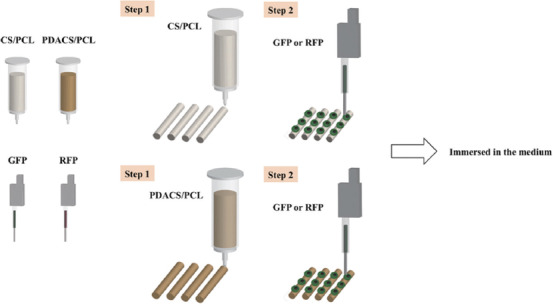
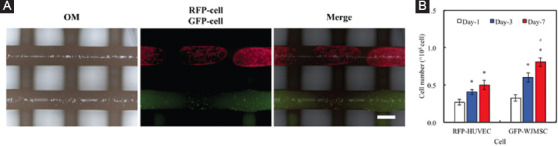
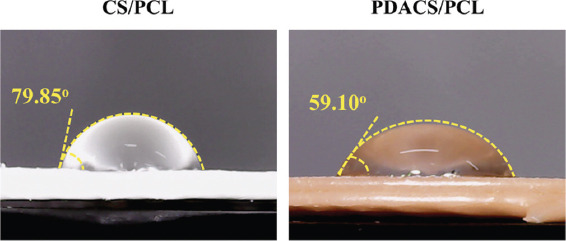
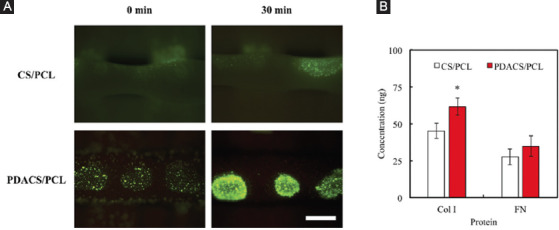
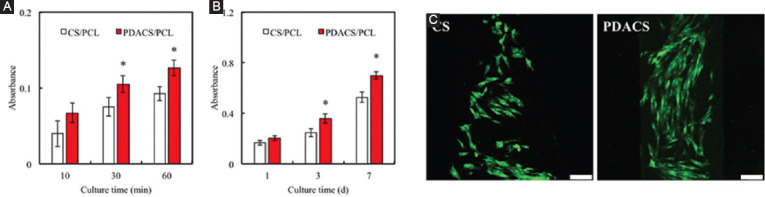
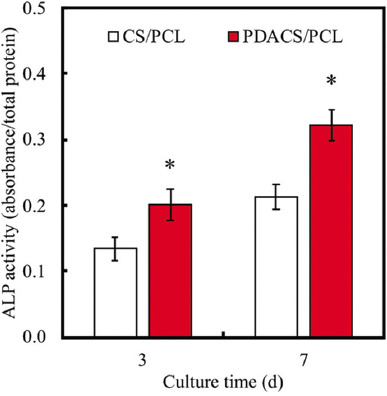
In recent years, the additive manufacture was popularly used in tissue engineering, as the various technologies for this field of research can be used. The most common method is extrusion, which is commonly used in many bioprinting applications, such as skin. In this study, we combined the two printing techniques; first, we use the extrusion technology to form the ceramic scaffold. Then, the stem cells were printed directly on the surface of the ceramic scaffold through a piezoelectric nozzle. We also evaluated the effects of polydopamine (PDA)-coated ceramic scaffolds for cell attachment after printing on the surface of the scaffold. In addition, we used fluorescein isothiocyanate to simulate the cell adhered on the scaffold surface after ejected by a piezoelectric nozzle. Finally, the attachment, growth, and differentiation behaviors of stem cell after printing on calcium silicate/polycaprolactone (CS/PCL) and PDACS/PCL surfaces were also evaluated. The PDACS/PCL scaffold is more hydrophilic than the original CS/PCL scaffold that provided for better cellular adhesion and proliferation. Moreover, the cell printing technology using the piezoelectric nozzle, the different cells can be accurately printed on the surface of the scaffold that provided and analyzed more information of the interaction between different cells on the material. We believe that this method may serve as a useful and effective approach for the regeneration of defective complex hard tissues in deep bone structures.
近年来,增材制造在组织工程中得到广泛应用,因为该研究领域的各种技术均可使用。最常见的方法是挤出,它常用于许多生物打印应用中,如皮肤打印。在本研究中,我们结合了两种打印技术;首先,我们使用挤出技术形成陶瓷支架。然后,通过压电喷嘴将干细胞直接打印在陶瓷支架表面。我们还评估了聚多巴胺(PDA)涂层陶瓷支架在打印后对细胞附着在支架表面的影响。此外,我们使用异硫氰酸荧光素来模拟通过压电喷嘴喷出后附着在支架表面的细胞。最后,还评估了干细胞在硅酸钙/聚己内酯(CS/PCL)和PDACS/PCL表面打印后的附着、生长和分化行为。PDACS/PCL支架比原始的CS/PCL支架更亲水,能提供更好的细胞黏附和增殖效果。此外,使用压电喷嘴的细胞打印技术,可以将不同的细胞精确打印在提供的支架表面,从而分析不同细胞在材料上相互作用的更多信息。我们相信,这种方法可能是一种用于深部骨结构中缺损复杂硬组织再生的有用且有效的方法。