Department of Translational Research in Psychiatry, Max Planck Institute of Psychiatry, Munich, Germany.
International Max Planck Research School for Translational Psychiatry (IMPRS-TP), Munich, Germany.
Hum Brain Mapp. 2020 Oct 1;41(14):4010-4023. doi: 10.1002/hbm.25106. Epub 2020 Jun 29.
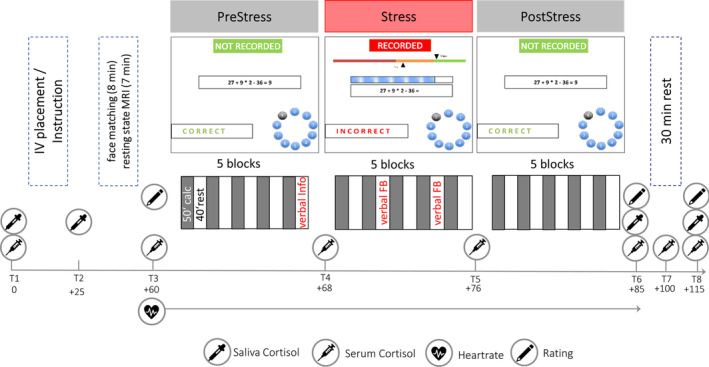
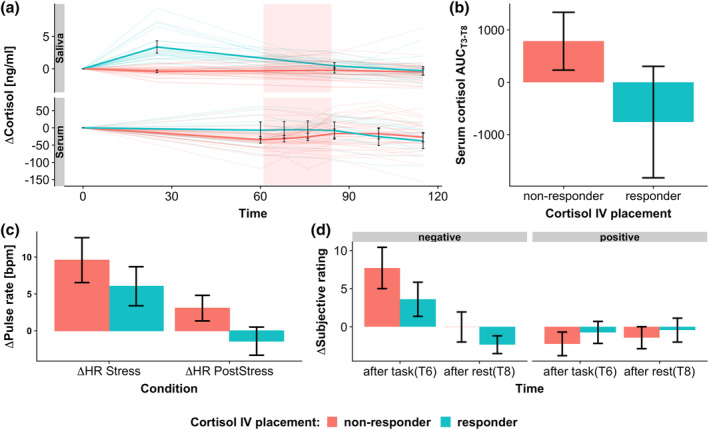
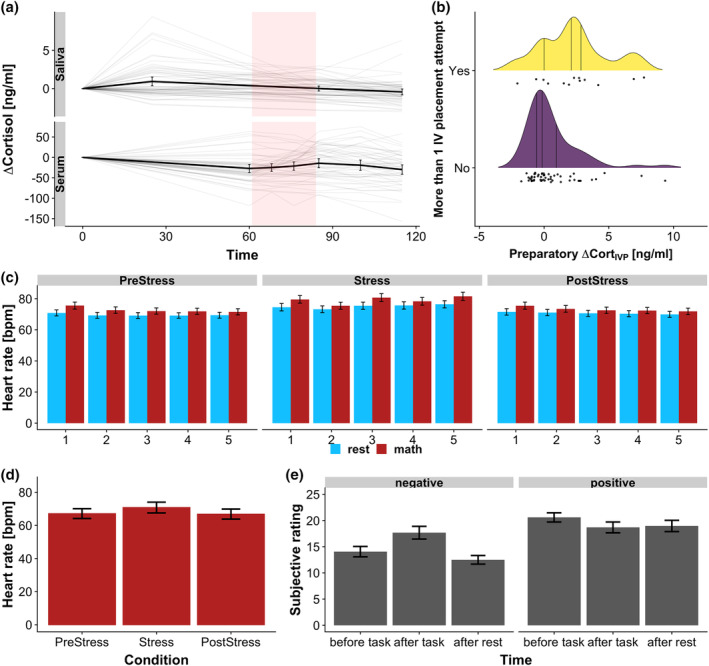
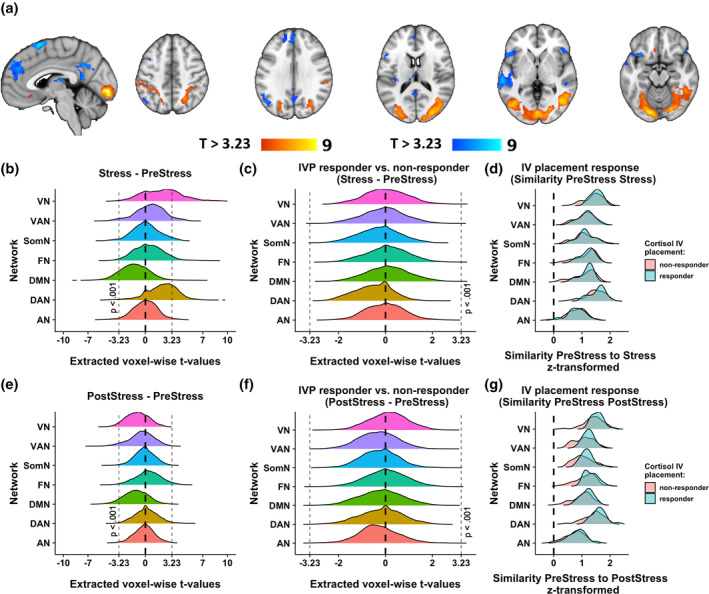
Acute and chronic stress are important factors in the development of mental disorders. Reliable measurement of stress reactivity is therefore pivotal. Critically, experimental induction of stress often involves multiple "hits" and it is an open question whether individual differences in responses to an earlier stressor lead to habituation, sensitization, or simple additive effects on following events. Here, we investigated the effect of the individual cortisol response to intravenous catheter placement (IVP) on subsequent neural, psychological, endocrine, and autonomous stress reactivity. We used an established psychosocial stress paradigm to measure the acute stress response (Stress) and recovery (PostStress) in 65 participants. Higher IVP-induced cortisol responses were associated with lower pulse rate increases during stress recovery (b = -4.8 bpm, p = .0008) and lower increases in negative affect after the task (b = -4.2, p = .040). While the cortisol response to IVP was not associated with subsequent specific stress-induced neural activation patterns, the similarity of brain responses Pre- and PostStress was higher IVP-cortisol responders (t[64] = 2.35, p = .022) indicating faster recovery. In conclusion, preparatory stress induced by IVP reduced reactivity in a subsequent stress task by modulating the latency of stress recovery. Thus, an individually stronger preceding release of cortisol may attenuate a second physiological response and perceived stress suggesting that relative changes, not absolute levels are crucial for stress attribution. Our study highlights that considering the entire trajectory of stress induction during an experiment is important to develop reliable individual biomarkers.
急性和慢性应激是精神障碍发展的重要因素。因此,可靠地测量应激反应至关重要。关键的是,实验性应激诱导通常涉及多个“打击”,并且尚未确定个体对早期应激源的反应差异是否导致习惯化、敏感化或对后续事件的简单相加效应。在这里,我们研究了个体对静脉内导管放置(IVP)的皮质醇反应对随后的神经、心理、内分泌和自主应激反应的影响。我们使用了一种既定的心理社会应激范式来测量 65 名参与者的急性应激反应(Stress)和恢复(PostStress)。IVP 诱导的皮质醇反应较高与应激恢复期间的脉搏率增加较低(b = -4.8 bpm,p =.0008)和任务后负性情绪增加较低有关(b = -4.2,p =.040)。虽然 IVP 皮质醇反应与随后的特定应激诱导的神经激活模式无关,但 Pre- 和 PostStress 的大脑反应相似性在 IVP 皮质醇反应较高的个体中更高(t[64] = 2.35,p =.022),表明恢复更快。总之,IVP 诱导的预备性应激通过调节应激恢复的潜伏期来降低随后应激任务的反应性。因此,先前释放的皮质醇个体较强可能会减轻第二次生理反应和感知到的压力,这表明相对变化而不是绝对水平对于应激归因至关重要。我们的研究强调,在实验期间考虑应激诱导的整个轨迹对于开发可靠的个体生物标志物很重要。