International Gaming Research Unit and Cyberpsychology Research Group, Psychology Department, Nottingham Trent University, 50 Shakespeare Street, Nottingham NG1 4FQ, UK.
Int J Environ Res Public Health. 2020 Jun 24;17(12):4566. doi: 10.3390/ijerph17124566.
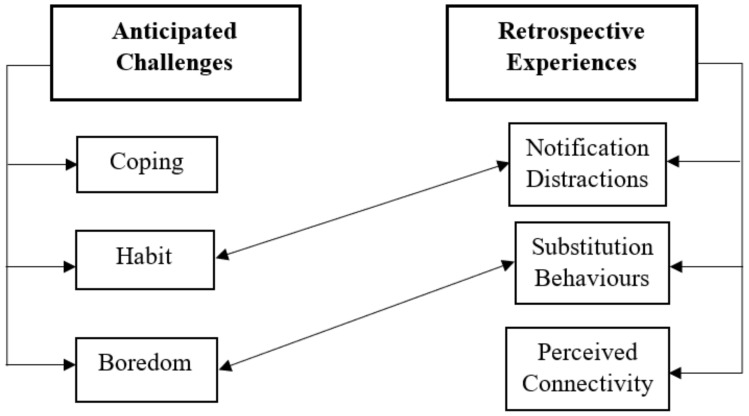
Smartphones aid the constant accessibility of social media (SM) applications, and these devices and platforms have become a key part of our everyday lives and needs. Previous research has focused on the psychological impact of social media use (SMU) and SM abstinence has only received limited attention. Therefore, employing a combination of an experimental within-subjects mixed methodology using surveys to obtain both quantitative and qualitative data, this study aimed to compare psychosocial factors of fear of missing out (FoMO), mental wellbeing (MWB), and social connectedness (SC) before and after seven days of SM abstinence. Results revealed that participants ( = 61) experienced a significant increase in MWB and SC, and a significant decrease in FoMO and smartphone use following SM abstinence. There was a significant positive relationship between MWB and SC change scores and a significant negative relationship between SC and FoMO change scores. There were no significant differences in levels of SMU before abstinence or across genders in FoMO, MWB, and SC change scores. Thematic analysis revealed coping, habit, and boredom as motivations for SMU, and notification distractions presenting a challenge for successful abstinence from SM. Participants indicated that abstinence resulted in the perceived need to fill their time with non-SM applications. Finally, thematic analysis revealed mixed experiences of perceived connectivity in the absence of SMU. Findings present implications for the importance of unplugging from SM for temporary periods because scrolling through SM to fill time is a key motivator of SMU, and notifications encourage SMU and trigger FoMO.
智能手机方便人们随时访问社交媒体 (SM) 应用程序,这些设备和平台已成为我们日常生活和需求的重要组成部分。之前的研究主要关注社交媒体使用 (SMU) 的心理影响,而对社交媒体戒断的研究关注较少。因此,本研究采用实验内被试混合方法,结合调查收集定量和定性数据,旨在比较社交媒体戒断前后错失恐惧 (FoMO)、心理健康 (MWB) 和社交联系 (SC) 的心理社会因素。结果表明,参与者(n=61)在社交媒体戒断后,MWB 和 SC 显著增加,FoMO 和智能手机使用显著减少。MWB 和 SC 变化得分之间存在显著的正相关关系,SC 和 FoMO 变化得分之间存在显著的负相关关系。在 FoMO、MWB 和 SC 变化得分方面,戒断前的 SMU 水平或性别之间没有显著差异。主题分析揭示了使用社交媒体的应对、习惯和无聊等动机,以及通知干扰是成功戒断社交媒体的挑战。参与者表示,戒断后,他们需要用非社交媒体应用来填补时间。最后,主题分析揭示了在没有社交媒体的情况下,感知连接的体验存在差异。研究结果表明,定期不使用社交媒体很重要,因为刷社交媒体来打发时间是使用社交媒体的主要动机,而通知会鼓励使用社交媒体并引发错失恐惧。