Department of Pediatrics, Faculty of Medicine, Menoufia University, Shebin El-Koum, Egypt.
Department of Public Health and Community Medicine, Faculty of Medicine, Menoufia University, Shebin El-Koum, Egypt.
Ital J Pediatr. 2020 Jun 29;46(1):91. doi: 10.1186/s13052-020-00855-y.
Under nutrition and overweight typically occur during nutritional transition periods in developing countries including Egypt. Short stature and anemia are public health concern due to its strong link with malnutrition which is a preventable risk factor.
to estimate the prevalence of overweight, obesity, underweight and short stature and its concurrence with anemia, also to determine the etiological profile of short stature among primary school children in Egypt.
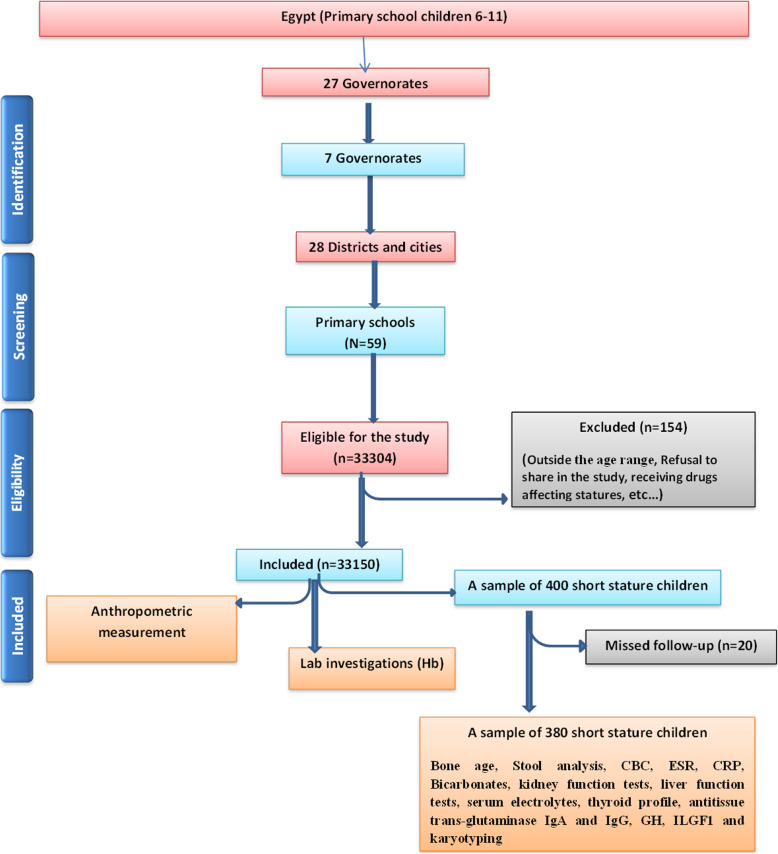
A cross-sectional study was carried out on 33,150 Egyptian children aged 6-11 years old from January 2018 to January 2020, allocated in 59 primary schools from diverse geographical districts in Egypt. Complete anthropometric measurements were conducted and applied according to WHO growth charts. Hemoglobin level was measured. Systematic approach to detect the etiology of short stature was applied randomly to a sample of 380 stunted children.
The prevalence of underweight was 8.2%, while obesity and overweight represented 21.8% (9.6 and 12.2% respectively). Overall short stature constituted 17%. The main etiologies of short stature were familial (40.8%) and constitutional (24.2%). Anemia was diagnosed in 26% of children; while concurrent anemia and stunting was reported in 9.9%. Regarding anemia and anemia with stunting were more common among girls (30.0% (OR = 1.50, CI95%: 1.43-1.58) and 11.4% (OR = 1.39, CI95%:1.29-1.49) respectively), who were living in rural areas (33.4% (OR = 1.96, CI 95%:1.87-2.06) &12.7% (OR = 1.72, CI 95%:1.60-1.85)) and those who had low socioeconomic status)34.6% (OR = 2.54, CI 95%:2.29-2.82) & 17.2% (OR = 3.32, CI 95%:2.85-3.88() respectively. Anemia with stunting was significantly higher among children aged ≥9 years old representing 12% (OR = 1.40, CI 95%:1.30-1.51).
Prevalence of short stature, obesity and anemia was high among primary school children in Egypt with a strong concurrence between anemia and stunting. Intensive parental health education and in-depth nutritional assessment are required.
在包括埃及在内的发展中国家,营养不足和超重通常发生在营养转型期。身材矮小和贫血是公共卫生关注的问题,因为它们与营养不良密切相关,而营养不良是可预防的风险因素。
评估超重、肥胖、消瘦和身材矮小的流行情况及其与贫血的并存情况,并确定埃及小学生身材矮小的病因谱。
对 2018 年 1 月至 2020 年 1 月期间 33150 名年龄在 6-11 岁的埃及儿童进行了横断面研究,这些儿童来自埃及不同地理区域的 59 所小学。根据世界卫生组织生长图表进行了完整的人体测量,并进行了应用。测量了血红蛋白水平。对 380 名身材矮小的儿童进行了随机抽样,采用系统方法来检测身材矮小的病因。
体重不足的患病率为 8.2%,而肥胖和超重的患病率分别为 21.8%(分别为 9.6%和 12.2%)。总体而言,身材矮小的患病率为 17%。身材矮小的主要病因是家族性(40.8%)和体质性(24.2%)。诊断出 26%的儿童患有贫血症;而报告的贫血症和矮小症并存的比例为 9.9%。关于贫血症和矮小症与贫血症并存的情况,女孩更为常见(30.0%(OR=1.50,95%CI:1.43-1.58)和 11.4%(OR=1.39,95%CI:1.29-1.49)),她们居住在农村地区(33.4%(OR=1.96,CI 95%:1.87-2.06)和 12.7%(OR=1.72,CI 95%:1.60-1.85)),社会经济地位较低(34.6%(OR=2.54,CI 95%:2.29-2.82)和 17.2%(OR=3.32,CI 95%:2.85-3.88))。≥9 岁的儿童中,贫血症与矮小症并存的比例显著更高,为 12%(OR=1.40,CI 95%:1.30-1.51)。
埃及小学生身材矮小、肥胖和贫血的患病率较高,且贫血症与矮小症之间存在很强的相关性。需要对家长进行强化健康教育和深入的营养评估。