Department of Mathematics, Temple University, Philadelphia, Pennsylvania, USA.
Department of Microbiology and Immunology, Lewis Katz School of Medicine at Temple University, Philadelphia, Pennsylvania, USA.
J Bacteriol. 2020 Aug 25;202(18). doi: 10.1128/JB.00253-20.
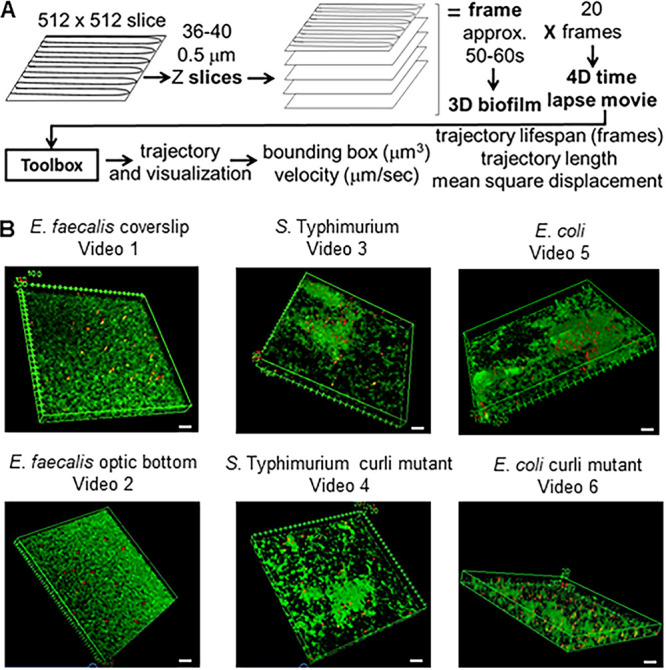
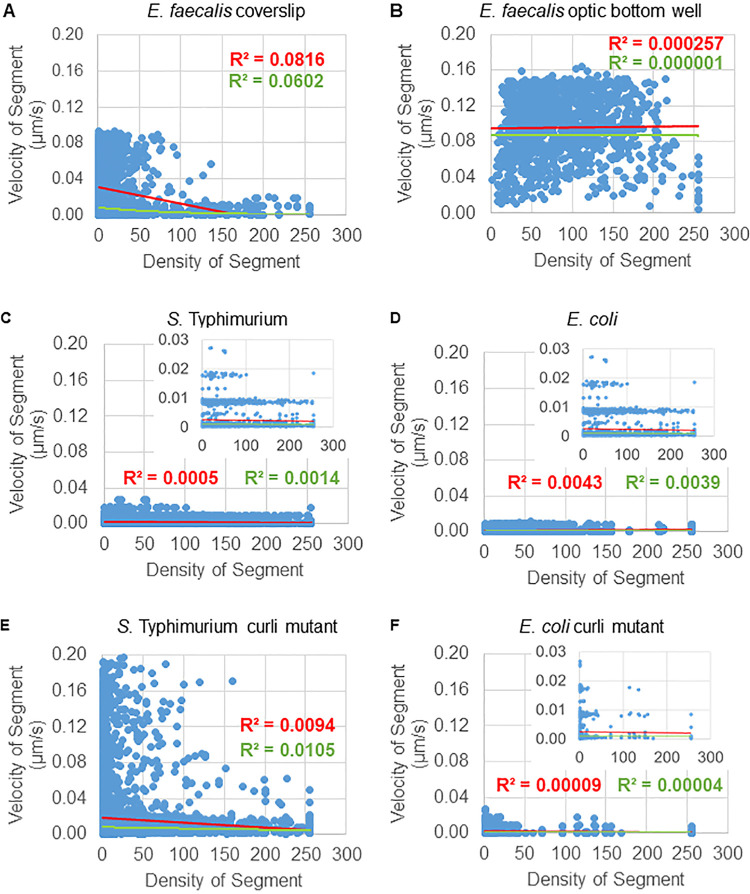
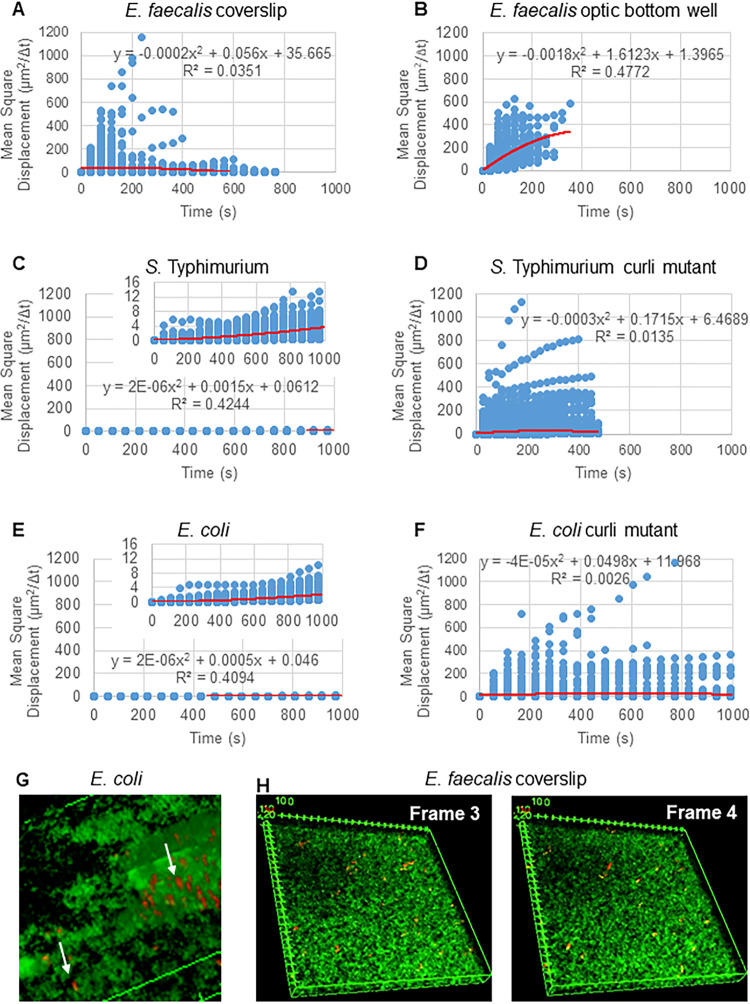
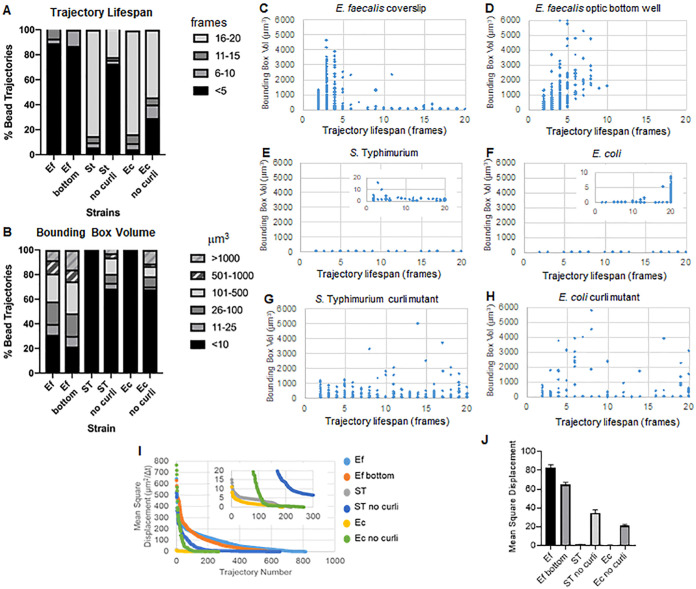
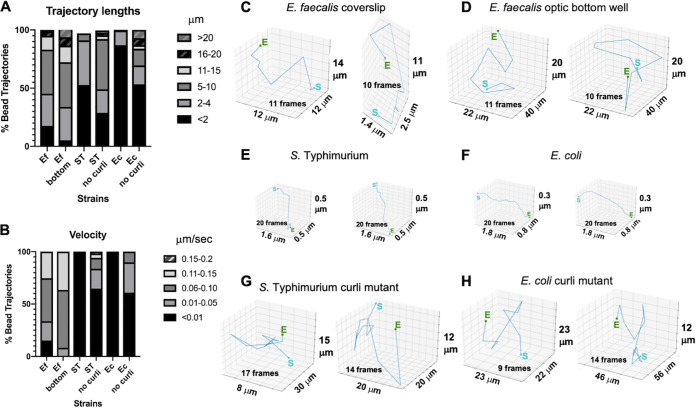
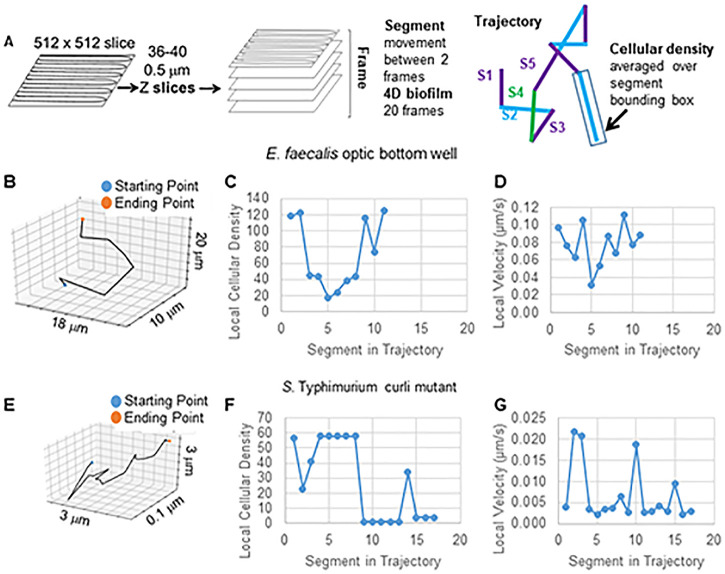
Biofilms exist in complex environments, including the intestinal tract, as a part of the gastrointestinal microbiota. The interaction of planktonic bacteria with biofilms can be influenced by material properties of the biofilm. During previous confocal studies, we observed that amyloid curli-containing serotype Typhimurium and biofilms appeared rigid. In these studies, , which lacks curli-like protein, showed more fluid movement. To better characterize the material properties of the biofilms, a four-dimensional (4D) model was designed to track the movement of 1-μm glyoxylate beads in 10- to 20-μm-thick biofilms over approximately 20 min using laser-scanning confocal microscopy. Software was developed to analyze the bead trajectories, the amount of time they could be followed (trajectory life span), the velocity of movement, the surface area covered (bounding boxes), and cellular density around each bead. Bead movement was found to be predominantly Brownian motion. Curli-containing biofilms had very little bead movement throughout the low- and high-density regions of the biofilm compared to and isogenic curli mutants. Curli-containing biofilms tended to have more stable bead interactions (longer trajectory life spans) than biofilms lacking curli. In biofilms lacking curli, neither the velocity of bead movement nor the bounding box volume was strictly dependent on cell density, suggesting that other material properties of the biofilms were influencing the movement of the beads and flexibility of the material. Taken together, these studies present a 4D method to analyze bead movement over time in a 3D biofilm and suggest curli confers rigidity to the extracellular matrix of biofilms. Mathematical models are necessary to understand how the material composition of biofilms can influence their physical properties. Here, we developed a 4D computational toolchain for the analysis of bead trajectories, which laid the groundwork for establishing critical parameters for mathematical models of particle movement in biofilms. Using this open-source trajectory analyzer, we determined that the presence of bacterial amyloid curli changes the material properties of a biofilm, making the biofilm matrix rigid. This software is a powerful tool to analyze treatment- and environment-induced changes in biofilm structure and cell movement in biofilms. The open-source analyzer is fully adaptable and extendable in a modular fashion using VRL-Studio to further enhance and extend its functions.
生物膜存在于复杂的环境中,包括肠道,是胃肠道微生物群的一部分。浮游细菌与生物膜的相互作用会受到生物膜的材料特性的影响。在之前的共聚焦研究中,我们观察到含有淀粉样物质 curli 的血清型鼠伤寒沙门氏菌和生物膜表现出刚性。在这些研究中,缺乏 curli 样蛋白的 表现出更多的流体运动。为了更好地描述生物膜的材料特性,设计了一个四维 (4D) 模型,使用激光扫描共聚焦显微镜跟踪 1-μm 乙二醛珠在 10-20-μm 厚生物膜中的运动,大约 20 分钟。开发了软件来分析珠轨迹、可以跟踪的时间量(轨迹寿命)、运动速度、覆盖的表面积(边界框)以及每个珠周围的细胞密度。发现珠的运动主要是布朗运动。与 和同源 curli 突变体相比,含有 curli 的生物膜在生物膜的低密和高密区域中珠的运动都很少。含有 curli 的生物膜比缺乏 curli 的生物膜具有更稳定的珠相互作用(更长的轨迹寿命)。在缺乏 curli 的生物膜中,珠的运动速度和边界框体积都不严格依赖于细胞密度,这表明生物膜的其他材料特性影响珠的运动和材料的灵活性。综上所述,这些研究提出了一种 4D 方法来分析生物膜中珠随时间的运动,并表明 curli 使生物膜的细胞外基质具有刚性。数学模型对于理解生物膜的材料组成如何影响其物理特性是必要的。在这里,我们开发了一个用于分析珠轨迹的 4D 计算工具链,为建立生物膜中颗粒运动的数学模型的关键参数奠定了基础。使用这个开源轨迹分析器,我们确定了细菌淀粉样物质 curli 的存在改变了生物膜的材料特性,使生物膜基质刚性化。这个软件是一个强大的工具,可以分析生物膜结构和细胞运动在治疗和环境诱导下的变化。开源分析器具有很强的适应性和可扩展性,可以使用 VRL-Studio 以模块化的方式进行增强和扩展,进一步增强和扩展其功能。