National Centre for Epidemiology and Population Health, Australian National University, Canberra, Australian Capital Territory, Australia
National Centre for Epidemiology and Population Health, Australian National University, Canberra, Australian Capital Territory, Australia.
BMJ Open. 2020 Jun 29;10(6):e037326. doi: 10.1136/bmjopen-2020-037326.
Determinants and drivers for emergencies, such as political instability, weak health systems, climate change and forcibly displaced populations, are increasing the severity, complexity and frequency of public health emergencies. As emergencies become more complex, it is increasingly important that the required skillset of the emergency response workforce is clearly defined. To enable essential epidemiological activities to be implemented and managed during an emergency, a workforce is required with the right mix of skills, knowledge, experience and local context awareness. This study aims to provide local and international responders with an opportunity to actively contribute to the development of new thinking around emergency response roles and required competencies. In this study, we will develop recommendations using a broad range of evidence to address identified lessons and challenges so that future major emergency responses are culturally and contextually appropriate, and less reliant on long-term international deployments.
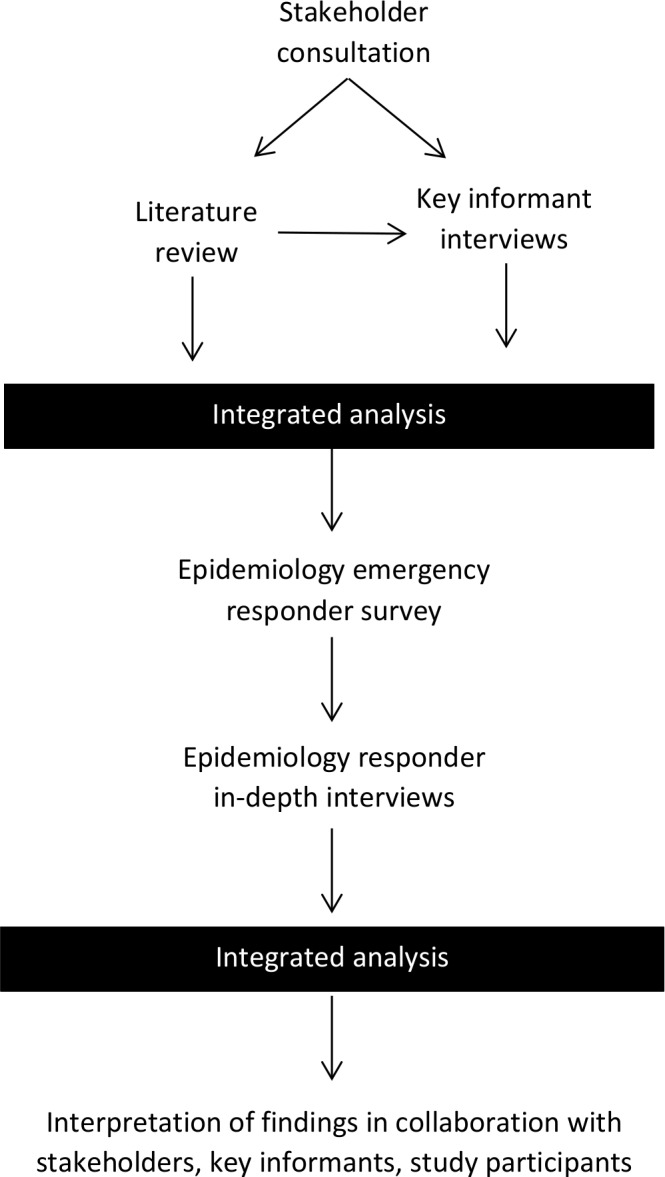
We will conduct a mixed-methods study using an exploratory sequential study design. The integration of four data sources, including key informant interviews, a scoping literature review, survey and semistructured interviews will allow the research questions to be examined in a flexible, semistructured way, from a range of perspectives. The study is unequally weighted, with a qualitative emphasis. We will analyse all activities as individual components, and then together in an integrated analysis. Thematic analysis will be conducted in NVivo V.11 and quantitative analysis will be conducted in Stata V.15.
All activities have been approved by the Science and Medical Delegated Ethics Review Committee at the Australian National University (protocol numbers 2018-521, 2018-641, 2019-068). Findings will be disseminated through international and local deployment partners, peer-reviewed publication, presentation at international conferences and through social media such as Twitter and Facebook.
紧急情况的决定因素和驱动因素,如政治不稳定、薄弱的卫生系统、气候变化和被迫流离失所的人口,正在增加公共卫生紧急情况的严重程度、复杂性和频率。随着紧急情况变得更加复杂,明确界定应急响应人员所需的技能组合变得越来越重要。为了在紧急情况下能够实施和管理必要的流行病学活动,需要一支具有正确技能、知识、经验和当地背景意识的应急响应人员队伍。本研究旨在为当地和国际应急人员提供一个机会,积极参与制定新的应急响应角色和所需能力的思路。在本研究中,我们将使用广泛的证据来制定建议,以解决已确定的经验教训和挑战,从而使未来的重大紧急情况反应在文化和背景上更加合适,减少对长期国际部署的依赖。
我们将使用混合方法研究,采用探索性顺序研究设计。四项数据来源的整合,包括关键知情人访谈、范围广泛的文献综述、调查和半结构化访谈,将使研究问题能够以灵活、半结构化的方式从多种角度进行检查。该研究的权重不同,重点是定性。我们将分析所有活动作为单独的组件,然后在综合分析中一起分析。将在 NVivo V.11 中进行主题分析,在 Stata V.15 中进行定量分析。
所有活动均已获得澳大利亚国立大学科学和医学授权伦理审查委员会的批准(协议编号 2018-521、2018-641、2019-068)。研究结果将通过国际和本地部署合作伙伴、同行评议出版物、国际会议上的演讲以及 Twitter 和 Facebook 等社交媒体进行传播。