National Centre for Epidemiology and Population Health, Research School of Population Health, Australian National University, Building 62, Mills Road, Acton, Canberra, Australian National Territory, 2601 Australia.
School of Medicine and Public Health, University of Newcastle, New South Wales, Australia.
Bull World Health Organ. 2021 May 1;99(5):351-358. doi: 10.2471/BLT.20.276998. Epub 2021 Mar 2.
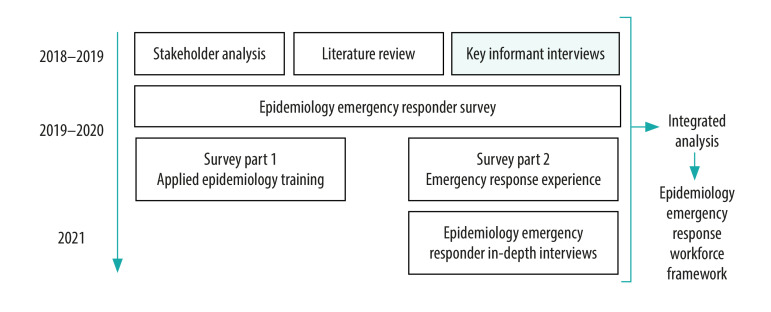
To determine the challenges met by, and needs of, the epidemiology emergency response workforce, with the aim of informing the development of a larger survey, by conducting key informant interviews of public health experts.
We defined our study population as public health experts with experience of epidemiology deployment. Using purposive sampling techniques, we applied random number sampling to shortlists of potential interviewees provided by key organizations to obtain 10 study participants; we identified three additional interviewees through snowballing. The same interviewer conducted all key informant interviews during May-August 2019. We thematically analysed de-identified transcripts using a qualitative data analysis computer software package.
Despite our interviewees having a wide range of organizational and field experience, common themes emerged. Interviewees reported a lack of clarity in the definition of an emergency response epidemiologist; the need for a broader range of skills; and inadequate leadership and mentoring in the field. Interviewees identified the lack of interpersonal skills (e.g. communication) and a lack of career progression options as limitations to the effectiveness of emergency response.
The epidemiology emergency response workforce is currently not achieving collective competence. The lack of a clear definition of the role must be addressed, and leadership is required to develop teams in which complementary skills are harmonized and those less experienced can be mentored. Epidemiology bodies must consider individual professional accreditation to ensure that the required skills are being achieved, as well as enabling continual professional development.
通过对公共卫生专家进行关键知情人访谈,确定流行病学应急响应人员所面临的挑战和需求,旨在为更大规模调查的开展提供信息。
我们将有流行病学部署经验的公共卫生专家定义为研究人群。我们采用目的抽样技术,通过关键组织提供的潜在受访者名单进行随机数抽样,选取了 10 名研究参与者;通过滚雪球的方式又确定了另外 3 名受访者。同一名访谈员在 2019 年 5 月至 8 月期间对所有关键知情人进行了访谈。我们使用定性数据分析计算机软件包对去识别的转录本进行了主题分析。
尽管我们的受访者具有广泛的组织和现场经验,但仍出现了一些共同的主题。受访者报告说,应急响应流行病学家的定义不明确;需要更广泛的技能;现场领导和指导不足。受访者认为缺乏人际交往能力(例如沟通)和职业发展选择是应急响应效果不佳的限制因素。
目前,流行病学应急响应人员尚未实现集体能力。必须解决角色定义不明确的问题,并需要领导能力来组建团队,协调互补的技能,并对经验不足的人员进行指导。流行病学机构必须考虑个人专业认证,以确保实现所需技能,并能够持续进行专业发展。