Department of Radiation Oncology, Sunnybrook Health Sciences Centre, Toronto, ON, Canada.
Department of Radiation Oncology, University of Toronto, Toronto, ON, Canada.
Cancer Med. 2020 Aug;9(16):5798-5806. doi: 10.1002/cam4.3255. Epub 2020 Jun 29.
This study was conducted in order to develop a model for predicting response to neoadjuvant chemotherapy (NAC) in patients with locally advanced breast cancer (LABC) using pretreatment quantitative ultrasound (QUS) radiomics.
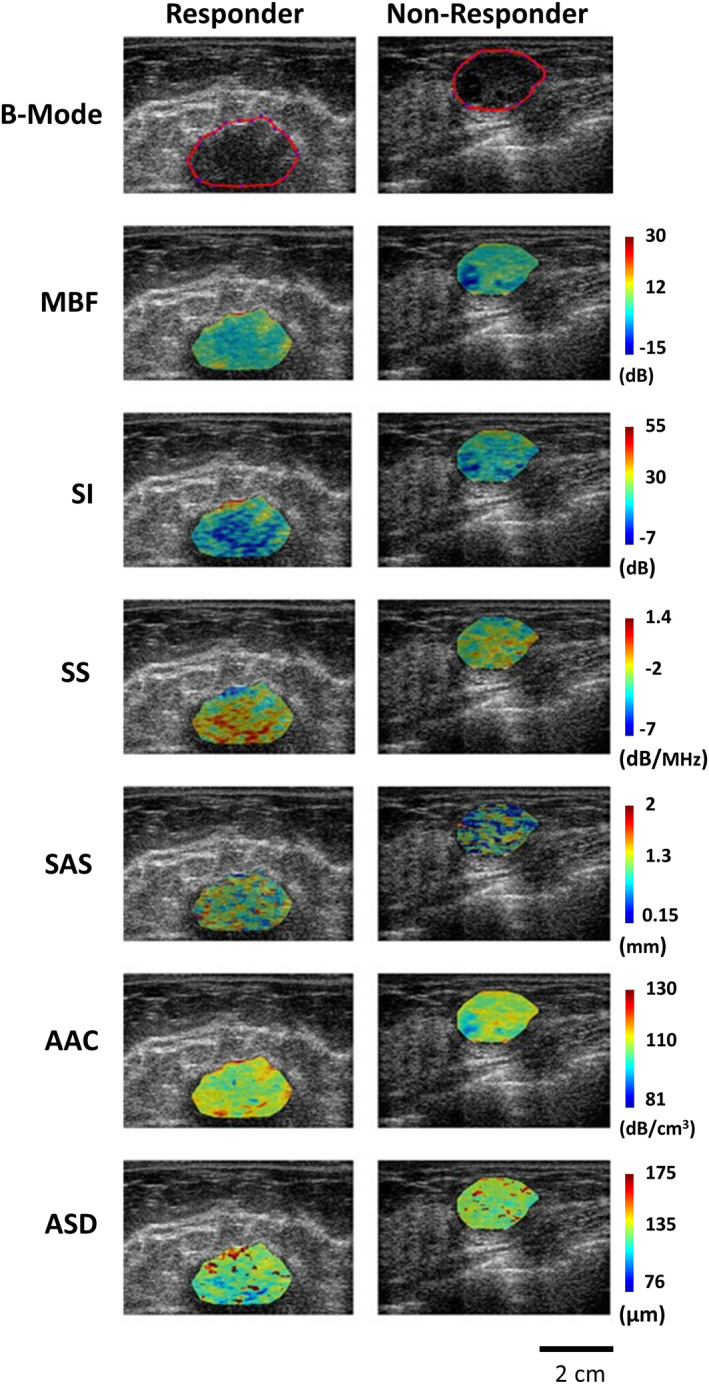
This was a multicenter study involving four sites across North America, and appropriate approval was obtained from the individual ethics committees. Eighty-two patients with LABC were included for final analysis. Primary tumors were scanned using a clinical ultrasound system before NAC was started. The tumors were contoured, and radiofrequency data were acquired and processed from whole tumor regions of interest. QUS spectral parameters were derived from the normalized power spectrum, and texture analysis was performed based on six QUS features using a gray level co-occurrence matrix. Patients were divided into responder or nonresponder classes based on their clinical-pathological response. Classification analysis was performed using machine learning algorithms, which were trained to optimize classification accuracy. Cross-validation was performed using a leave-one-out cross-validation method.
Based on the clinical outcomes of NAC treatment, there were 48 responders and 34 nonresponders. A K-nearest neighbors (K-NN) approach resulted in the best classifier performance, with a sensitivity of 91%, a specificity of 83%, and an accuracy of 87%.
QUS-based radiomics can predict response to NAC based on pretreatment features with acceptable accuracy.
本研究旨在利用预处理定量超声(QUS)放射组学为局部晚期乳腺癌(LABC)患者建立预测新辅助化疗(NAC)反应的模型。
这是一项多中心研究,涉及北美的四个地点,已从各个伦理委员会获得适当批准。最终对 82 名 LABC 患者进行了分析。在开始 NAC 之前,使用临床超声系统对原发性肿瘤进行扫描。对肿瘤进行轮廓勾画,并从整个肿瘤感兴趣区域获取射频数据并进行处理。从归一化功率谱中得出 QUS 光谱参数,并使用灰度共生矩阵基于六个 QUS 特征进行纹理分析。根据临床病理反应将患者分为应答者或非应答者。使用机器学习算法进行分类分析,该算法经过训练以优化分类准确性。使用留一交叉验证方法进行交叉验证。
根据 NAC 治疗的临床结果,有 48 名应答者和 34 名无应答者。K-最近邻(K-NN)方法得出的分类器性能最佳,灵敏度为 91%,特异性为 83%,准确性为 87%。
基于 QUS 的放射组学可以根据预处理特征预测 NAC 的反应,具有可接受的准确性。