Bhardwaj Divya, Dasgupta Archya, DiCenzo Daniel, Brade Stephen, Fatima Kashuf, Quiaoit Karina, Trudeau Maureen, Gandhi Sonal, Eisen Andrea, Wright Frances, Look-Hong Nicole, Curpen Belinda, Sannachi Lakshmanan, Czarnota Gregory J
Physical Sciences, Sunnybrook Research Institute, Toronto, ON M4N 3M5, Canada.
Department of Radiation Oncology, Sunnybrook Health Sciences Centre, Toronto, ON M4N 3M5, Canada.
Cancers (Basel). 2022 Feb 28;14(5):1247. doi: 10.3390/cancers14051247.
This study was conducted to explore the use of quantitative ultrasound (QUS) in predicting recurrence for patients with locally advanced breast cancer (LABC) early during neoadjuvant chemotherapy (NAC).
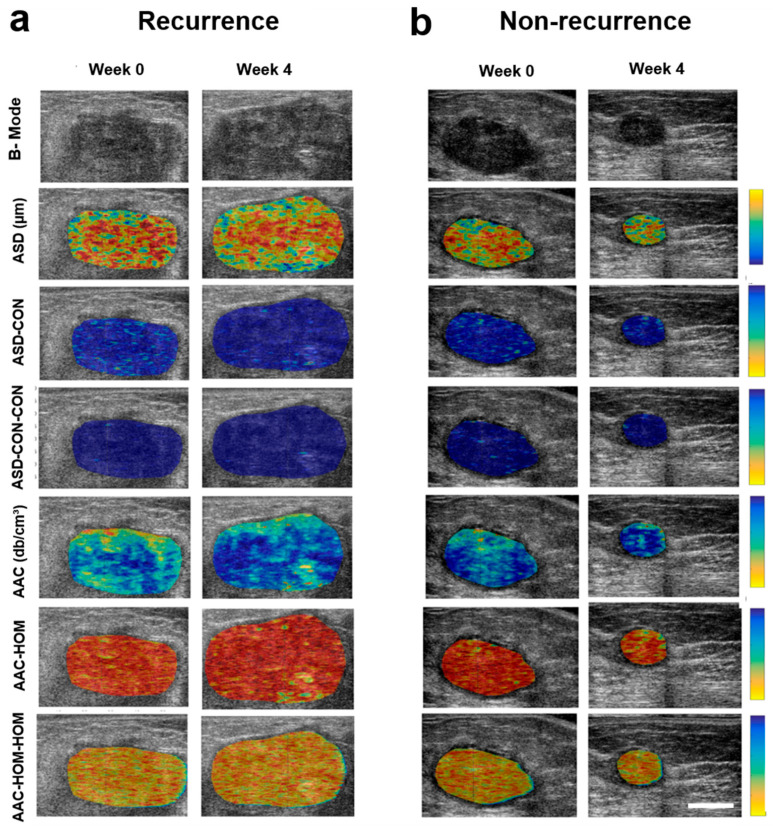
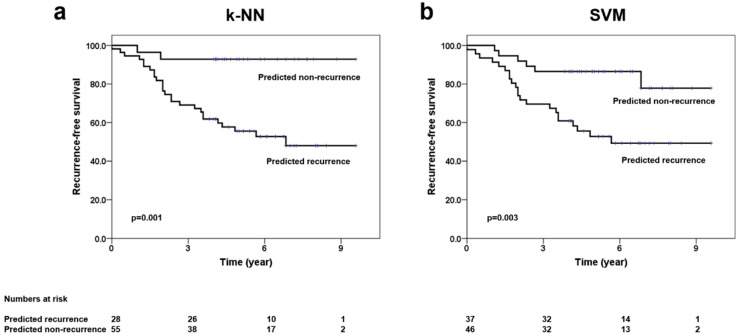
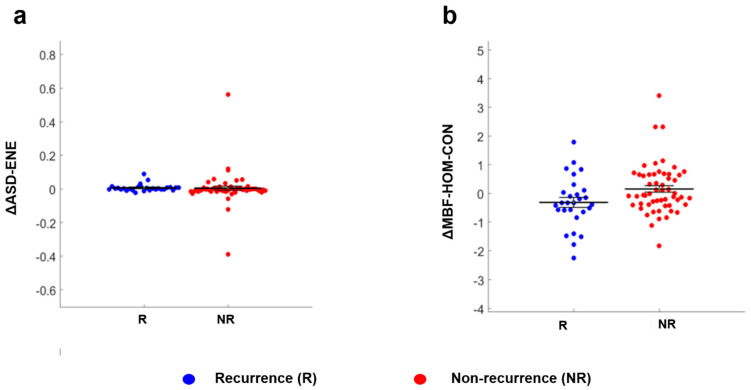
Eighty-three patients with LABC were scanned with 7 MHz ultrasound before starting NAC (week 0) and during treatment (week 4). Spectral parametric maps were generated corresponding to tumor volume. Twenty-four textural features (QUS-Tex) were determined from parametric maps acquired using grey-level co-occurrence matrices (GLCM) for each patient, which were further processed to generate 64 texture derivatives (QUS-Tex-Tex), leading to a total of 95 features from each time point. Analysis was carried out on week 4 data and compared to baseline (week 0) data. ∆Week 4 data was obtained from the difference in QUS parameters, texture features (QUS-Tex), and texture derivatives (QUS-Tex-Tex) of week 4 data and week 0 data. Patients were divided into two groups: recurrence and non-recurrence. Machine learning algorithms using -nearest neighbor (k-NN) and support vector machines (SVMs) were used to generate radiomic models. Internal validation was undertaken using leave-one patient out cross-validation method.
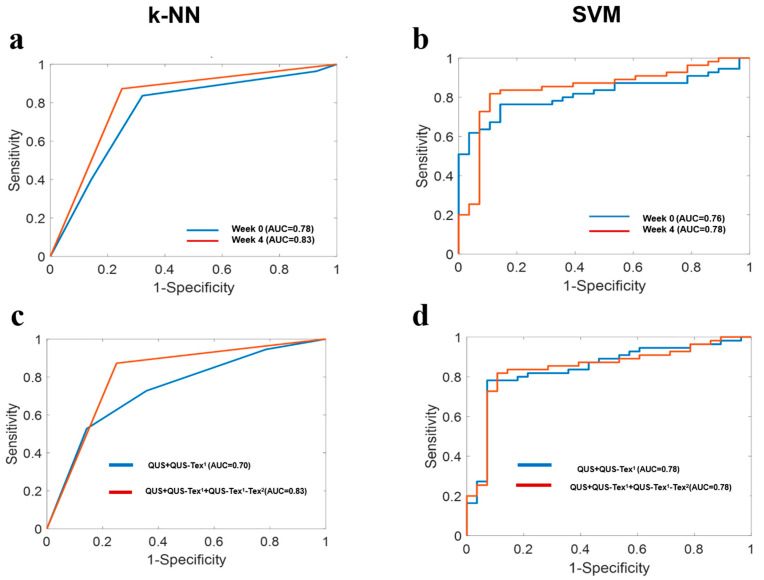
With a median follow up of 69 months (range 7-118 months), 28 patients had disease recurrence. The k-NN classifier was the best performing algorithm at week 4 with sensitivity, specificity, accuracy, and area under curve (AUC) of 87%, 75%, 81%, and 0.83, respectively. The inclusion of texture derivatives (QUS-Tex-Tex) in week 4 QUS data analysis led to the improvement of the classifier performances. The AUC increased from 0.70 (0.59 to 0.79, 95% confidence interval) without texture derivatives to 0.83 (0.73 to 0.92) with texture derivatives. The most relevant features separating the two groups were higher-order texture derivatives obtained from scatterer diameter and acoustic concentration-related parametric images.
This is the first study highlighting the utility of QUS radiomics in the prediction of recurrence during the treatment of LABC. It reflects that the ongoing treatment-related changes can predict clinical outcomes with higher accuracy as compared to pretreatment features alone.
本研究旨在探讨定量超声(QUS)在新辅助化疗(NAC)早期预测局部晚期乳腺癌(LABC)患者复发情况中的应用。
83例LABC患者在开始NAC前(第0周)和治疗期间(第4周)接受7MHz超声扫描。生成与肿瘤体积对应的频谱参数图。从每位患者使用灰度共生矩阵(GLCM)获取的参数图中确定24个纹理特征(QUS-Tex),进一步处理这些特征以生成64个纹理衍生特征(QUS-Tex-Tex),每个时间点共有95个特征。对第4周的数据进行分析,并与基线(第0周)数据进行比较。第4周数据的∆是通过第4周数据和第0周数据的QUS参数、纹理特征(QUS-Tex)和纹理衍生特征(QUS-Tex-Tex)的差异获得的。患者分为两组:复发组和非复发组。使用k近邻(k-NN)和支持向量机(SVM)的机器学习算法生成放射组学模型。采用留一患者交叉验证法进行内部验证。
中位随访69个月(范围7-118个月),28例患者疾病复发。k-NN分类器在第4周是表现最佳的算法,其灵敏度、特异度、准确度和曲线下面积(AUC)分别为87%、75%、81%和0.83。在第4周的QUS数据分析中纳入纹理衍生特征(QUS-Tex-Tex)可提高分类器性能。AUC从无纹理衍生特征时的0.70(0.59至0.79,95%置信区间)增加到有纹理衍生特征时的0.83(0.73至0.92)。区分两组的最相关特征是从散射体直径和声浓度相关参数图像获得的高阶纹理衍生特征。
这是第一项强调QUS放射组学在LABC治疗期间预测复发实用性的研究。它表明,与单独的治疗前特征相比,正在进行的与治疗相关的变化能够更准确地预测临床结果。