Department of Microbiology and Immunology, University of North Carolina at Chapel Hill, Chapel Hill, North Carolina 27599, USA; email:
Department of Biochemistry, Albert Einstein College of Medicine, Bronx, New York 10461, USA; email:
Annu Rev Virol. 2020 Sep 29;7(1):421-446. doi: 10.1146/annurev-virology-011720-095930. Epub 2020 Jun 30.
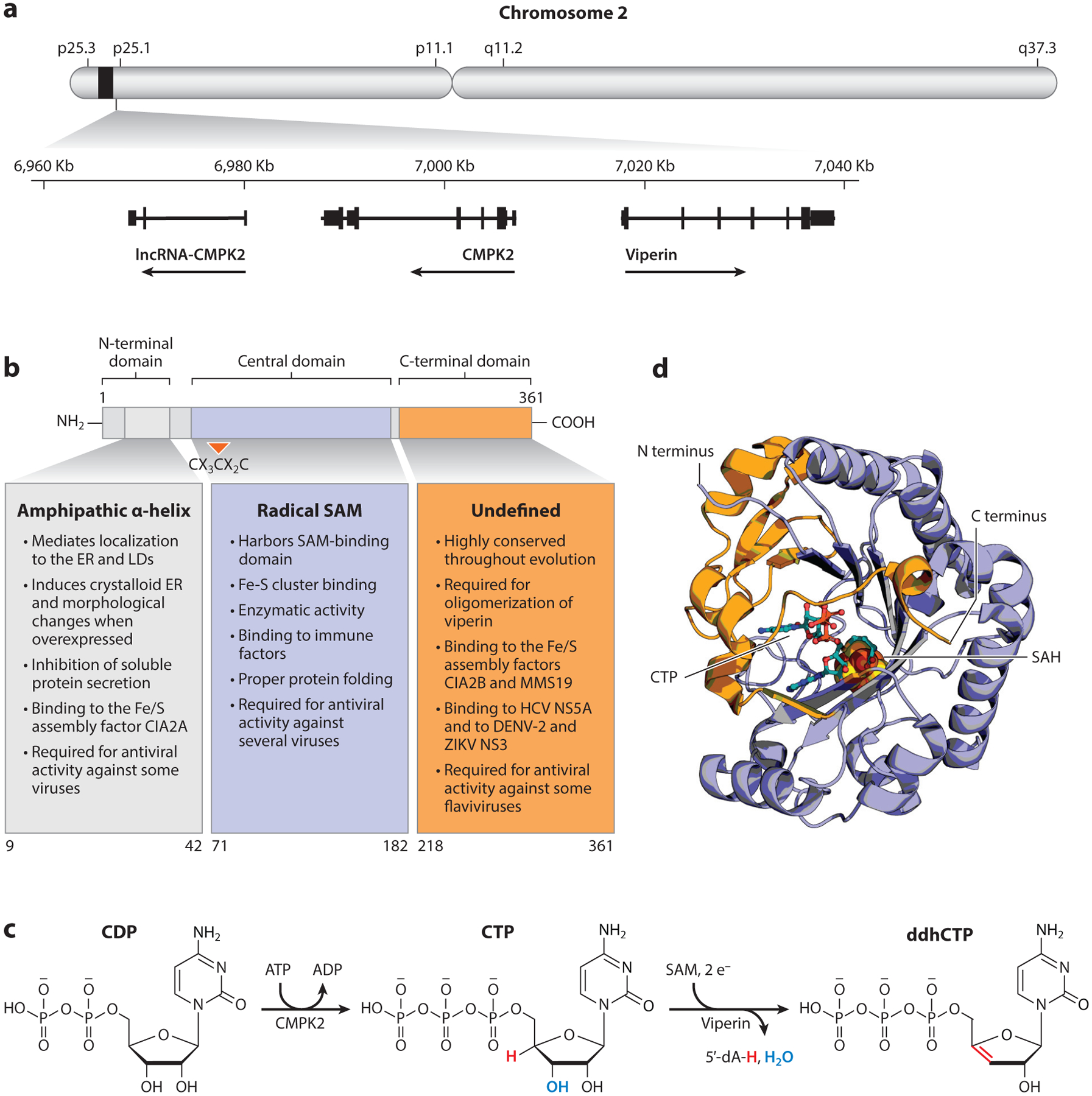
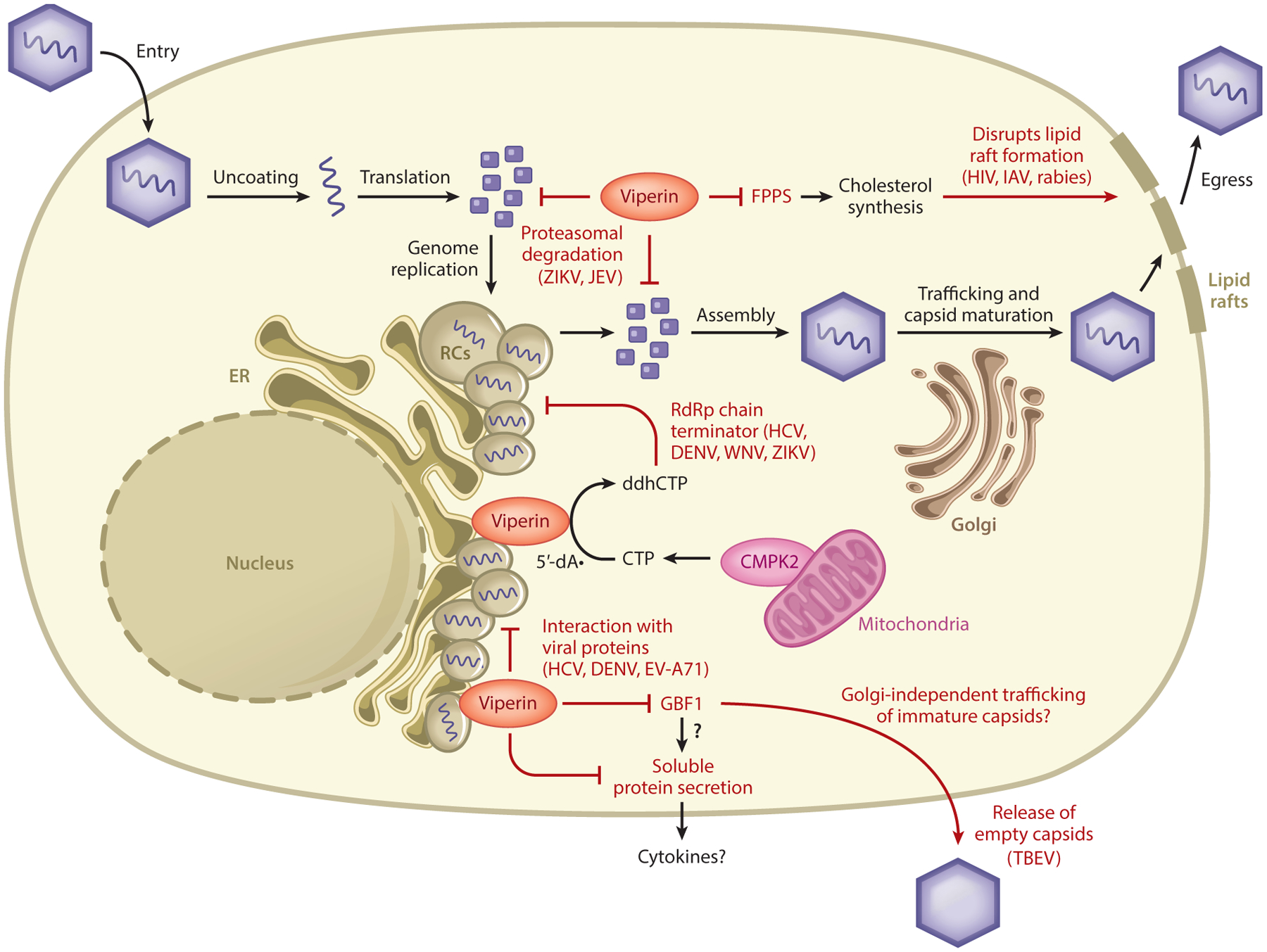
Most cells respond to viral infections by activating innate immune pathways that lead to the induction of antiviral restriction factors. One such factor, viperin, was discovered almost two decades ago based on its induction during viral infection. Since then, viperin has been shown to possess activity against numerous viruses via multiple proposed mechanisms. Most recently, however, viperin was demonstrated to catalyze the conversion of cytidine triphosphate (CTP) to 3'-deoxy-3',4'-didehydro-CTP (ddhCTP), a previously unknown ribonucleotide. Incorporation of ddhCTP causes premature termination of RNA synthesis by the RNA-dependent RNA polymerase of some viruses. To date, production of ddhCTP by viperin represents the only activity of viperin that links its enzymatic activity directly to an antiviral mechanism in human cells. This review examines the multiple antiviral mechanisms and biological functions attributed to viperin.
大多数细胞通过激活先天免疫途径来响应病毒感染,从而诱导抗病毒限制因子。二十年前,根据病毒感染时的诱导作用,发现了一种这样的因子,即 viperin。此后,通过多种提出的机制,已经证明 viperin 对多种病毒具有活性。然而,最近,viperin 被证明能够催化胞苷三磷酸 (CTP) 转化为 3'-脱氧-3',4'-二氢-CTP (ddhCTP),这是一种以前未知的核苷酸。一些病毒的 RNA 依赖的 RNA 聚合酶将 ddhCTP 掺入 RNA 会导致 RNA 合成过早终止。迄今为止,viperin 产生 ddhCTP 是其酶活性与人类细胞中抗病毒机制直接相关的唯一活性。这篇综述考察了归因于 viperin 的多种抗病毒机制和生物学功能。