Department of Mechanical Engineering, Seoul National University, 1 Gwanak-ro, Gwanak-gu, Seoul 08826, Korea.
Air Quality Analysis and Control Center, Seoul Metropolitan Research Institute of Public Health and Environment, 30, Janggunmaeul 3-gil, Gwacheon-si, Gyeonggi-do, Seoul 08826, Korea.
Sensors (Basel). 2020 Jun 27;20(13):3617. doi: 10.3390/s20133617.
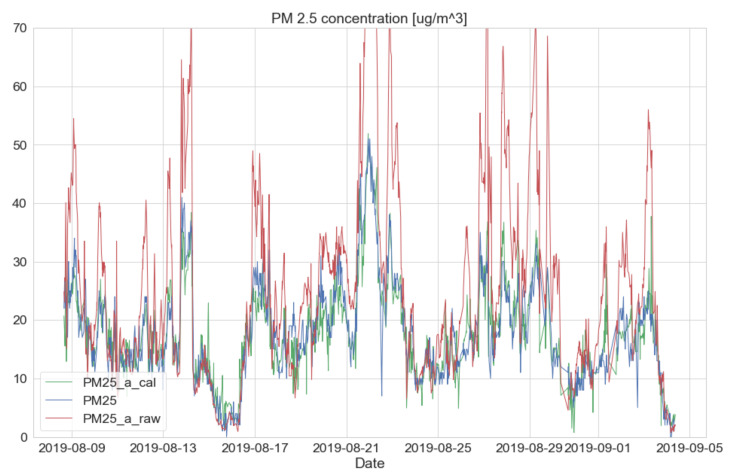
Low-cost light scattering particulate matter (PM) sensors have been widely researched and deployed in order to overcome the limitations of low spatio-temporal resolution of government-operated beta attenuation monitor (BAM). However, the accuracy of low-cost sensors has been questioned, thus impeding their wide adoption in practice. To evaluate the accuracy of low-cost PM sensors in the field, a multi-sensor platform has been developed and co-located with BAM in Dongjak-gu, Seoul, Korea from 15 January 2019 to 4 September 2019. In this paper, a sample variation of low-cost sensors has been analyzed while using three commercial low-cost PM sensors. Influences on PM sensor by environmental conditions, such as humidity, temperature, and ambient light, have also been described. Based on this information, we developed a novel combined calibration algorithm, which selectively applies multiple calibration models and statistically reduces residuals, while using a prebuilt parameter lookup table where each cell records statistical parameters of each calibration model at current input parameters. As our proposed framework significantly improves the accuracy of the low-cost PM sensors (e.g., RMSE: 23.94 → 4.70 μ g/m 3 ) and increases the correlation (e.g., R 2 : 0.41 → 0.89), this calibration model can be transferred to all sensor nodes through the sensor network.
为了克服政府运营的β射线衰减监测仪(BAM)时空分辨率低的局限性,低成本的光散射颗粒物(PM)传感器已得到广泛研究和应用。然而,低成本传感器的准确性一直受到质疑,从而阻碍了其在实践中的广泛应用。为了评估现场低成本 PM 传感器的准确性,我们在韩国首尔东江区从 2019 年 1 月 15 日到 9 月 4 日建立了一个多传感器平台,并与 BAM 一起使用。在本文中,我们分析了使用三个商业低成本 PM 传感器时低成本传感器的样本变化。还描述了环境条件(如湿度、温度和环境光)对 PM 传感器的影响。基于这些信息,我们开发了一种新的组合校准算法,该算法选择性地应用多个校准模型,并通过使用预建的参数查找表对其进行统计处理,该查找表中的每个单元记录了当前输入参数下每个校准模型的统计参数。由于我们提出的框架显著提高了低成本 PM 传感器的精度(例如,RMSE:23.94→4.70μg/m3)并增加了相关性(例如,R2:0.41→0.89),因此可以通过传感器网络将该校准模型传输到所有传感器节点。