Department of Psychology, University of Toronto Scarborough, Toronto, M1C1A4, Canada.
Department of Cell and Systems Biology, University of Toronto Scarborough, Toronto, M1C1A4, Canada.
Sci Rep. 2020 Jun 30;10(1):10612. doi: 10.1038/s41598-020-67619-w.
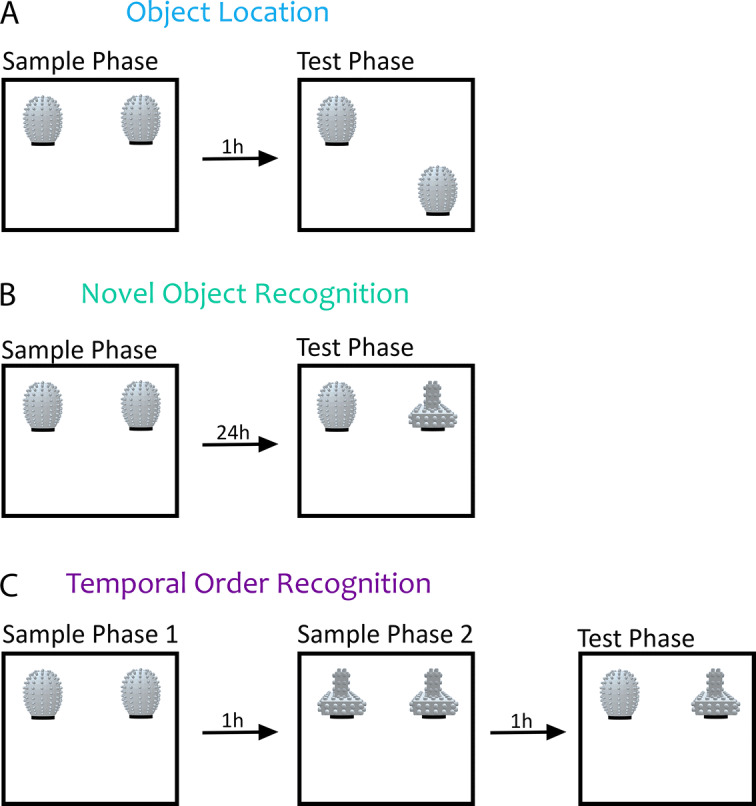
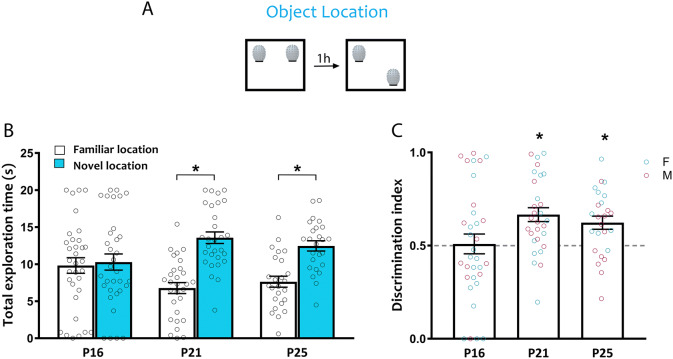
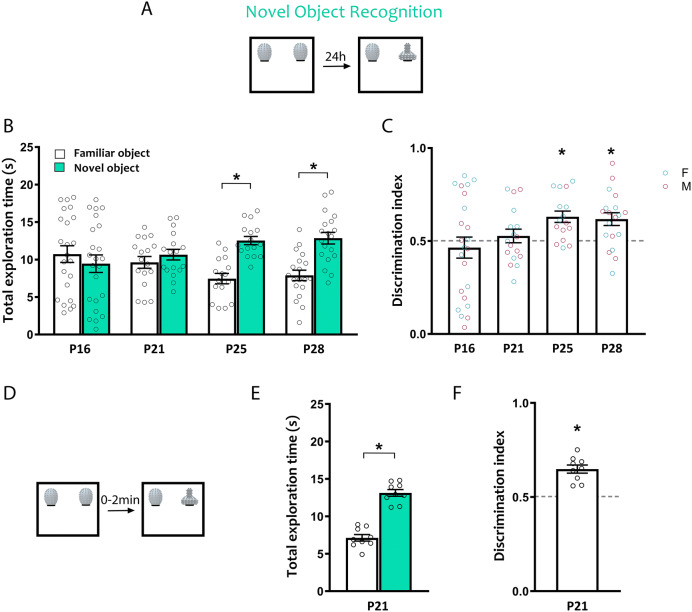
Spontaneous recognition memory tasks build on an animal's natural preference for novelty to assess the what, where and when components of episodic memory. Their simplicity, ethological relevance and cross-species adaptability make them extremely useful to study the physiology and pathology of memory. Recognition memory deficits are common in rodent models of neurodevelopmental disorders, and yet very little is known about the expression of spontaneous recognition memory in young rodents. This is exacerbated by the paucity of data on the developmental onset of recognition memory in mice, a major animal model of disease. To address this, we characterized the ontogeny of three types of spontaneous recognition memory in mice: object location, novel object recognition and temporal order recognition. We found that object location is the first to emerge, at postnatal day (P)21. This was followed by novel object recognition (24 h delay), at P25. Temporal order recognition was the last to emerge, at P28. Elucidating the developmental expression of recognition memory in mice is critical to improving our understanding of the ontogeny of episodic memory, and establishes a necessary blueprint to apply these tasks to probe cognitive deficits at clinically relevant time points in animal models of developmental disorders.
自发识别记忆任务基于动物对新奇事物的自然偏好,评估情景记忆的“什么”、“哪里”和“何时”成分。它们的简单性、生态学相关性和跨物种适应性使得它们非常有用,可以研究记忆的生理学和病理学。在神经发育障碍的啮齿动物模型中,自发识别记忆缺陷很常见,但对于年幼啮齿动物自发识别记忆的表达却知之甚少。由于关于小鼠识别记忆发育起始的数据很少,这种情况更加严重,而小鼠是疾病的主要动物模型。为了解决这个问题,我们描述了小鼠三种类型的自发识别记忆的发生:物体位置、新物体识别和时间顺序识别。我们发现物体位置最早出现,在出生后第 21 天(P21)。随后是新物体识别(24 小时延迟),在 P25。时间顺序识别是最后出现的,在 P28。阐明小鼠识别记忆的发育表达对于提高我们对情景记忆发生的理解至关重要,并为将这些任务应用于在发育障碍动物模型中在临床相关时间点探测认知缺陷奠定了必要的基础。