Department of Economics, University of New Mexico, Albuquerque, NM.
Department of Psychology, University of New Mexico, Albuquerque, NM.
Yale J Biol Med. 2020 Jun 29;93(2):251-264. eCollection 2020 Jun.
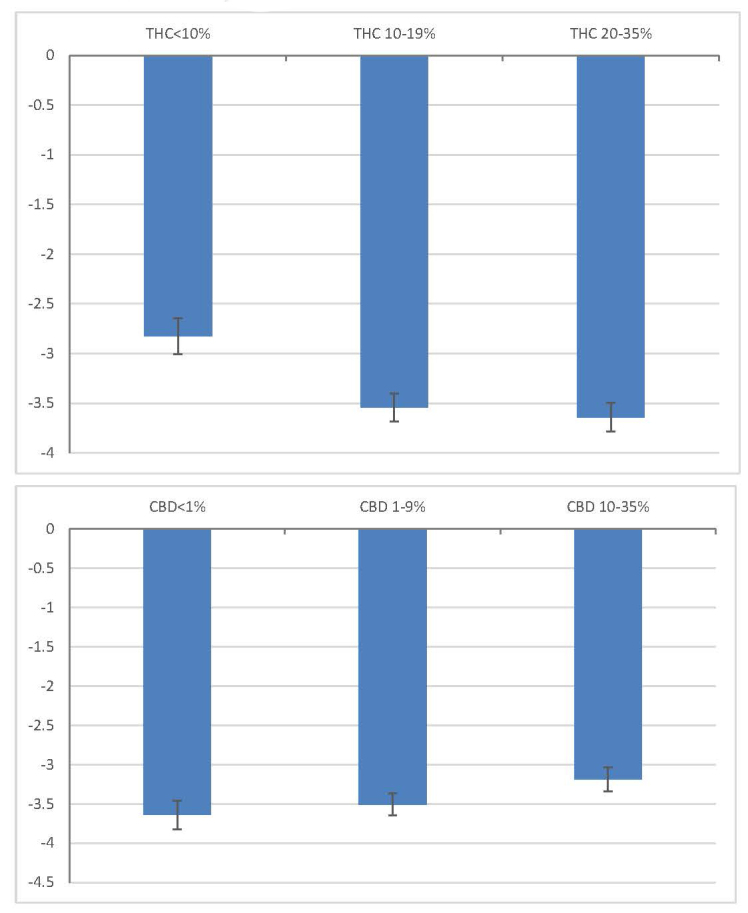
: Scientific research on how consumption of whole, natural flower affects low mood and behavioral motivations more generally is largely nonexistent, and few studies to date have measured how common and commercially available flower used may affect the experience of "depression" in real-time. : We observed 1,819 people who completed 5,876 cannabis self-administration sessions using the ReleafApp™ between 06/07/2016 and 07/08/2019, with the goal of measuring real-time effects of consuming flower for treating symptoms of depression. Results: On average, 95.8% of users experienced symptom relief following consumption with an average symptom intensity reduction of -3.76 points on a 0-10 visual analogue scale (SD = 2.64, d = 1.71, p <.001). Symptom relief did not differ by labeled plant phenotypes ("," ," or "hybrid") or combustion method. Across cannabinoid levels, tetrahydrocannabinol (THC) levels were the strongest independent predictors of symptom relief, while cannabidiol (CBD) levels, instead, were generally unrelated to real-time changes in symptom intensity levels. Cannabis use was associated with some negative side effects that correspond to increased depression ( feeling unmotivated) in up to 20% of users, as well as positive side effects that correspond to decreased depression ( feeling happy, optimistic, peaceful, or relaxed) in up to 64% of users. : The findings suggest that, at least in the short term, the vast majority of patients that use cannabis experience antidepressant effects, although the magnitude of the effect and extent of side effect experiences vary with chemotypic properties of the plant.
关于全天然花卉消费如何更普遍地影响情绪低落和行为动机的科学研究几乎不存在,迄今为止,很少有研究测量常见且市售的花卉使用如何实时影响“抑郁”体验。我们观察了 1819 名在 2016 年 6 月 7 日至 2019 年 7 月 8 日期间使用 ReleafApp™完成 5876 次大麻自我给药疗程的人,目的是衡量消费花卉治疗抑郁症状的实时效果。结果:平均而言,95.8%的使用者在消费后经历了症状缓解,0-10 视觉模拟量表的平均症状强度降低了 3.76 分(SD=2.64,d=1.71,p<.001)。症状缓解与标签植物表型(“ indica”、“ sativa”或“ hybrid”)或燃烧方法无关。在所有大麻素水平中,四氢大麻酚(THC)水平是症状缓解的最强独立预测因子,而大麻二酚(CBD)水平通常与症状强度水平的实时变化无关。大麻使用与一些负面副作用相关,这些副作用对应着高达 20%的使用者的抑郁加重(感觉没有动力),以及高达 64%的使用者的抑郁减轻(感觉快乐、乐观、平静或放松)的正面副作用。研究结果表明,至少在短期内,绝大多数使用大麻的患者都经历了抗抑郁作用,尽管效应的幅度和副作用体验的程度因植物的化学特征而异。