Stith Sarah S, Li Xiaoxue, Diviant Jegason P, Brockelman Franco C, Keeling Keenan S, Hall Branden, Vigil Jacob M
Department of Economics, University of New Mexico, Albuquerque, USA.
Department of Psychology, University of New Mexico, Albuquerque, USA.
J Cannabis Res. 2020 Dec 9;2(1):47. doi: 10.1186/s42238-020-00051-z.
An observational research design was used to evaluate which types of commonly labeled Cannabis flower product characteristics are associated with changes in momentary feelings of distress-related symptoms.
We used data from 2306 patient-directed cannabis administration sessions among 670 people who used the real-time Cannabis effects recording software, Releaf App, between June 6, 2016, and February 23, 2019, for tracking the effects of Cannabis flower consumption. Fixed effects multivariable panel regression techniques were used to establish overall relief by symptom type and to determine which labeled product characteristics (e.g., subspecies/subtype, inhalation method, and major cannabinoid contents) showed the strongest correlation with changes in momentary feelings of agitation/irritability, anxiety, and stress, along with experienced side effects.
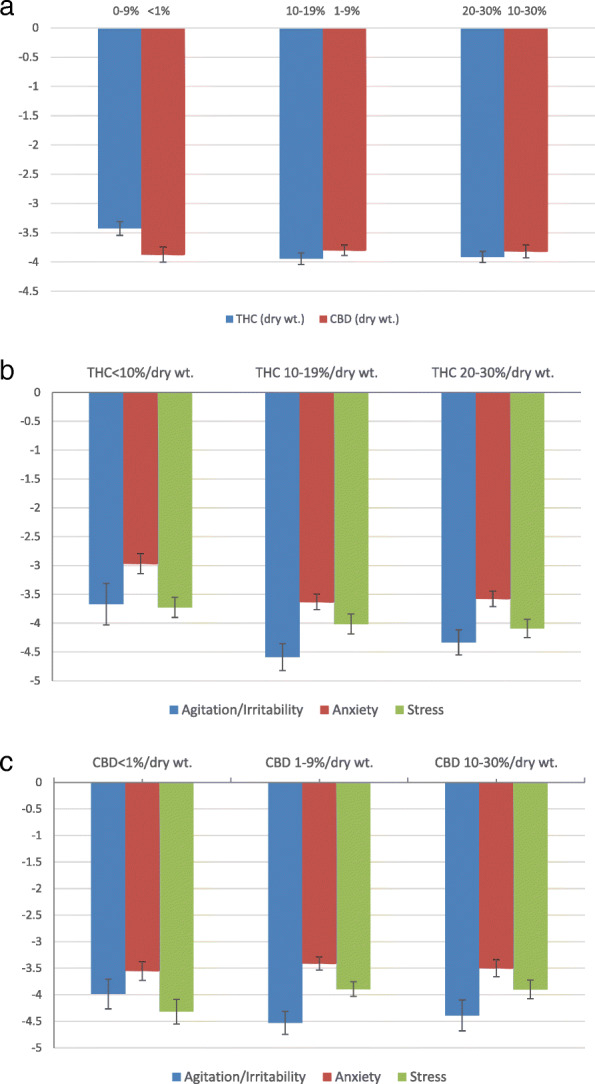
In total, a decrease in symptom intensity levels was reported in 95.51% of Cannabis usage sessions, an increase in 2.32% of sessions, and no change in 2.16% of sessions. Fixed effects models showed, on average, respondents recorded a maximum symptom intensity reduction of 4.33 points for agitation/irritability (SE = 0.20, p < 0.01), 3.47 points for anxiety (SE = 0.13, p < 0.01), and 3.98 for stress (SE = 0.12, p < 0.01) on an 11-point visual analog scale. Fixed effects regressions showed that, controlling for time-invariant user characteristics, mid and high tetrahydrocannabinol (THC) levels were the primary independent predictor of increased symptom relief, and that when broken out by symptom type, this effect was only statistically significant for our largest sample of users, those reporting anxiety rather than agitation/irritability or stress. Cannabidiol (CBD) levels were generally not associated with changes in symptom intensity levels. In a minority of cannabis use sessions (< 13%), cannabis users reported anxiogenic-related negative side effects (e.g., feeling anxious, irritable, paranoid, rapid pulse, or restless), whereas in a majority of sessions (about 66%), users reported positive anxiolytic side effects (e.g., feeling chill, comfy, happy, optimistic, peaceful, or relaxed).
The findings suggest the majority of patients in our sample experienced relief from distress-related symptoms following consumption of Cannabis flower, and that among product characteristics, higher THC levels were the strongest predictors of relief.
采用观察性研究设计来评估常见标签的大麻花卉产品的哪些特征与痛苦相关症状的即时感受变化有关。
我们使用了2016年6月6日至2019年2月23日期间670名使用实时大麻效果记录软件Releaf App的患者自行使用大麻的2306次记录数据,以追踪大麻花卉消费的效果。使用固定效应多变量面板回归技术,按症状类型确定总体缓解情况,并确定哪些标签产品特征(例如,亚种/亚型、吸入方法和主要大麻素含量)与即时烦躁/易怒、焦虑和压力感受的变化以及所经历的副作用显示出最强的相关性。
总体而言,95.51%的大麻使用记录中症状强度水平下降,2.32%的记录中症状强度水平上升,2.16%的记录中症状强度水平无变化。固定效应模型显示,平均而言,在11点视觉模拟量表上,受访者记录的烦躁/易怒症状强度最大降低4.33分(标准误=0.20,p<0.01),焦虑症状强度降低3.47分(标准误=0.13,p<0.01),压力症状强度降低3.98分(标准误=0.12,p<0.01)。固定效应回归显示,在控制了时间不变的用户特征后,中高四氢大麻酚(THC)水平是症状缓解增加的主要独立预测因素,并且按症状类型细分时,这种效应仅在我们最大的用户样本中具有统计学意义,即那些报告焦虑而非烦躁/易怒或压力的用户。大麻二酚(CBD)水平通常与症状强度水平的变化无关。在少数大麻使用记录(<13%)中,大麻使用者报告了与焦虑相关的负面副作用(例如,感到焦虑、易怒、偏执、脉搏加快或烦躁不安),而在大多数记录(约66%)中,使用者报告了积极的抗焦虑副作用(例如,感到放松、舒适、快乐、乐观、平静或轻松)。
研究结果表明,我们样本中的大多数患者在食用大麻花卉后痛苦相关症状得到缓解,并且在产品特征中,较高的THC水平是缓解的最强预测因素。