Odonkor Stephen T, Mahami Tahiru
School of Public Service and Governance, Ghana Institute of Management and Public Administration, Accra, Ghana.
Ghana Atomic Energy Commission, Kwabenya, Accra, Ghana.
Int J Microbiol. 2020 Jun 15;2020:2534130. doi: 10.1155/2020/2534130. eCollection 2020.
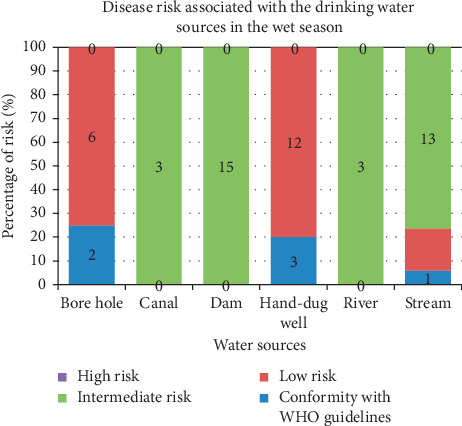
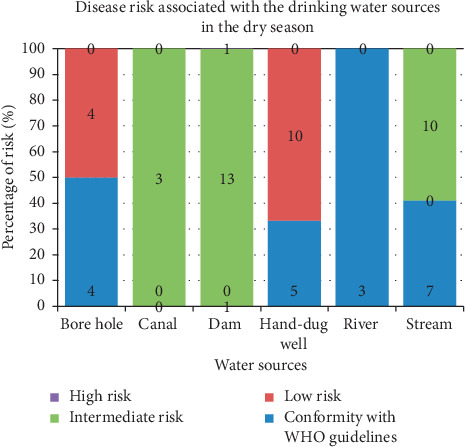
Many diseases have been associated with poor drinking water quality including diseases caused by diarrheagenic pathogens, especially in developing countries where access to a consistent water supply is a problem. The objective of the study was to evaluate the health risks associated with the sources of drinking water in the Dangme West District of Ghana using as a measurement tool, aiming at ascertaining the paths leading to contamination of the water sources. A total of 464 water samples were obtained for analysis. Sampling covered a year across the dry and wet seasons in Ghana. Water samples were obtained from groundwater and surface water sources. counts were determined using the most probable number method (MPN). Disease risk assessment was carried out using the WHO drinking water risk assessment guidelines. Generally, the study revealed significantly higher counts in the wet season than in the dry season. Among the water samples analyzed, surface water, especially from the dams, was found to pose the highest disease risk as compared to the other water sources. Samples from groundwater sources, especially boreholes, posed the lowest disease risk. In conclusion, observations from the study implied that most water sources in the study district are highly polluted with bacteria pathogens beyond recommended safety guidelines. The main causes of faecal contamination in these water sources were purported to be anthropogenic. Therefore, there is a need to formulate a policy aimed at managing and improving rural water sources.
许多疾病都与饮用水质量差有关,包括由致泻性病原体引起的疾病,尤其是在那些难以获得稳定供水的发展中国家。本研究的目的是使用[未提及具体测量工具名称]作为测量工具,评估加纳丹格梅西区饮用水源相关的健康风险,旨在确定导致水源污染的途径。共采集了464份水样进行分析。采样覆盖了加纳旱季和雨季的一整年。水样取自地下水和地表水水源。使用最可能数法(MPN)确定[未提及具体指标名称]计数。采用世界卫生组织饮用水风险评估指南进行疾病风险评估。总体而言,研究表明雨季的[未提及具体指标名称]计数显著高于旱季。在分析的水样中,与其他水源相比,地表水,尤其是来自水坝的地表水,被发现具有最高的疾病风险。来自地下水水源,尤其是钻孔的水样,疾病风险最低。总之,该研究的观察结果表明,研究区域内的大多数水源受到细菌病原体的高度污染,超出了推荐的安全指南。这些水源中粪便污染的主要原因据说是人为造成的。因此,有必要制定一项旨在管理和改善农村水源的政策。