IHAP, University of Toulouse, INRA, ENVT, Toulouse, France.
Front Public Health. 2020 Jun 16;8:294. doi: 10.3389/fpubh.2020.00294. eCollection 2020.
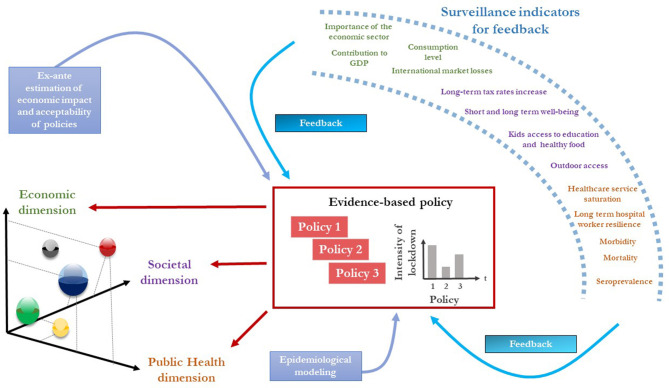
The lifting of COVID-19 (coronavirus disease 2019) lockdown requires, in the short and medium terms, a holistic and evidence-based approach to population health management based on combining risk factors and bio-economic outcomes, including actors' behaviors. This dynamic and global approach to health control is necessary to deal with the new paradigm of living with an infectious disease, which disrupts our individual freedom and behaviors. The challenge for policymakers consists of defining methods of lockdown-lifting and follow-up (middle-term rules) that best meet the needs for resumption of economic activity, societal wellbeing, and containment of the outbreak. There is no simple and ready-to-use way to do this since it means considering several competing objectives at the same time and continuously adapting the strategy and rules, ideally at local scale. We propose a framework for creating a precision evidence-based health policy that simultaneously considers public health, economic, and societal dimensions while accounting for constraints and uncertainty. It is based on the four following principles: integrating multiple and heterogeneous information, accepting navigation with uncertainty, adjusting the strategy dynamically with feedback mechanisms, and managing clusters through a multi-scalar conception. The evidence-based policy intervention for COVID-19 obtained includes scientific background via epidemiological modeling and bio-economic modeling. A set of quantitative and qualitative indicators are used as feedback to precisely monitor the societal-economic-epidemiological dynamics, allowing tightening or loosening of measures before epidemic damage (re-)occurs. Altogether, this allows an evidence-based policy that steers the strategy with precision and avoids any political shock.
解除 COVID-19(2019 年冠状病毒病)封锁需要在短期和中期内采取一种整体的、基于证据的人口健康管理方法,该方法基于结合风险因素和生物经济结果,包括行为者的行为。这种动态的、全球性的健康控制方法是必要的,以应对与传染病共存的新范式,这种范式扰乱了我们的个人自由和行为。政策制定者面临的挑战在于定义解除封锁和后续措施(中期规则)的方法,这些方法最好满足恢复经济活动、社会福利和控制疫情爆发的需求。没有简单的、现成的方法可以做到这一点,因为这意味着同时考虑几个相互竞争的目标,并不断调整策略和规则,理想情况下是在地方层面进行调整。我们提出了一个创建基于精准证据的卫生政策的框架,该框架同时考虑公共卫生、经济和社会维度,同时考虑到约束和不确定性。它基于以下四个原则:整合多种异质信息,接受不确定性下的导航,利用反馈机制动态调整策略,以及通过多尺度概念管理集群。所获得的 COVID-19 基于证据的政策干预措施包括通过流行病学建模和生物经济建模获得的科学背景。一组定量和定性指标被用作反馈,以精确监测社会经济流行病学动态,在疫情损害(重新)发生之前收紧或放宽措施。总之,这使得基于证据的政策能够精确地引导策略,避免任何政治冲击。