Cleveland Clinic Lou Ruvo Center for Brain Health, Las Vegas, NV, USA.
Cleveland Clinic Lou Ruvo Center for Brain Health, Las Vegas, NV, USA; UW Medicine, Seattle, WA, USA.
Neuroimage. 2020 Oct 15;220:117111. doi: 10.1016/j.neuroimage.2020.117111. Epub 2020 Jun 30.
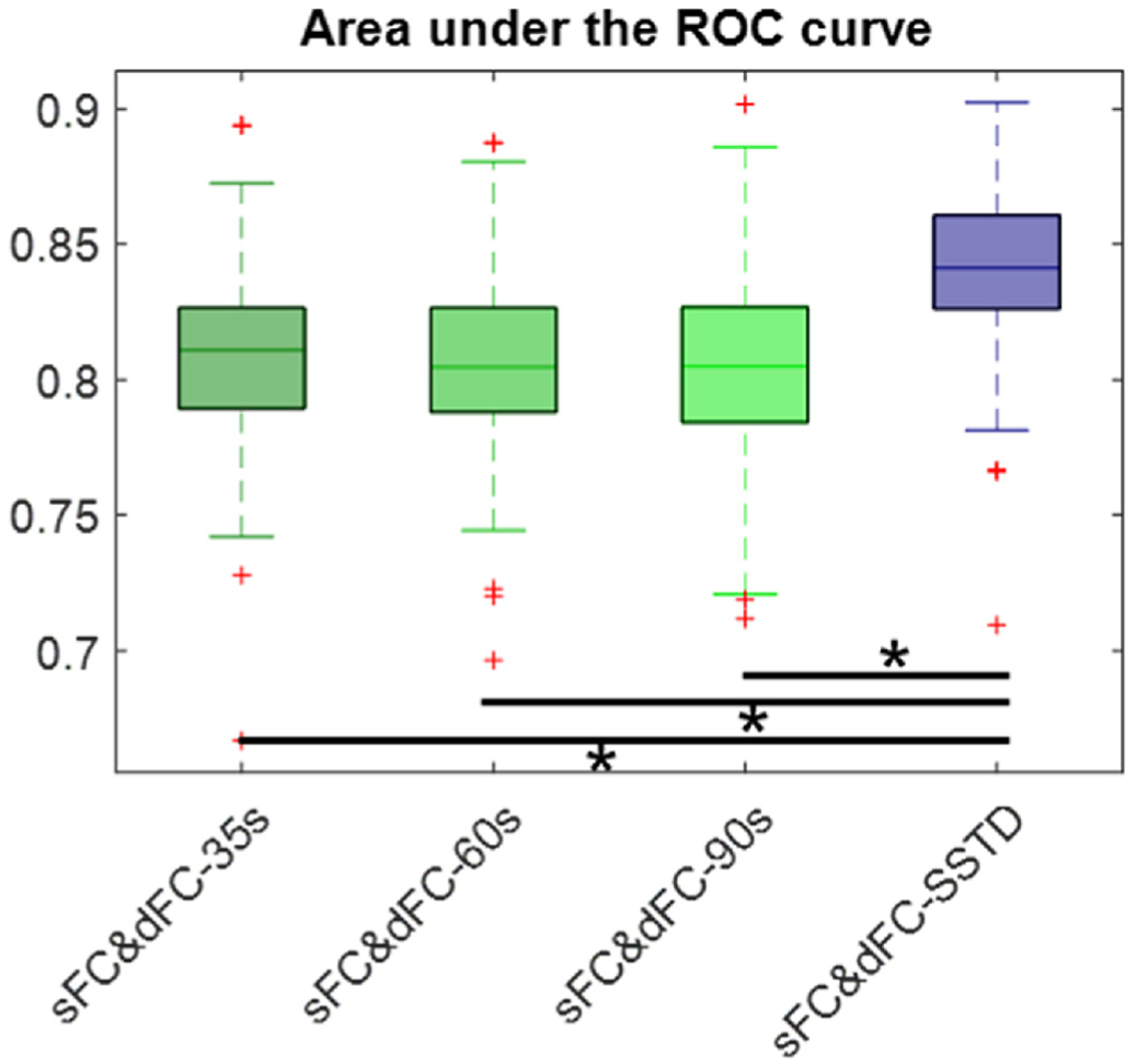
During the past ten years, dynamic functional connectivity (FC) has been extensively studied using the sliding-window method. A fixed window-size is usually selected heuristically, since no consensus exists yet on choice of the optimal window-size. Furthermore, without a known ground-truth, the validity of the computed dynamic FC remains unclear and questionable. In this study, we computed single-scale time-dependent (SSTD) window-sizes for the sliding-window method. SSTD window-sizes were based on the frequency content at every time point of a time series and were computed without any prior information. Therefore, they were time-dependent and data-driven. Using simulated sinusoidal time series with frequency shifts, we demonstrated that SSTD window-sizes captured the time-dependent period (inverse of frequency) information at every time point. We further validated the dynamic FC values computed with SSTD window-sizes with both a classification analysis using fMRI data with a low sampling rate and a regression analysis using fMRI data with a high sampling rate. Specifically, we achieved both a higher classification accuracy in predicting cognitive impairment status in fighters and a larger explained behavioral variance in healthy young adults when using dynamic FC matrices computed with SSTD window-sizes as features, as compared to using dynamic FC matrices computed with the conventional fixed window-sizes. Overall, our study computed and validated SSTD window-sizes in the sliding-window method for dynamic FC analysis. Our results demonstrate that dynamic FC matrices computed with SSTD window-sizes can capture more temporal dynamic information related to behavior and cognitive function.
在过去的十年中,动态功能连接(FC)已广泛使用滑动窗口方法进行研究。通常通过启发式方法选择固定的窗口大小,因为对于最佳窗口大小的选择尚未达成共识。此外,由于没有已知的真实情况,因此计算出的动态 FC 的有效性仍然不清楚和值得怀疑。在这项研究中,我们为滑动窗口方法计算了单尺度时变(SSTD)窗口大小。SSTD 窗口大小基于时间序列中每个时间点的频率内容,并且是在没有任何先验信息的情况下计算得出的。因此,它们是时变和数据驱动的。使用具有频率偏移的模拟正弦时间序列,我们证明 SSTD 窗口大小可以捕获每个时间点的时变周期(频率的倒数)信息。我们进一步使用低采样率的 fMRI 数据进行分类分析和高采样率的 fMRI 数据进行回归分析,验证了使用 SSTD 窗口大小计算得出的动态 FC 值。具体来说,与使用传统固定窗口大小计算得出的动态 FC 矩阵作为特征相比,我们在预测战斗机认知障碍状态时实现了更高的分类准确性,并且在健康年轻人中实现了更大的行为方差解释。总的来说,我们的研究在滑动窗口方法中计算和验证了 SSTD 窗口大小,用于动态 FC 分析。我们的结果表明,使用 SSTD 窗口大小计算得出的动态 FC 矩阵可以捕获更多与行为和认知功能相关的时间动态信息。