Harding Edward C, Franks Nicholas P, Wisden William
Department of Life Sciences, Imperial College London, South Kensington, SW7 2AZ, UK.
Centre for Neurotechnology, Imperial College London, SW7 2AZ, UK.
Curr Opin Physiol. 2020 Jun;15:7-13. doi: 10.1016/j.cophys.2019.11.008.
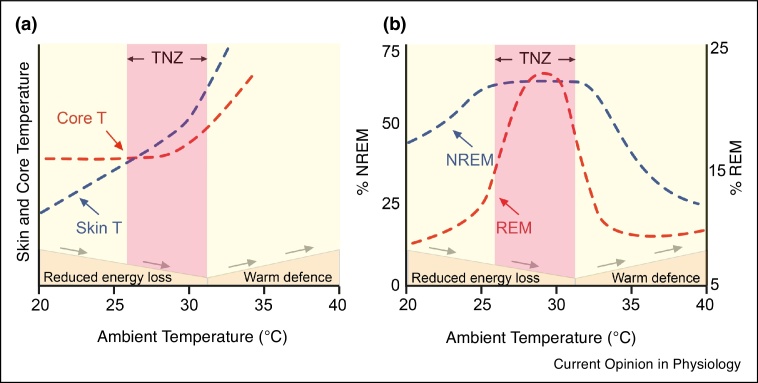
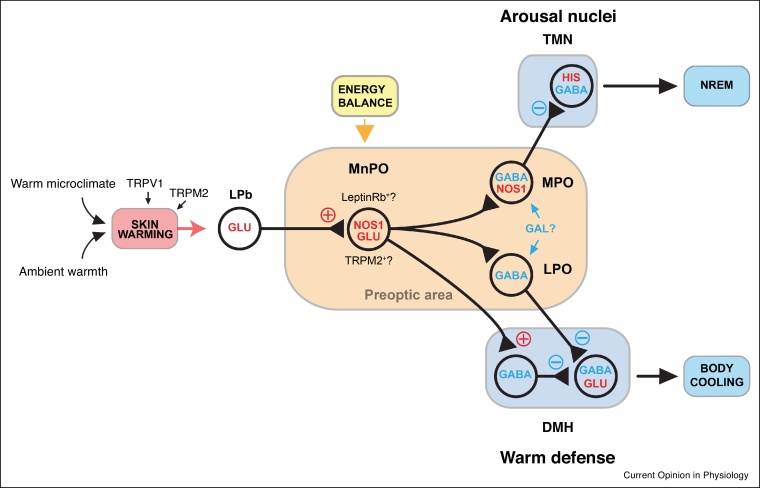
In homeothermic animals sleep preparatory behaviours often promote thermal efficiency, including warmth-seeking, adopting particular postures (curling up, head tucking) and nest building, all promoting warmer skin microclimates. Skin warmth induces NREM sleep and body cooling via circuitry that connects skin sensation to the preoptic hypothalamus. Coupling sleep induction and lower body temperature could serve to minimise energy expenditure or allow energy reallocation. Cooling during NREM sleep may also induce transcriptional changes in genes whose products facilitate housekeeping functions or measure the time spent sleeping.
在恒温动物中,睡眠准备行为通常会提高热效率,包括寻找温暖、采取特定姿势(蜷缩、藏头)和筑巢,所有这些都能促进更温暖的皮肤微气候。皮肤温暖通过将皮肤感觉与视前下丘脑相连的神经回路诱导非快速眼动睡眠和身体降温。将睡眠诱导与降低体温相结合可能有助于将能量消耗降至最低或实现能量重新分配。非快速眼动睡眠期间的降温也可能诱导基因的转录变化,这些基因的产物有助于维持机体功能或测量睡眠时间。