1Department of Tropical Medicine, Center for Applied Malaria Research and Evaluation, Tulane University School of Public Health and Tropical Medicine, New Orleans, Louisiana.
2National Malaria Elimination Centre, Zambia Ministry of Health, Chainama Hospital Grounds, Lusaka, Zambia.
Am J Trop Med Hyg. 2020 Aug;103(2_Suppl):37-45. doi: 10.4269/ajtmh.19-0667.
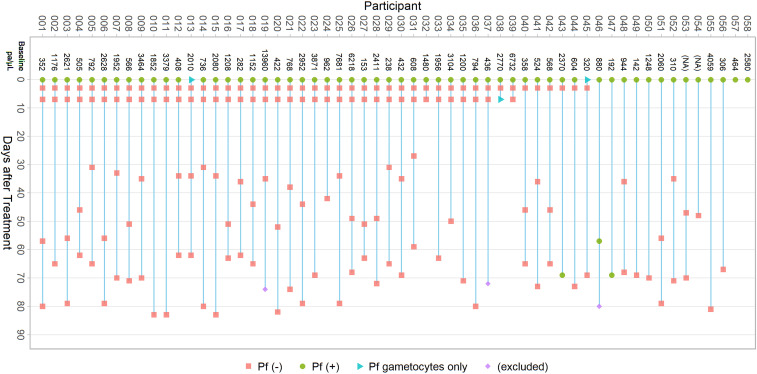
Mass drug administration (MDA) with artemisinin combination therapy is a potentially useful tool for malaria elimination programs, but its success depends partly on drug effectiveness and treatment coverage in the targeted population. As part of a cluster-randomized controlled trial in Southern Province, Zambia evaluating the impact of MDA and household focal MDA (fMDA) with dihydroartemisinin-piperaquine (DHAp), sub-studies were conducted investigating population drug adherence rates and effectiveness of DHAp as administered in clearing infections following household mass administration. Adherence information was reported for 181,534 of 336,821 DHAp (53.9%) treatments administered during four rounds of MDA/fMDA, of which 153,197 (84.4%) reported completing the full course of DHAp. The proportion of participants fully adhering to the treatment regimen differed by MDA modality (MDA versus fMDA), RDT status, and whether the first dose was observed by those administering treatments. Among a subset of participants receiving DHAp and selected for longitudinal follow-up, 58 were positive for asexual-stage infection by microscopy at baseline. None of the 45 participants followed up at days 3 and/or 7 were slide positive for asexual-stage parasitemia. For those with longer term follow-up, one participant was positive 47 days after treatment, and two additional participants were positive after 69 days, although these two were determined to be new infections by genotyping. High completion of a 3-day course of DHAp and parasite clearance in the context of household MDA are promising as Zambia's National Malaria Programme continues to weigh appropriate interventions for malaria elimination.
大规模药物治疗(MDA)联合青蒿素类复方疗法是消除疟疾规划中一种有潜力的工具,但它的成功部分取决于目标人群中的药物有效性和治疗覆盖率。在赞比亚南部省进行的一项评估 MDA 和家庭集中药物治疗(fMDA)联合双氢青蒿素-哌喹(DHAp)对疟疾消除影响的整群随机对照试验中,开展了一些子研究,以调查人群药物依从率以及在家庭大规模给药后清除 感染方面 DHAp 的实际效果。在四轮 MDA/fMDA 期间,共对 336821 次 DHAp(53.9%)治疗进行了依从性报告,其中 153197 次(84.4%)报告完成了 DHAp 的全部疗程。参与者完全遵守治疗方案的比例因 MDA 模式(MDA 与 fMDA)、RDT 状态以及治疗给药人员是否观察到第一剂而有所不同。在接受 DHAp 治疗并选择进行纵向随访的部分参与者中,58 人基线时显微镜下呈无性期 感染阳性。在接受治疗的 45 名参与者中,有 3 天和/或 7 天随访时无一例出现无性期寄生虫血症阳性。对于那些随访时间较长的参与者,1 名参与者在治疗后 47 天阳性,另有 2 名参与者在治疗后 69 天阳性,但通过基因分型确定这两人是新感染。在家庭 MDA 背景下,完成 3 天的 DHAp 疗程并清除寄生虫的情况很有希望,因为赞比亚国家疟疾规划继续权衡适当的干预措施以实现疟疾消除。