1Malaria Elimination Initiative, Global Health Group, University of California San Francisco, San Francisco, California.
2Department of Tropical Medicine, Center for Applied Malaria Research and Evaluation, Tulane University School of Public Health and Tropical Medicine, New Orleans, Louisiana.
Am J Trop Med Hyg. 2020 Aug;103(2_Suppl):54-65. doi: 10.4269/ajtmh.19-0657.
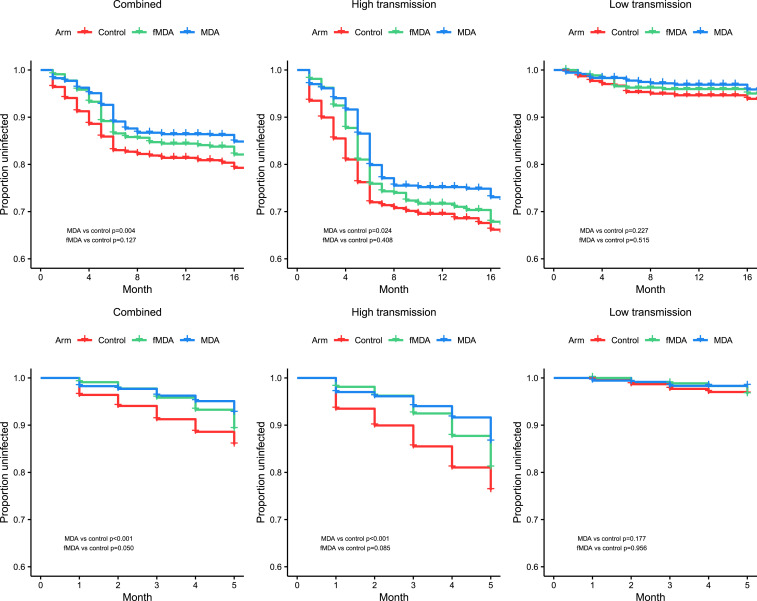
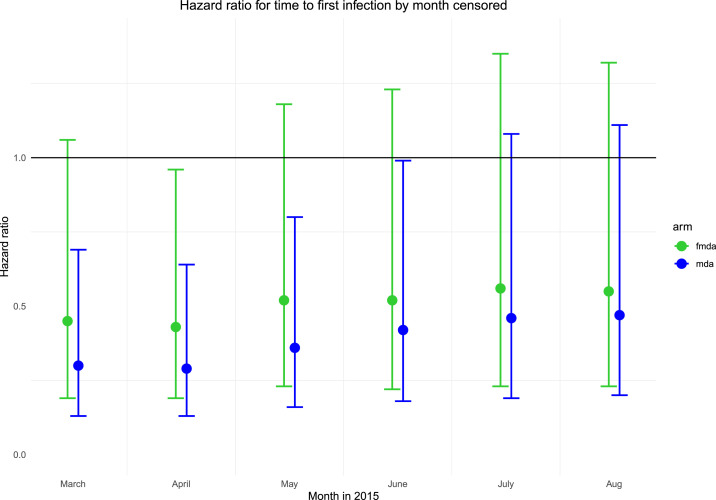
Rigorous evidence of effectiveness is needed to determine where and when to apply mass drug administration (MDA) or focal MDA (fMDA) as part of a malaria elimination strategy. The Zambia National Malaria Elimination Centre recently completed a community-randomized controlled trial in Southern Province to evaluate MDA and fMDA for transmission reduction. To assess the role of MDA and fMDA on infection incidence, we enrolled a longitudinal cohort for an 18-month period of data collection including monthly malaria parasite infection detection based on polymerase chain reaction and compared time to first infection and cumulative infection incidence outcomes across study arms using Cox proportional hazards and negative binomial models. A total of 2,026 individuals from 733 households were enrolled and completed sufficient follow-up for inclusion in analysis. Infection incidence declined dramatically across all study arms during the period of study, and MDA was associated with reduced risk of first infection (hazards ratio: 0.36; 95% CI: 0.16-0.80) and cumulative infection incidence during the first rainy season (first 5 months of follow-up) (incidence rate ratio: 0.34; 95% CI: 0.12-0.95). No significant effect was found for fMDA or for either arm over the full study period. Polymerase chain reaction infection status at baseline was strongly associated with follow-up infection. The short-term effects of MDA suggest it may be an impactful accelerator of transmission reduction in areas with high coverage of case management and vector control and should be considered as part of a malaria elimination strategy.
需要严格的有效性证据来确定在何处以及何时应用大规模药物治疗(MDA)或局部 MDA(fMDA)作为消除疟疾策略的一部分。赞比亚国家疟疾消除中心最近在南部省完成了一项社区随机对照试验,以评估 MDA 和 fMDA 在降低传播方面的效果。为了评估 MDA 和 fMDA 对感染发生率的作用,我们招募了一个纵向队列,进行了为期 18 个月的数据分析,包括每月基于聚合酶链反应的疟疾寄生虫感染检测,并使用 Cox 比例风险和负二项式模型比较了研究臂之间的首次感染时间和累积感染发生率结果。共有 733 户家庭的 2026 人入组并完成了足够的随访,纳入分析。在整个研究期间,所有研究臂的感染发生率都显著下降,MDA 与首次感染的风险降低相关(风险比:0.36;95%CI:0.16-0.80),以及在第一个雨季(前 5 个月的随访)的累积感染发生率(发病率比:0.34;95%CI:0.12-0.95)。在整个研究期间,fMDA 或任何一个研究臂都没有发现显著效果。基线聚合酶链反应感染状况与随访感染密切相关。MDA 的短期效果表明,在病例管理和病媒控制覆盖率高的地区,它可能是降低传播的有力加速器,应作为消除疟疾策略的一部分加以考虑。