Morales-Valenzuela Adriana A, Scougall-Vilchis Rogelio J, Lara-Carrillo Edith, Garcia-Contreras Rene, Salmeron-Valdes Elias N, Aguillón-Sol Lizzeth
Oral Health Prev Dent. 2020 Jul 4;18(2):319-323. doi: 10.3290/j.ohpd.a44034.
The aim of this paper was to compare three conventional hand mixing glass-ionomer cements (GICs) and a new mechanical mixing glass-ionomer cement.
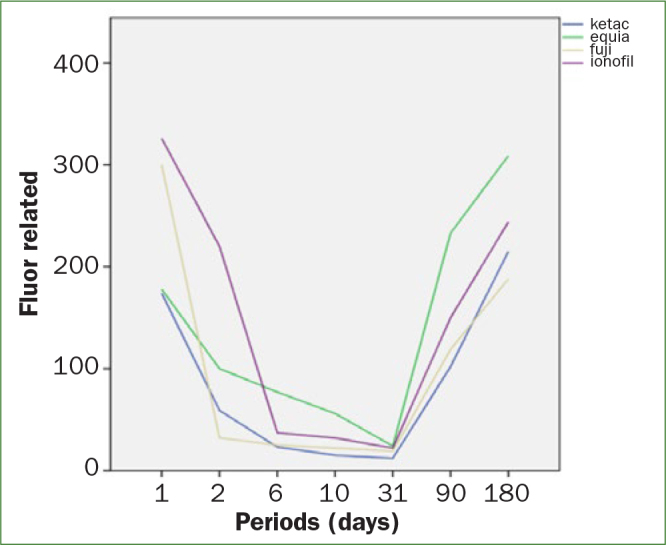
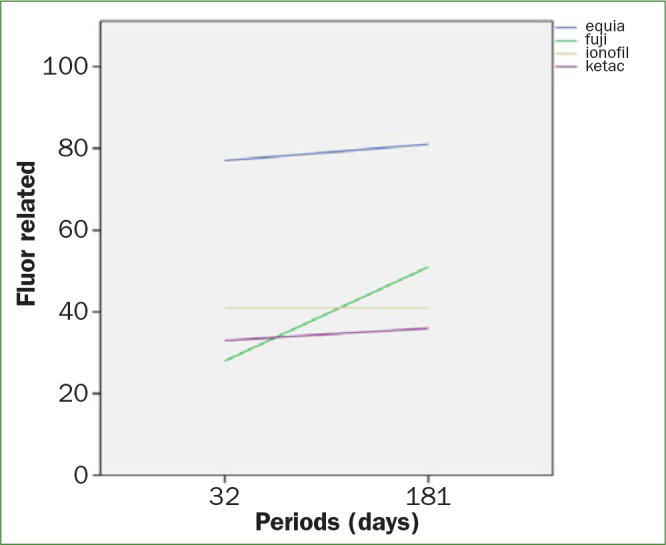
Samples were measured on days 1, 2, 6, 10, 31, 90 and 180. After 32 and 181 days of monitoring, the samples were recharged by using 1 ml of 2% sodium fluoride gel.
The fluoride release started in high concentration during the first day for all GICs, with a value for GIII of 32.6 ppm. From the 2nd day, a slow, steady decline, with the exception of GII, which showed a marked decline to a value of 3.2 ppm. Analysis of variance (ANOVA) test showed statistically significant differences between the amounts of fluoride of the four materials in the first 24 h. Student t test was used to compare the fluoride release between the first and second recharge in each one of the study groups. Statistically significant differences were found when we compared the fluoride release in groups I (t = -16.95, p = 0.000) and IV (t = -2.644, p = 0.26).
A mechanical mixing was the material with the more constant fluoride release and after recharge showed the highest fluoride release which make it an important benefit for clinicians.
本文旨在比较三种传统手工搅拌玻璃离子水门汀(GICs)和一种新型机械搅拌玻璃离子水门汀。
在第1、2、6、10、31、90和180天对样本进行测量。在监测32天和181天后,使用1毫升2%氟化钠凝胶对样本进行再充电。
所有GICs在第一天氟释放量开始时浓度较高,GIII的值为32.6 ppm。从第2天起,除GII外,氟释放量缓慢、稳定下降,GII显示出明显下降至3.2 ppm的值。方差分析(ANOVA)测试表明,四种材料在最初24小时内的氟含量存在统计学显著差异。使用学生t检验比较每个研究组第一次和第二次再充电之间的氟释放量。当我们比较I组(t = -16.95,p = 0.000)和IV组(t = -2.644,p = 0.26)的氟释放量时,发现存在统计学显著差异。
机械搅拌的材料氟释放更恒定,再充电后显示出最高的氟释放量,这对临床医生来说是一个重要的优势。