Department of Thoracic Oncology, The Netherlands Cancer Institute, Postbus 90203, 1006 BE, Amsterdam, The Netherlands.
Division of Molecular Oncology & Immunology, The Netherlands Cancer Institute, Amsterdam, The Netherlands.
J Transl Med. 2020 Jul 3;18(1):271. doi: 10.1186/s12967-020-02436-3.
The tumor immune microenvironment is a heterogeneous entity. Gene expression analysis allows us to perform comprehensive immunoprofiling and may assist in dissecting the different components of the immune infiltrate. As gene expression analysis also provides information regarding tumor cells, differences in interactions between the immune system and specific tumor characteristics can also be explored. This study aims to gain further insights in the composition of the tumor immune infiltrate and to correlate these components to histology and overall survival in non-small cell lung cancer (NSCLC).
Archival tissues from 530 early stage, resected NSCLC patients with annotated tumor and patient characteristics were analyzed using the NanoString nCounter Analysis system.
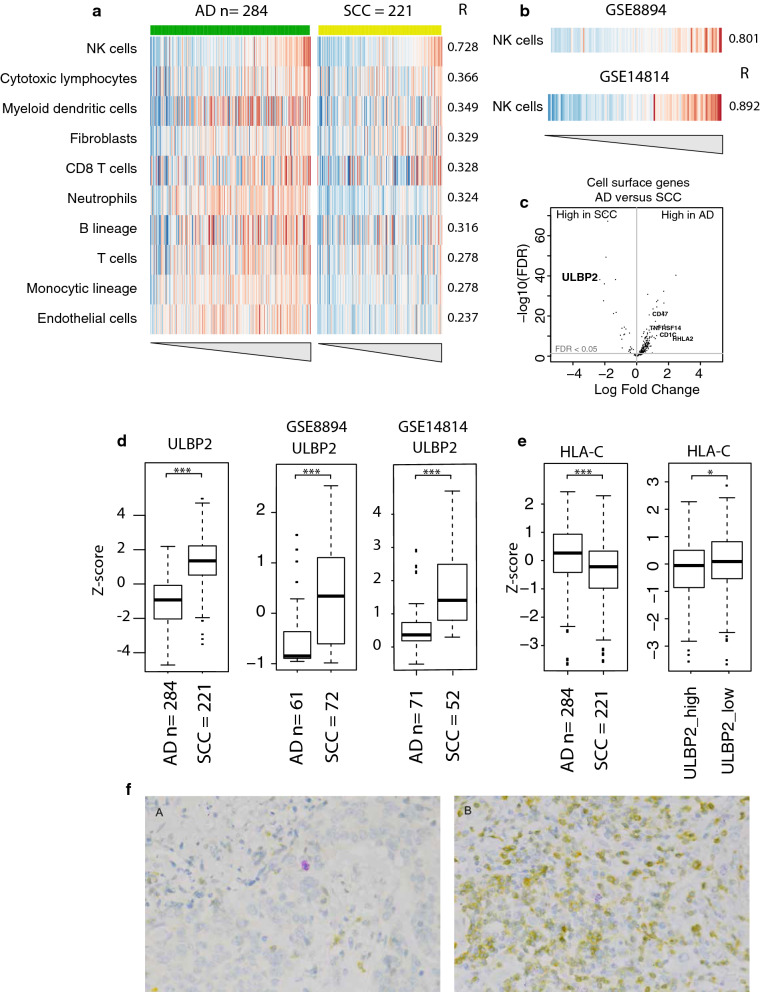
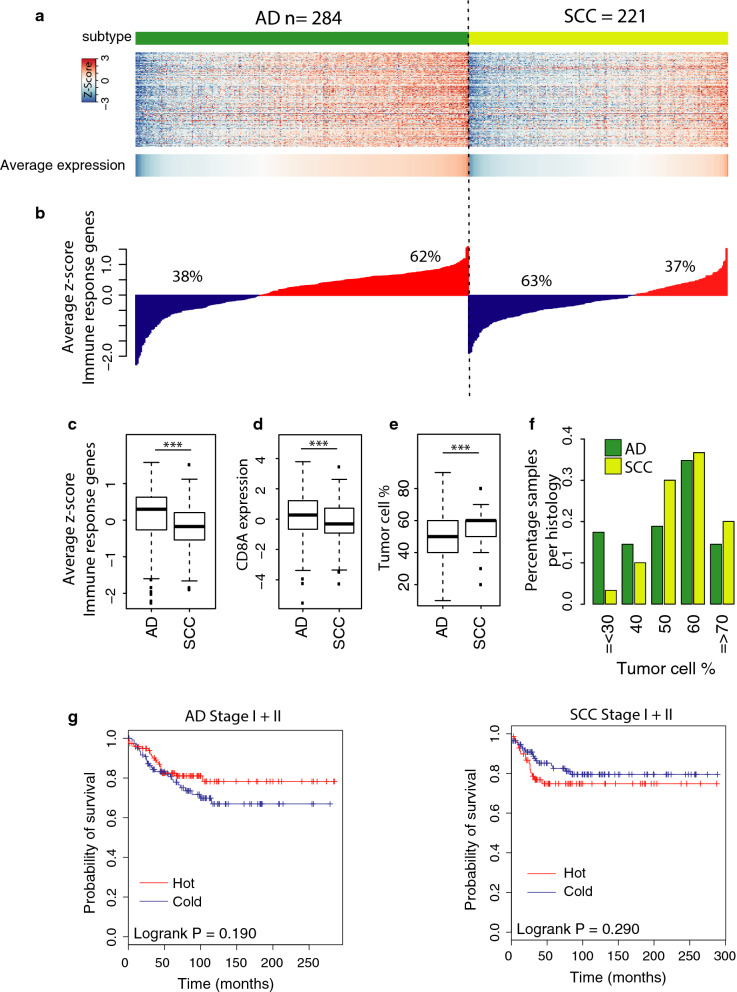
Unsupervised clustering of the samples was mainly driven by the overall level of inflammation, which was not correlated with survival in this patient set. Adenocarcinoma (AD) showed a significantly higher degree of immune infiltration compared to squamous cell carcinoma (SCC). A 34-gene signature, which did not correlate with the overall level of immune infiltration, was identified and showed an OS benefit in SCC. Strikingly, this benefit was not observed in AD. This difference in OS in SCC specifically was confirmed in two independent NSCLC cohorts. The highest correlation between expression of the 34-gene signature and specific immune cell populations was observed for NK cells, but although a plausible mechanism for NK cell intervention in tumor growth could be established in SCC over AD, this could not be translated back to immunohistochemistry, which showed that NK cell infiltration is scarce irrespective of histology.
These findings suggest that the ability of immune cell infiltration and the interaction between tumor and immune cells may be different between AD and SCC histology and that a subgroup of SCC tumors seems more susceptible to Natural Killer cell recognition and killing, whereas this may not occur in AD tumors. A highly sensitive technique like NanoString was able to detect this subgroup based on a 34-gene signature, but further research will be needed to assist in explaining the biological rationale of such low-level expression signatures.
肿瘤免疫微环境是一个异质实体。基因表达分析使我们能够进行全面的免疫分析,并有助于剖析免疫浸润的不同成分。由于基因表达分析还提供了有关肿瘤细胞的信息,因此还可以探索免疫系统与特定肿瘤特征之间的相互作用差异。本研究旨在进一步深入了解肿瘤免疫浸润的组成,并将这些成分与非小细胞肺癌(NSCLC)的组织学和总生存期相关联。
使用 NanoString nCounter 分析系统对 530 例早期切除的 NSCLC 患者的存档组织进行分析,这些患者的肿瘤和患者特征均有注释。
样本的无监督聚类主要由整体炎症水平驱动,而在该患者组中,炎症水平与生存率无关。腺癌(AD)的免疫浸润程度明显高于鳞状细胞癌(SCC)。鉴定出一个与整体免疫浸润水平无关的 34 基因特征,该特征在 SCC 中具有 OS 获益。令人惊讶的是,在 AD 中并未观察到这种 OS 获益。在两个独立的 NSCLC 队列中证实了 SCC 中 OS 差异的存在。34 基因特征与特定免疫细胞群之间的相关性最高的是 NK 细胞,但尽管在 SCC 中可以建立 NK 细胞干预肿瘤生长的合理机制,但这不能转化为免疫组化,即无论组织学如何,NK 细胞浸润都很少。
这些发现表明,AD 和 SCC 组织学中免疫细胞浸润的能力和肿瘤与免疫细胞之间的相互作用可能不同,并且 SCC 肿瘤的一个亚组似乎更容易被自然杀伤(NK)细胞识别和杀伤,而 AD 肿瘤中则不会出现这种情况。像 NanoString 这样的高灵敏度技术能够基于 34 基因特征检测到这个亚组,但需要进一步的研究来协助解释这种低水平表达特征的生物学原理。