Department of Pharmacy, The Central Hospital of Wuhan, Tongji Medical College, Huazhong University of Science and Technology, Wuhan, Hubei, China.
Department of Respiratory and Critical Care Medicine, The Central Hospital of Wuhan, Tongji Medical College, Huazhong University of Science and Technology, Wuhan, Hubei, China.
Clin Microbiol Infect. 2020 Oct;26(10):1400-1405. doi: 10.1016/j.cmi.2020.06.033. Epub 2020 Jul 2.
Most cases of coronavirus disease 2019 (COVID-19) are identified as moderate, which is defined as having a fever or dry cough and lung imaging with ground-glass opacities. The risk factors and predictors of prognosis in such cohorts remain uncertain.
All adults with COVID-19 of moderate severity diagnosed using quantitative RT-PCR and hospitalized at the Central Hospital of Wuhan, China, from 1 January to 20 March 2020 were enrolled in this retrospective study. The main outcomes were progression from moderate to severe or critical condition or death.
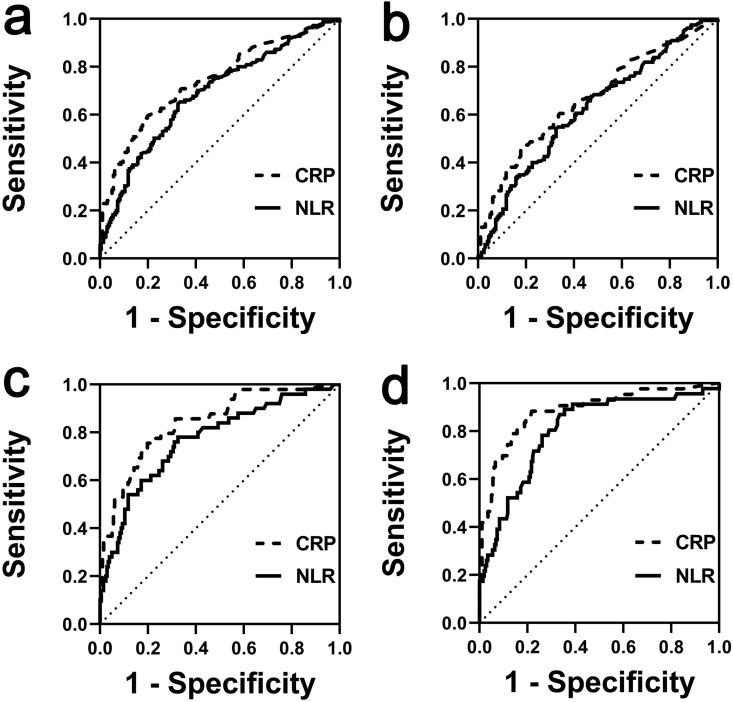
Among the 456 enrolled patients with moderate COVID-19, 251/456 (55.0%) had poor prognosis. Multivariate logistic regression analysis identified higher neutrophil count: lymphocyte count ratio (NLR) on admission (OR 1.032, 95% CI 1.042-1.230, p 0.004) and higher C-reactive protein (CRP) on admission (OR 3.017, 95% CI 1.941-4.690, p < 0.001) were associated with increased OR of poor prognosis. The area under the receiver operating characteristic curve (AUC) for NLR and CRP in predicting progression to critical condition was 0.77 (95% CI 0.694-0.846, p < 0.001) and 0.84 (95% CI 0.780-0.905, p < 0.001), with a cut-off value of 2.79 and 25.95 mg/L, respectively. The AUC of NLR and CRP in predicting death was 0.81 (95% CI 0.732-0.878, p < 0.001) and 0.89 (95% CI 0.825-0.946, p < 0.001), with a cut-off value of 3.19 and 33.4 mg/L, respectively.
Higher levels of NLR and CRP at admission were associated with poor prognosis of individuals with moderate COVID-19. NLR and CRP were good predictors of progression to critical condition and death.
大多数 2019 年冠状病毒病(COVID-19)病例被确定为中度,其定义为发热或干咳,肺部影像学表现为磨玻璃样混浊。此类人群的预后风险因素和预测因素仍不确定。
本回顾性研究纳入了 2020 年 1 月 1 日至 3 月 20 日期间在中国武汉市中心医院因中度严重程度的 COVID-19 而接受定量 RT-PCR 诊断并住院的所有成年人。主要结局是从中度恶化至重度或危重症或死亡。
在纳入的 456 例中度 COVID-19 患者中,251/456(55.0%)预后不良。多变量逻辑回归分析确定入院时较高的中性粒细胞计数:淋巴细胞计数比值(NLR)(比值比 1.032,95%置信区间 1.042-1.230,p=0.004)和入院时较高的 C 反应蛋白(CRP)(比值比 3.017,95%置信区间 1.941-4.690,p<0.001)与不良预后的比值比增加相关。NLR 和 CRP 预测病情恶化至危重症的受试者工作特征曲线(ROC)下面积(AUC)分别为 0.77(95%置信区间 0.694-0.846,p<0.001)和 0.84(95%置信区间 0.780-0.905,p<0.001),截断值分别为 2.79 和 25.95 mg/L。NLR 和 CRP 预测死亡的 AUC 分别为 0.81(95%置信区间 0.732-0.878,p<0.001)和 0.89(95%置信区间 0.825-0.946,p<0.001),截断值分别为 3.19 和 33.4 mg/L。
入院时 NLR 和 CRP 水平较高与中度 COVID-19 患者的不良预后相关。NLR 和 CRP 是病情恶化至危重症和死亡的良好预测指标。