Scarborough Jessica A, McClure Erin, Anderson Peter, Dhawan Andrew, Durmaz Arda, Lessnick Stephen L, Hitomi Masahiro, Scott Jacob G
Translational Hematology and Oncology Research, Taussig Cancer Institute, Cleveland Clinic, Cleveland, OH 44106, USA; Systems Biology and Bioinformatics Department, School of Medicine, Case Western Reserve University, Cleveland OH 44106, USA.
Translational Hematology and Oncology Research, Taussig Cancer Institute, Cleveland Clinic, Cleveland, OH 44106, USA; Morsani College of Medicine, University of South Florida, Tampa, FL 33612, USA.
iScience. 2020 Jul 24;23(7):101293. doi: 10.1016/j.isci.2020.101293. Epub 2020 Jun 20.
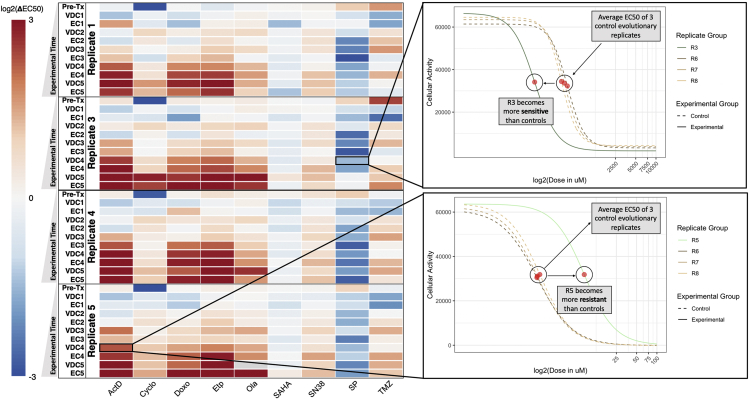
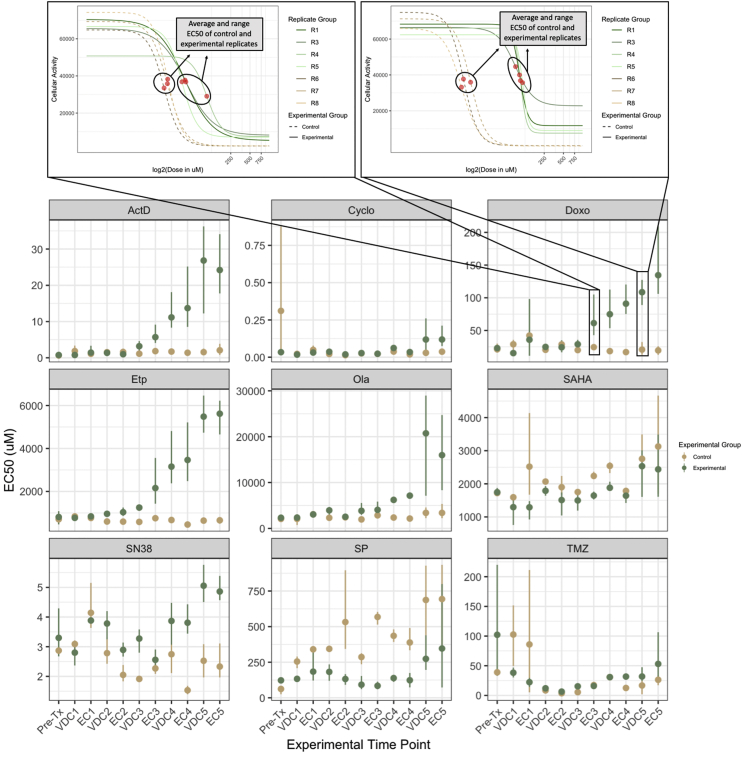
Advances in the treatment of Ewing's sarcoma (EWS) are desperately needed, particularly in the case of metastatic disease. A deeper understanding of collateral sensitivity, where the evolution of therapeutic resistance to one drug aligns with sensitivity to another drug, may improve our ability to effectively target this disease. For the first time in a solid tumor, we produced a temporal collateral sensitivity map that demonstrates the evolution of collateral sensitivity and resistance in EWS. We found that the evolution of collateral resistance was predictable with some drugs but had significant variation in response to other drugs. Using this map of temporal collateral sensitivity in EWS, we can see that the path toward collateral sensitivity is not always repeatable, nor is there always a clear trajectory toward resistance or sensitivity. Identifying transcriptomic changes that accompany these states of transient collateral sensitivity could improve treatment planning for patients with EWS.
尤因肉瘤(EWS)治疗方面急需取得进展,特别是在转移性疾病的治疗中。对旁系敏感性有更深入的了解,即对一种药物的治疗抗性演变与对另一种药物的敏感性相一致,可能会提高我们有效靶向这种疾病的能力。在实体瘤中,我们首次绘制了一张时间旁系敏感性图谱,展示了EWS中旁系敏感性和抗性的演变。我们发现,某些药物的旁系抗性演变是可预测的,但对其他药物的反应存在显著差异。利用EWS的这张时间旁系敏感性图谱,我们可以看到旁系敏感性的发展路径并非总是可重复的,通向抗性或敏感性也并非总有清晰的轨迹。识别伴随这些短暂旁系敏感性状态的转录组变化,有助于改善EWS患者的治疗方案规划。