Younes Maged, Aggett Peter, Aguilar Fernando, Crebelli Riccardo, Filipič Metka, Frutos Maria Jose, Galtier Pierre, Gott David, Gundert-Remy Ursula, Kuhnle Gunter Georg, Lambré Claude, Leblanc Jean-Charles, Lillegaard Inger Therese, Moldeus Peter, Mortensen Alicja, Oskarsson Agneta, Stankovic Ivan, Waalkens-Berendsen Ine, Woutersen Rudolf Antonius, Wright Matthew, Briemer Leon, Pasquale Mosesso, Christodoulidou Anna, Horvath Zsuzsanna, Lodi Federica, Tard Alexandra, Dusemund Birgit
EFSA J. 2018 Jul 26;16(7):e05370. doi: 10.2903/j.efsa.2018.5370. eCollection 2018 Jul.
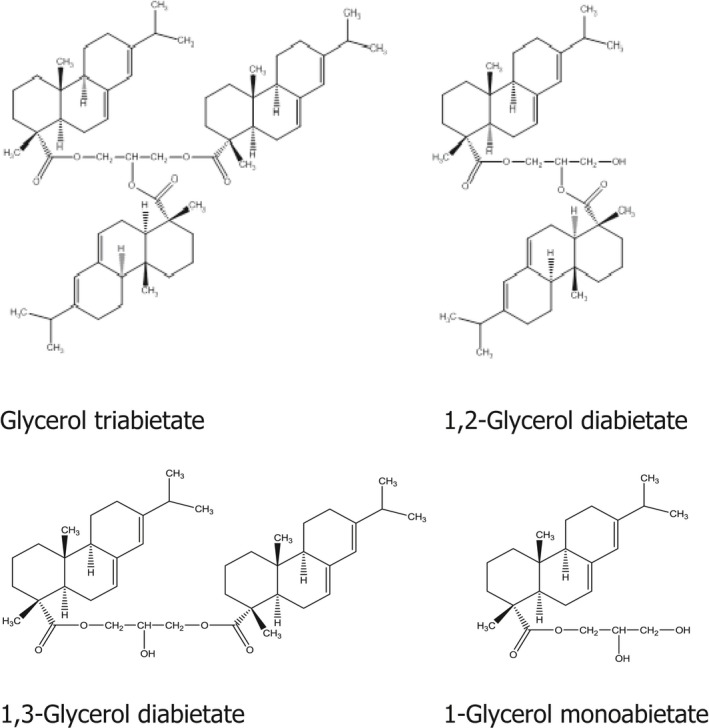
The present opinion deals with the re-evaluation of glycerol esters of wood rosin (GEWR, E 445) when used as a food additive. Regarding GEWR originating from (longleaf pine) and (slash pine), based on the overall toxicity database, and given the absence of reproductive and developmental toxicity data, the Panel concluded that the current acceptable daily intake (ADI) of 12.5 mg/kg body weight (bw) per day for GEWR (E 445) as established by the Scientific Committee on Food (SCF) in 1994 should be temporary pending the provision of such data. This assessment is restricted to GEWR derived from (longleaf pine) and (slash pine) and with a chemical composition in compliance with GEWR used in the toxicological testing. The Panel concluded that the mean and the high exposure levels (P95) of the brand-loyal refined exposure scenario did not exceed the temporary ADI in any of the population groups from the use of GEWR (E 445) as a food additive at the reported use levels. For GEWR originating from and , the Panel noted that concentrations of the fractions of 'glycerol monoesters', 'free resin acids' and 'neutrals', which are considered to be of particular toxicological relevance, are not known; therefore, the evaluation of chemical equivalence with GEWR originating from (longleaf pine) and (slash pine) is not possible; no data on stability were available; no toxicological data were available. Therefore, the Panel concluded that a safety assessment of GEWR originating from and could not be performed. The Panel recommended the European Commission to consider an update of the definition of GEWR (E 445) in the EU specifications. It should be indicated that GEWR (E 445) (i) contain, besides the mentioned glycerol di- and triesters, a residual fraction of glycerol monoesters, and (ii) contain residual free resin acids and neutrals (non-acidic other saponifiable and unsaponifiable substances).
本意见涉及对用作食品添加剂的木松香甘油酯(GEWR,E 445)的重新评估。关于源自长叶松和湿地松的GEWR,基于总体毒性数据库,并鉴于缺乏生殖和发育毒性数据,专家小组得出结论,食品科学委员会(SCF)于1994年确定的GEWR(E 445)目前每日可接受摄入量(ADI)为12.5毫克/千克体重/天应暂时保留,直至提供此类数据。该评估仅限于源自长叶松和湿地松且化学成分符合毒理学测试中使用的GEWR的产品。专家小组得出结论,在报告的使用水平下,作为食品添加剂使用GEWR(E 445)时,品牌忠诚精制暴露情景的平均和高暴露水平(P95)在任何人群组中均未超过临时ADI。对于源自和的GEWR,专家小组指出,被认为具有特别毒理学相关性的“甘油单酯”、“游离树脂酸”和“中性物质”部分的浓度未知;因此,无法评估与源自长叶松和湿地松的GEWR的化学等效性;没有稳定性数据;没有毒理学数据。因此,专家小组得出结论,无法对源自和的GEWR进行安全性评估。专家小组建议欧盟委员会考虑更新欧盟规范中GEWR(E 445)的定义。应指出的是,GEWR(E 445)(i)除上述甘油二酯和三酯外,还含有残余的甘油单酯部分,以及(ii)含有残余的游离树脂酸和中性物质(非酸性其他可皂化和不可皂化物质)。